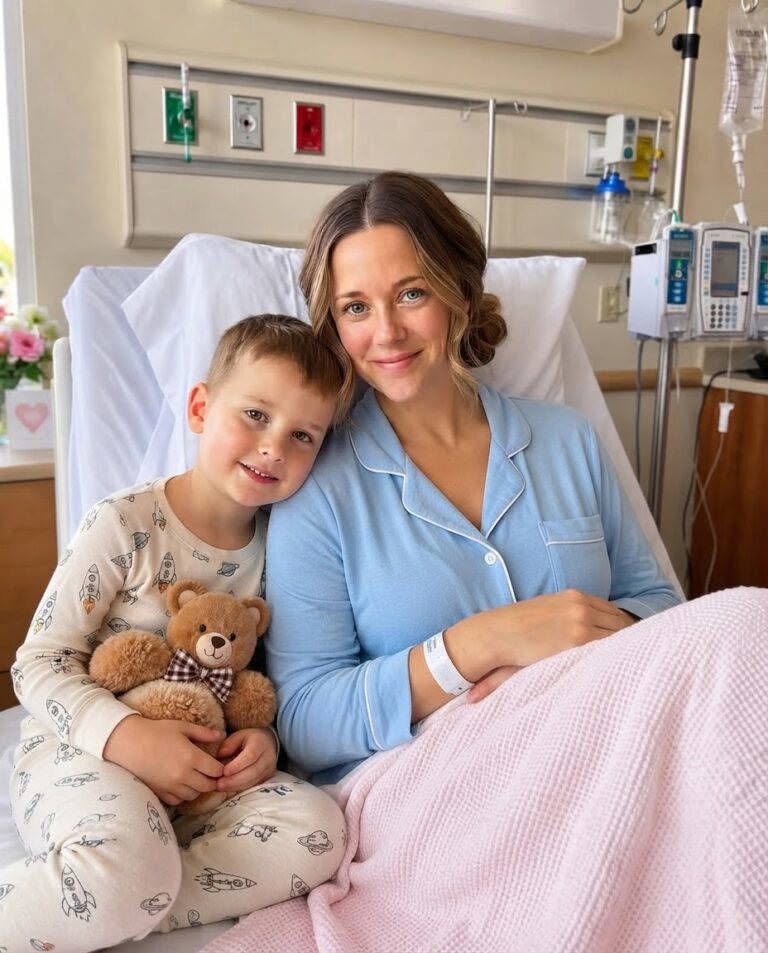
And that my husband, Lucas, had seen him watching.
“He asked what I saw,” Toby whispered.
“What did you tell him?”
“That I didn’t see anything.”
His eyes filled.
“But I think he knew I was lying.”
Suddenly, his behavior since the hospital made sense.
The closed bedroom door.
The fear around Lucas.
The little jar where he had been quietly saving money.
I had thought Toby was grieving.
Maybe he had been afraid.
Then Lucas appeared in the doorway.
He looked at Toby’s tear-stained face.
“What’s going on?”
“Toby misses Emma.”
Lucas softened.
At least, he appeared to.
But when he stepped toward our son, Toby moved closer to me.
Lucas noticed.
So did I.
That was when I stopped asking questions.
Not because I trusted Lucas.
Because I no longer knew whether questioning him in front of Toby was safe.
That night, after Lucas fell asleep, I checked our joint financial records.
Three days before Emma was born:
$15,000 cash withdrawal.
Two days after the delivery:
$25,000 payment to B. Keller.
I saved everything.
Then I found a phone number that appeared repeatedly before Emma’s birth.
The next morning, after Lucas left, I called it.
A woman answered.
I gave my name.
Silence.
Then she hung up.
I went back to the hospital.
One of the doctors who had been present during my delivery, Dr. Patel, agreed to speak privately.
I asked him the question I had been afraid to say aloud.
“Was Emma born alive?”
He hesitated.
Then:
“Yes.”
Everything inside me stopped.
She had needed immediate treatment, he explained, but her heartbeat stabilized.
“Did you personally confirm that she died?”
“No.”
He later found that records he remembered seeing had changed.
Neonatal information was missing.
The chart stated that Emma had died, but he had never personally verified it.
He had raised concerns.
Soon afterward, his contract was not renewed.
“Why didn’t you contact me?”
“I tried.”
My stomach tightened.
“What happened?”
“I spoke to Lucas.”
Lucas had told him I was emotionally fragile and did not want further discussion about the delivery.
All those nights Lucas held me while I cried.
All those times he told me we had to accept what happened.
And when someone tried to question it, he had apparently stopped the conversation before it reached me.
Then I gave Dr. Patel the name from the bank transfer.
“B. Keller.”
He looked up.
“Beth Keller?”
The name pulled an old memory loose.
Beth had once worked with Lucas when he sold medical equipment.
Red hair.
Friendly.
Perhaps too friendly.
Years earlier, I had asked about her.
Lucas laughed it off.
Now I remembered seeing Beth at a company event with her hand around his waist.
Behind them in an old photograph was the logo of a nonprofit called Mercy Families Foundation.
The organization worked with infertility, difficult pregnancies, and infant loss.
Another old volunteer name appeared in its materials.
Brenda Morgan.
Lucas’s mother.
That evening Brenda came over.
I asked her about Beth.
Her reaction told me more than her answer did.
Then I asked:
“Did you see Emma after she was born?”
Brenda stopped moving.
“Yes.”
“Was she alive?”
Tears filled her eyes.
“Yes.”
I had to hold onto the chair.
“Then what happened?”
“Lucas told me there were complications.”
“Did you personally see her die?”
“No.”
Of course.
Again, Lucas.
Then I told her Toby had seen Beth at the hospital.
Brenda admitted she knew Beth had visited.
“Why?”
“Lucas called her.”
I stared at her.
“What was in the envelope?”
Brenda froze.
I had never mentioned an envelope.
Toby had.
Her face changed.
She knew something.
Maybe not everything.
But enough to be afraid.
“Claire,” she whispered, “don’t confront Lucas alone.”
“Why?”
“There are things you don’t understand yet.”
Then Lucas’s car entered the driveway.
Brenda lowered her voice.
“Take Toby somewhere safe tomorrow.”
That was the first useful thing anyone had told me.
After Brenda left, Toby came downstairs holding a photograph he had found in her purse.
A newborn slept inside a white bassinet.
Yellow knitted hat.
A card beside her read:
EMMA
On the back was an address.
And underneath:
October 8. Final placement.
Three days away.
I contacted an attorney that night.
The attorney told me not to confront anyone, to preserve every record, and to involve investigators.
The next morning, Toby went to stay with my sister.
Then authorities went to the address.
It belonged to a large house in a rural area.
I waited nearby.
Then a familiar SUV appeared.
Lucas was driving.
Brenda sat beside him.
Inside the house, investigators found Beth Keller.
Lucas.
Brenda.
And a newborn girl.
Alive.
Well cared for.
When I finally heard her crying from the house, my legs nearly gave way.
For two weeks I had mourned a daughter who had been breathing somewhere else.
Emma was alive.
But recovering her uncovered another secret.
Inside the house, Beth confronted Lucas.
Then she said:
“Does Claire know Emma isn’t biologically yours?”
I could barely understand the words.
There had never been another man.
Then fragments of my own medical history returned.
Years earlier, while trying to conceive, Lucas and I had gone through fertility treatment.
Later, when we tried for another child, Lucas handled almost everything.
The appointments.
The records.
The clinic correspondence.
I had interpreted that as support.
Now Beth claimed I had never been told the full details of the embryo transfer.
The embryo used in my pregnancy, she said, had originally belonged to another family.
I had not known.
Even Brenda appeared horrified.
And then another man arrived with an attorney.
The attorney said his client had spent months trying to trace an embryo he believed had disappeared through irregular clinic records.
He described his client as Emma’s biological father.
At that point, I stopped trying to understand everything at once.
There would be records.
Tests.
Investigations.
Lawyers.
Questions about what had been done without my knowledge.
Those would come later.
At that moment, only one thing mattered.
Emma was safe.
A nurse carried her toward me.
My daughter.
Alive.
Wrapped in a yellow blanket.
I touched her hand.
Her fingers closed around mine.
For a moment, nothing else existed.
Then I noticed the man who had arrived with the attorney.
He was older than Lucas.
Gray at the temples.
He stared at Emma with an expression I could not read.
Then he saw a photograph of Toby on my phone.
His face changed.
“Is that Tobias?”
I stared at him.
“How do you know my son’s name?”
Behind him, Lucas went completely still.
Brenda covered her mouth.
The stranger looked from Toby’s photograph to Emma.
And suddenly I understood that whatever had happened to my daughter had not begun with her birth.
It reached back eight years.
Back to the fertility treatments that eventually gave us Toby.
Back to records Lucas had handled while I trusted him to tell me what mattered.
I did not yet know the truth.
And I would not invent one simply because uncertainty was unbearable.
That was something the last two weeks had already taught me.
Hope was not proof.
Suspicion was not proof.
Even betrayal did not give me permission to decide the rest before the evidence did.
What I knew was enough.
My daughter was alive.
My son had carried a secret no child should have been asked to carry.
And the man I had trusted with our family’s most vulnerable decisions had withheld truths that belonged to me too.
The next answers would come through records, witnesses, and testing.
But one decision had already been made.
Whatever truth waited behind Toby’s birth, he would never be made to feel like a mistake created by adults.
He was my son.
Emma was my daughter.
And whatever other people had done with biology, paperwork, money, or fear, neither child would carry the shame for it.