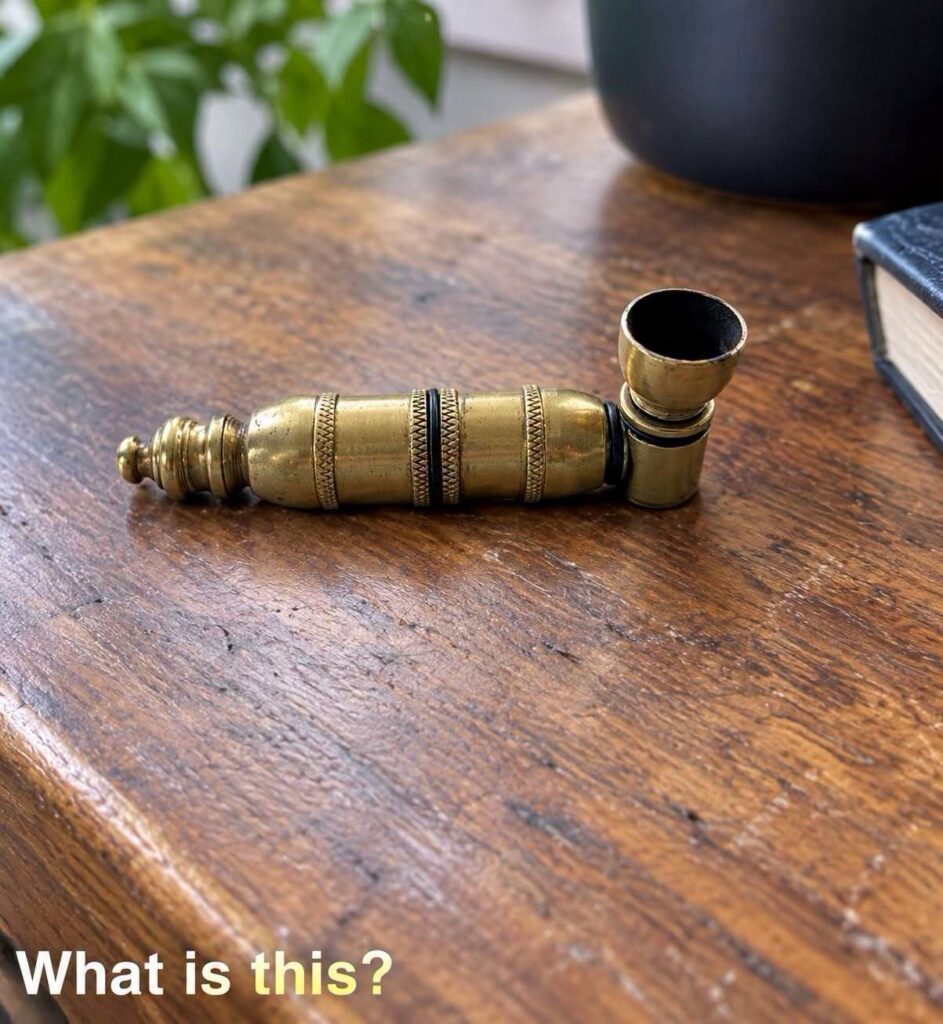
It was a small, heavy brass object with smooth, worn curves and a tiny opening at one end.
I picked it up and turned it over in my hands.
At first, I had absolutely no idea what I was looking at.
The metal had lost most of its original shine, and the surface was covered with tiny scratches and marks that suggested it had once been used regularly.
That made me even more curious.
Why had my grandfather kept it?
And what exactly had it been used for?
I examined every part of it, looking for a clue.
Its shape was unusual.
It seemed too small to be a traditional tool, yet too carefully designed to be nothing more than a decorative object.
The opening at one end only added to the mystery.
For a while, I wondered whether it might have been some kind of old mechanical accessory, a piece from a larger device, or perhaps something people once carried in their pockets.
Nothing seemed to fit.
Eventually, curiosity got the better of me.
I started searching through photographs of vintage objects, old-fashioned tools, and personal accessories, comparing their shapes and details with the strange brass item in my hand.
Several possibilities looked promising at first, but each one turned out to be wrong.
Then I came across an object that looked almost identical.
Suddenly, everything made sense.
What I had found was a small brass pocket pipe.
Its compact size had been designed to make it easy to carry, likely in a pocket or small bag.
The seams I had noticed were also meaningful. They suggested that parts of the pipe could be separated, making it easier to clean and maintain.
Even the choice of material made sense.
Brass is durable, which explained how the little object had managed to survive through so many years while remaining almost completely intact.
But identifying it only created another kind of mystery.
I had never known my grandfather owned anything like it.
The grandfather I remembered existed through familiar routines and family stories.
I remembered the things he said.
The way he dressed.
The places he liked to sit.
The little habits everyone in the family associated with him.
Yet this tiny brass pipe hinted at another side of his everyday life that had somehow never become part of those stories.
I began wondering when he had bought it.
Was he young?
Had someone given it to him?
Did he carry it every day, or had it only been used occasionally?
Had it traveled with him somewhere?
Those were questions I would probably never be able to answer.
Knowing what the object was could not tell me the story behind it.
Those details belonged to my grandfather.
Still, the uncertainty somehow made the discovery feel even more personal.
The pipe itself was probably not worth much money.
It was not an especially rare treasure, and there was nothing luxurious about it.
Its value came from something far simpler.
My grandfather had held it.
He had chosen to keep it.
At some point in his life, this small brass object had been part of his routine.
And decades later, it was still sitting quietly among his belongings.
Holding it made the years between us feel slightly smaller.
It reminded me that people leave pieces of themselves behind in unexpected places.
Not always in important documents or carefully preserved family heirlooms.
Sometimes, they remain in an ordinary drawer.
Inside an old box.
Or hidden beneath a pile of forgotten receipts and photographs.
That little brass pipe became more meaningful to me than I ever expected.
Not because of what it was worth, but because of whose hands had once held it.
And it reminded me that sometimes the smallest, most ordinary objects can become the strongest connection to someone we miss.