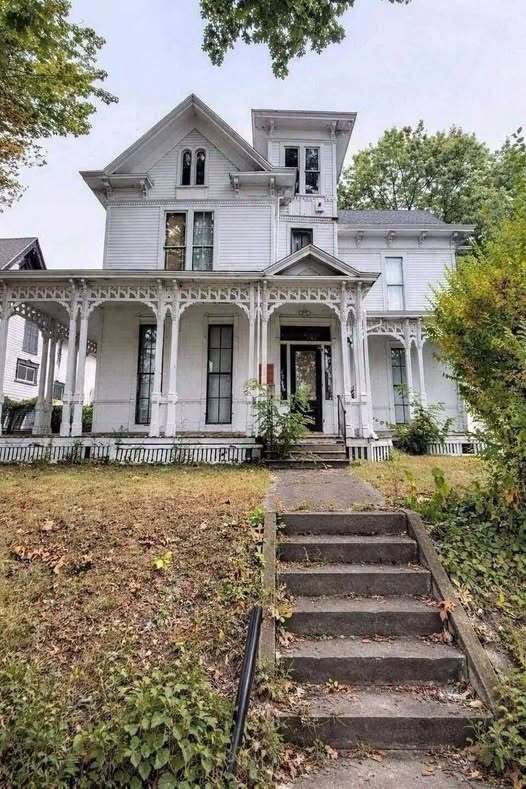
Despite the aging exterior, many of the home’s defining architectural details appear to remain intact.
Tall, narrow double-hung windows give the facade a strong vertical rhythm, while the traditional entrance is topped by a transom window that adds another period detail.
The tower is perhaps the most eye-catching feature.
Combined with the steep rooflines and decorative porch, it gives the house a dramatic silhouette that immediately separates it from newer homes.
The wooden siding clearly shows signs of age and exposure, but the overall structure still carries the personality of the era in which it was built.
That is exactly what makes homes like this so appealing to preservation-minded buyers.
Restoring It Would Be a Major Undertaking
A property of this age would require far more than paint, landscaping, and cosmetic repairs.
Before any decorative work begins, a full inspection would be essential.
The foundation, roof, electrical system, plumbing, heating, drainage, and structural framing would all need careful evaluation.
Older homes can also contain materials such as lead-based paint or asbestos, so those possibilities would need to be assessed professionally.
The most urgent work would likely involve keeping the house dry, structurally stable, and protected from further deterioration.
That could mean roof repairs, gutter replacement, foundation work, exterior sealing, and improvements to drainage around the property.
Only after those major concerns are addressed would it make sense to focus on the home’s decorative features.
The Original Details Could Be Worth Saving
One of the greatest advantages of a house like this is that many of its original elements may be difficult or extremely expensive to recreate from scratch.
Windows, doors, flooring, staircases, trim, porch details, and ornamental woodwork can all contribute heavily to the home’s historic value.
Whenever possible, restoration would ideally focus on repairing those features rather than replacing them with modern alternatives.
That approach could preserve the character that makes the house special in the first place.
Specialist craftsmen might be needed to reproduce missing brackets, damaged spindle work, or decorative trim.
The cost could be significant, but the results could also be extraordinary.
Modern Comfort Without Losing Historic Character
The interior could still be adapted for modern living without stripping away everything that makes the property unique.
Kitchens and bathrooms could be updated.
Heating and electrical systems could be modernized.
Insulation could be improved.
Plumbing and utilities could be brought up to current standards.
The challenge would be doing all of that without altering the proportions of the rooms or removing original details unnecessarily.
A thoughtful restoration would allow modern convenience and historic design to exist together.
A Project That Would Require Patience
Restoring a large Victorian home is rarely a quick project.
The work could take place in phases, beginning with structural stability and weatherproofing before moving toward interior restoration and decorative finishes.
A realistic budget would be essential.
So would patience.
Older homes often reveal unexpected problems once work begins, especially behind walls, beneath floors, or around foundations.
But they can also reveal surprises in the opposite direction—original woodwork hidden under paint, old flooring beneath carpet, or decorative details that have survived for more than a century.
The Potential Is Still There
Despite its neglected appearance, the home still has an unmistakable visual identity.
The tower.
The steep gables.
The wrap-around porch.
The tall windows.
The intricate wooden ornamentation.
Together, those features create the kind of architecture that would be difficult to recreate today without enormous expense.
For the right owner, this property could become much more than a renovation project.
It could be an opportunity to preserve a piece of architectural history.
With careful planning, skilled craftsmanship, and a willingness to restore the house in stages, this forgotten Victorian could once again become a striking residence.
The years may have taken their toll, but the character of the home is still clearly visible.
And sometimes, that is exactly what makes an old house worth saving.