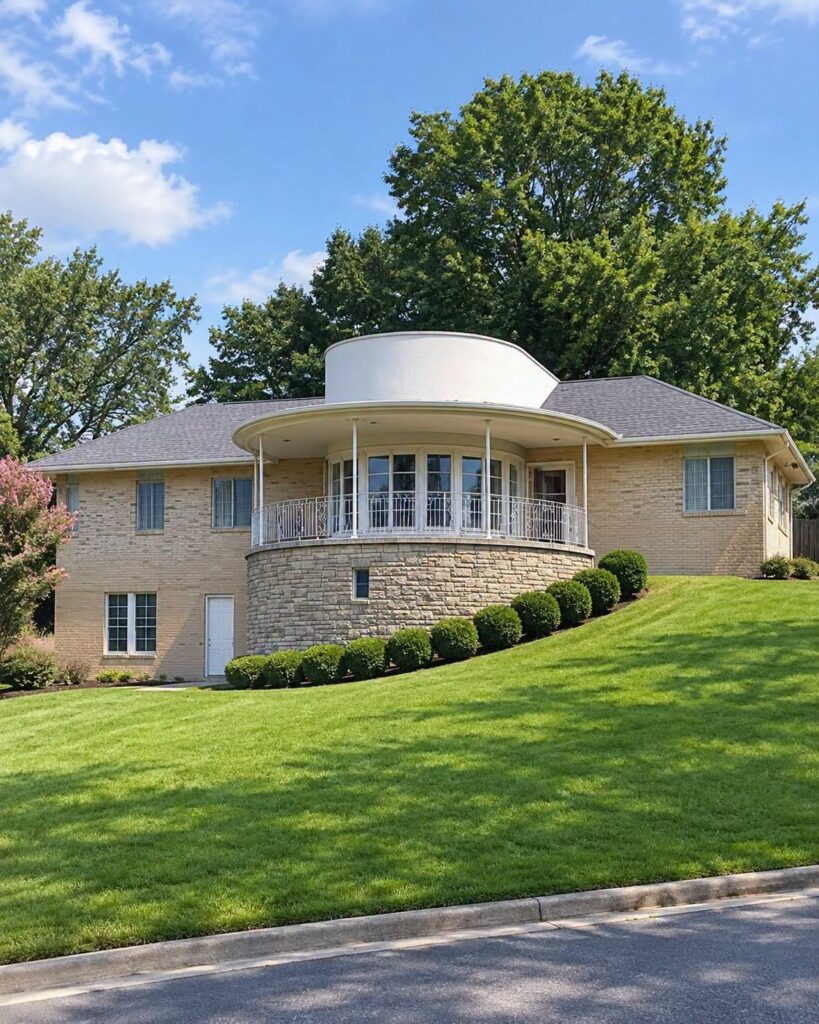
The architecture is easily the property’s most striking feature.
Instead of traditional straight walls and square windows, the house is filled with curves, dramatic glass panels, and geometric shapes.
Its tall cylindrical section gives the structure the appearance of a futuristic tower, while the broad windows make the home feel open and filled with light.
The design has a strong Art Deco influence, giving the property a personality rarely seen in ordinary residential neighborhoods.
Whoever originally imagined the home clearly was not interested in building something typical.
They wanted something memorable.
And they certainly succeeded.
The Interior Tells a Different Story
While the exterior may look ambitious and dramatic, the inside reveals why the home comes with such a low asking price.
This is not a polished, move-in-ready property.
Far from it.
The interior feels unfinished and worn, with large areas that would need serious attention before the home could comfortably be lived in.
Still, the bones of the design are easy to see.
The rooms are spacious.
The large windows allow natural light to pour inside.
And the unconventional layout creates opportunities that would be difficult to find in a more traditional home.
For someone with imagination, that could be exactly what makes the property appealing.
A Renovator’s Dream — or Nightmare
The right buyer might see the house not as a problem, but as a blank canvas.
Rather than stripping away its unusual character, a thoughtful renovation could preserve the dramatic curves, glass features, and geometric details while modernizing the rest of the home.
Updated flooring, contemporary lighting, restored walls, and clean modern finishes could completely transform the space.
With the right design choices, the property could become a stunning architectural statement.
But there is another side to that possibility.
Renovating a home this unusual may not be simple or cheap.
Custom windows, curved walls, structural repairs, specialized materials, permits, plumbing, electrical work, and heating or cooling upgrades could all add significantly to the cost.
That means the $65,000 purchase price may only be the beginning.
The Real Cost Could Be Much Higher
Anyone tempted by the low price would need to look far beyond the listing number.
A home like this could require extensive inspections and potentially major repairs.
Depending on its current condition, a buyer might face costs related to roofing, foundations, utilities, structural reinforcement, moisture damage, or outdated systems.
And because the design is so unconventional, some repairs could require custom work rather than standard materials.
That could quickly turn a seemingly affordable property into a major financial commitment.
In other words, this house is not necessarily cheap.
It is simply inexpensive to buy.
What comes afterward could be a very different story.
That’s Exactly What Makes It So Fascinating
The home sits somewhere between architectural treasure and renovation gamble.
Some people may see an unfinished disaster.
Others may see enormous potential.
Its strange shape and unusual history make it the kind of property that sparks imagination almost immediately.
Could it become a one-of-a-kind dream home?
A creative retreat?
A dramatic vacation rental?
Or would the cost of restoring it outweigh everything that makes it special?
That question is part of the appeal.
For now, the home remains perched above the surrounding streets, its curved glass reflecting the light and its unusual silhouette standing apart from everything nearby.
It waits for someone willing to make a difficult decision.
Spend heavily to preserve and restore a forgotten architectural vision—or walk away before the bargain becomes an expensive mistake.
At $65,000, it may look like the deal