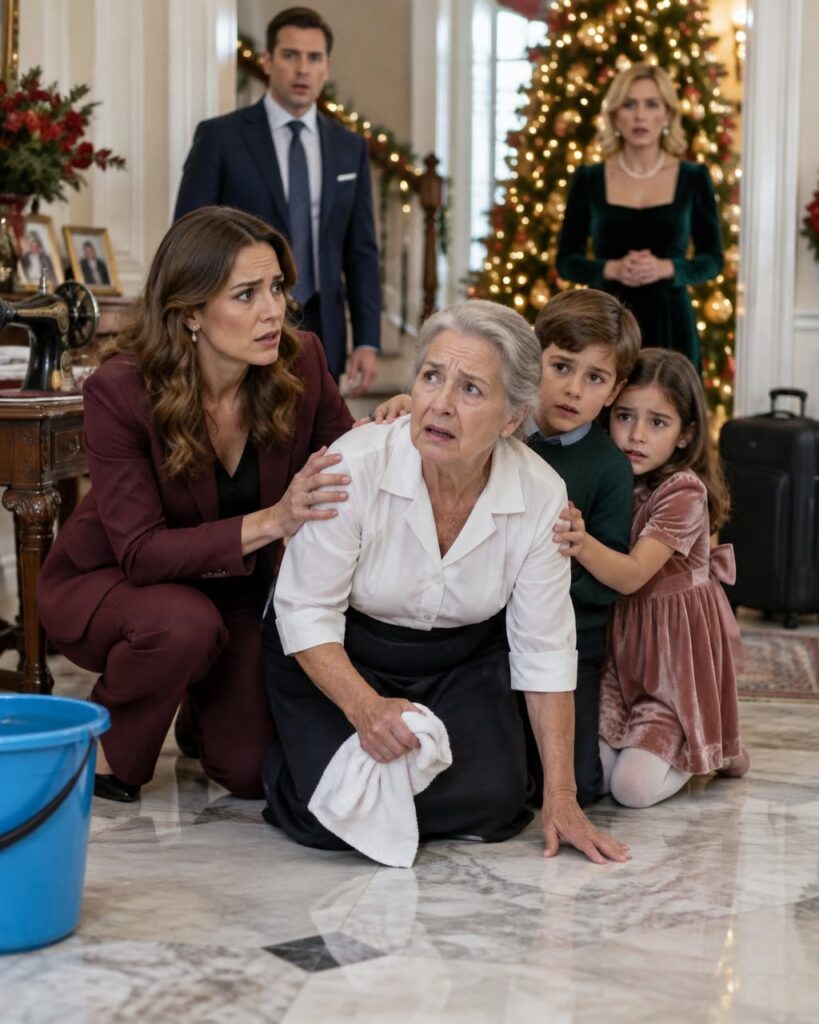
I followed the sound.
My mother was kneeling beside the toilet.
She was sixty-eight.
Arthritis had swollen her hands so badly that the cleaning brush trembled between her fingers.
Mateo clung to her leg.
Sofia sat crying beside her.
Then Mom looked up.
There was a bruise beneath her eye.
“Mom.”
She tried to smile.
“I slipped.”
I helped her stand.
Her sleeve moved.
Four dark marks circled her wrist.
Finger marks.
Someone had grabbed her.
My husband Mauricio was in the living room watching television.
His mother Patricia sat beside him.
Dirty dishes covered the table.
Patricia looked at me.
“Good. Tell your mother to hurry. Mauricio still has shirts that need ironing.”
I stared at her.
“My mother does not work for you.”
“She’s staying here for free.”
That wasn’t true.
Mom had come specifically to help with the twins while I traveled.
Mauricio had promised me he would arrange help with the house.
Instead, my mother had become it.
I went back to her.
“Tell me what happened.”
She finally did.
Patricia had grabbed her after Sofia spilled juice.
Mauricio had seen it.
He told Mom not to tell me.
Then, two days later, when Mom refused to wash his clothes, Mauricio grabbed her shoulder.
She lost her balance and struck the furniture.
That was the bruise beneath her eye.
Something in me went cold.
“I’m taking Mom and the children.”
Mauricio stepped into the doorway.
“The kids stay.”
“Move.”
His voice lowered.
“If you create a custody fight, my mother can tell everyone you disappear for work and barely see them.”
Patricia folded her arms.
“I’ve seen plenty.”
That was when I remembered something my father had told me shortly before he died.
If you ever see your mother hurt, don’t argue.
At the time, I didn’t understand him.
Now I did.
Not every danger needs a confrontation.
Sometimes the first responsibility is simply to get people somewhere safe.
So I took the twins.
I took Mom.
And we walked out.
We did not go far.
Ten steps, approximately.
The property next door had appeared vacant for years.
Mauricio believed it was tied up with a bank.
It wasn’t.
My father had bought it through a private trust before Mauricio and I married.
I placed my thumb against the electronic lock.
The door opened.
Warm lights came on.
Mom stared at me.
Mauricio followed us outside.
“You own this?”
“It belongs to the trust Dad created.”
Patricia had gone strangely quiet.
Then she looked toward the basement windows.
“Your father promised that basement would never be opened.”
That was the first indication that whatever my father had feared began long before that night.
But I did not investigate immediately.
First, I photographed Mom’s injuries.
Saved Mauricio’s threatening messages.
Called my father’s longtime attorney, Tomás.
And made sure my children were safe.
The past could wait.
My mother could not.
Tomás arrived an hour later.
When he saw Mom’s face, his expression changed.
He opened his briefcase and removed an envelope in my father’s handwriting.
DANIELA — IF ANYONE EVER HURTS YOUR MOTHER, OPEN THIS.
Inside were old company records.
Nearly thirty years earlier, Patricia had worked for my father’s construction company.
During that period, a large amount of money disappeared.
The official blame fell on Patricia’s husband, Samuel—Mauricio’s father.
Samuel vanished before the matter was resolved.
My father never believed he was responsible.
He had found altered transfers.
False invoices.
Documents using Samuel’s credentials.
He suspected Patricia.
But the evidence had been incomplete.
And my father had another reason for staying quiet.
Years earlier, during a separation from my mother, he had been involved with Patricia.
She later claimed Mauricio was his child and used the possibility to pressure him.
A private test eventually showed Mauricio was Samuel’s son.
It was a messy history.
My father had hidden too much of it.
Some of that secrecy came from shame.
Some from fear.
Some, I think, from believing he could protect everyone by carrying the truth alone.
He couldn’t.
Secrets rarely stay contained simply because someone had good intentions when they buried them.
The old records eventually led us to Samuel.
He was alive.
For almost three decades, he had lived elsewhere under another surname.
Patricia had framed him strongly enough that he believed disappearing was his only way to avoid prosecution.
That decision had consequences too.
Mauricio had grown up believing his father abandoned him.
Patricia had filled that absence with another story:
My family had destroyed theirs.
That belief explained some of Mauricio’s resentment.
It did not excuse what he had done to my mother.
Understanding is not absolution.
Samuel produced copies of the original financial records.
We turned everything over to the proper authorities.
The older allegations were complicated by time.
The abuse of my mother was not.
There were photographs.
Messages.
Medical records.
Witnesses.
And Mauricio eventually gave a statement.
He stopped protecting Patricia.
That mattered.
But it did not erase his own actions.
He had watched his mother mistreat mine.
He had helped silence her.
Then he put his own hands on her.
And when I tried to leave, he threatened me through our children.
I did not need to hate him to understand that my marriage was over.
So I filed for divorce.
Mom stayed with me in the neighboring house while everything settled.
Later, Tomás showed us something else my father had quietly restored.
Years earlier, my mother had sold family land to help pay for my education.
Dad eventually bought it back.
Sixteen hectares.
Now partly leased for solar energy.
It was legally hers.
Mom cried when she saw the documents.
“I thought it was gone.”
My father had spent his last years trying to return things he believed she never should have been forced to sacrifice.
Not because property could repair a marriage.
Not because money could erase history.
But because he finally understood that providing for someone should not mean allowing them to disappear inside everyone else’s needs.
We used part of the land income to build Mom a small house there.
She chose everything.
Wide doors.
Easy handles for her arthritic hands.
Drawers that opened without much grip strength.
Counters at a comfortable height.
On the first day, she ran her hand across the kitchen table and cried.
“Your father knew my hands would get worse.”
“Yes.”
“So he planned this?”
I shook my head.
“He wasn’t really planning a house.”
I hugged her.
“He was planning for you.”
A year later, we celebrated Mom’s birthday there.
Mateo chased butterflies outside.
Sofia covered herself in flour helping Grandma make dough.
Samuel came too.
His relationship with Mauricio remained difficult.
Twenty-nine missing years do not vanish simply because the truth arrives.
But they began talking.
Coffee first.
Then longer visits.
Eventually, Samuel met his grandchildren.
Mauricio and I remained separated.
He saw the children under clear arrangements.
He apologized.
I believed some of that apology was sincere.
But sincerity does not automatically restore trust.
And forgiveness does not require rebuilding every relationship that was broken.
Sometimes forgiveness simply means refusing to make hatred your next home.
Late that afternoon, Tomás brought me one final letter from Dad.
He had found it hidden inside my mother’s old sewing machine.
Daniela,
If you are reading this, someone mistook your mother’s love for permission to use her.
I stopped reading for a moment.
Then continued.
I bought the other house because I wanted there always to be ten steps between Elena and somewhere safe.
Ten steps.
That was exactly how far we had walked that night.
Then came the part I kept.
No property I leave you will ever be your real inheritance.
A house can be sold.
Money can disappear.
A family name can lie.
What no one has the right to demand from you is your dignity, your freedom, or your right to decide who deserves to remain beside you.
I folded the letter.
Across the garden, Mauricio was helping Mateo with his bicycle.
Mom stood in the kitchen laughing with Sofia.
Her hands were moving slowly.
Not because someone had ordered her to clean.
Not because usefulness was the price of being allowed to stay.
Because she had chosen what she wanted to do.
That was the difference.
For years, several people in our family had confused love with access.
Access to money.
Labor.
Silence.
Forgiveness.
Even another person’s body.
But love does not create ownership.
Being family does not entitle anyone to use another person until they are exhausted and then call the sacrifice natural.
My father had made mistakes.
Serious ones.
His secrecy had allowed old wounds to survive far longer than they should have.
But before he died, he tried to leave us one thing clearer than the secrets he had kept.
A way out.
Ten steps between danger and safety.
In the end, that house was not the inheritance that mattered most.
The real inheritance was knowing we were allowed to walk those ten steps.
And understanding that a home is not safe merely because family lives inside it.
A home is safe when nobody inside has to be afraid of anyone else.