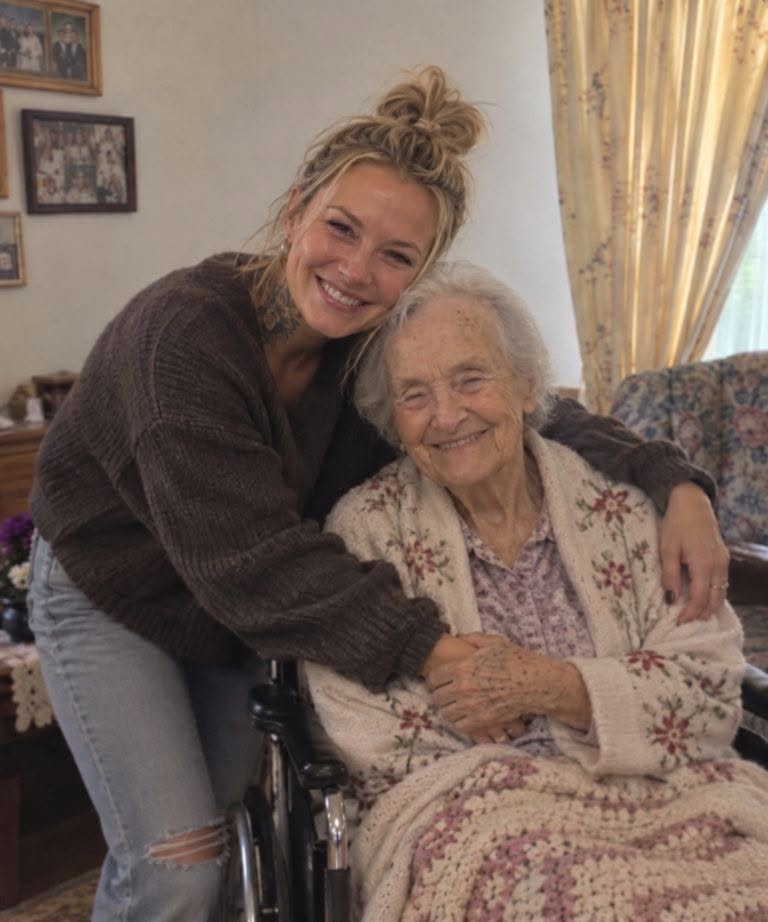
That was how I met Marianne.
She was eighty-four, silver-haired, sharp-eyed, and living alone in a house that felt much larger than one person needed.
“I don’t need a nurse,” she told me.
“I need someone to sit at my table and make this place feel like family again.”
I looked at her.
“Pretending costs extra.”
She smiled.
“Good. You’re honest.”
Every Sunday after that, I came back.
Marianne had once been a seamstress and owned a small clothing shop in the city.
She told stories about silk, difficult customers, impossible hems, and women who wanted dresses that made them feel braver than they were.
She noticed things too.
A missing button on my coat.
A burn on my wrist from work.
The way I tensed whenever someone mentioned mothers.
One afternoon she repaired my coat, then said:
“You’ve had a difficult life, haven’t you?”
I couldn’t answer.
She didn’t make me.
That was one of the first things I loved about her.
She could see something without forcing me to explain it.
Eventually, I stopped thinking about the money.
When I tried returning it, Marianne pushed it back.
“We made an agreement.”
Then one Sunday, she handed me an old metal sewing box.
Faded roses were painted across the lid.
“You think I’m losing my mind,” she said.
“But one day this box will save you.”
“From what?”
“You’ll know when it matters.”
I carried it home on the bus.
I cried the entire way.
I didn’t know that would be the last time I saw her.
The following Sunday, I called because I was running late.
A man answered.
“I’m Marianne’s friend,” I said. “Is she there?”
He laughed bitterly.
“I’m her nephew.”
Then:
“She died two nights ago.”
The room around me disappeared.
Before I could ask anything else, he added:
“And before you start wondering—she left you nothing.”
“I don’t want anything.”
That part was true.
I wanted one more Sunday.
One more terrible cup of tea.
One more chance to tell Marianne that the arrangement had stopped being pretend a long time ago.
The call ended.
At home, I sat on my kitchen floor holding the sewing box against my chest.
“I should have told you,” I whispered.
My thumb caught against a tiny ridge underneath.
I pressed it.
Click.
A false bottom opened.
Inside was a brass key and a note in Marianne’s handwriting.
My darling girl,
I told you this box would save you.
Go to my house. The key opens the cabinet in my sewing room.
When I arrived, Marianne’s nephew Arthur was clearing the house.
Bags filled the porch.
Inside them were pieces of fabric and clothing I recognized from her stories.
He blocked the doorway.
“You’re the woman she was paying.”
“Yes.”
“She left you nothing.”
“I’m not here to take your inheritance.”
I held up the key.
“She asked me to open something.”
He did not like that.
But eventually, I reached the sewing room.
In the corner stood an old cabinet.
The brass key fit.
Inside was a cream envelope.
My name was written across it.
The letter began:
Dear Addie,
Marianne explained that the little store she had told me about still existed.
She still owned it.
A former apprentice named Simon had been running it for years.
Then came the part I had to read twice.
She was leaving her ownership of the shop to me.
There was one condition.
I had to learn the trade.
Work there.
Earn my place in it.
Then she wrote:
You owe Simon and me nothing except the work.
Arthur stared at me.
“That can’t be valid.”
But Marianne had prepared carefully.
Her lawyer had witnessed the documents.
Her doctor had confirmed her capacity.
She had made the decision months earlier.
Arthur looked angry.
I understood some of it.
He had lost an aunt.
Now he was discovering she had made choices about her belongings he did not expect.
But his disappointment was not something I could fix by surrendering what Marianne had deliberately given me.
So I took the papers and left.
Several weeks later, after everything was verified, I took the train into the city.
Simon was waiting outside the shop.
He was in his fifties, gentle-faced, with ink on his fingers.
“You’re Addie.”
“Yes.”
“Marianne talked about you constantly.”
I swallowed.
“She did?”
He smiled.
“She said I’d recognize you by the way you hold your shoulders.”
Inside, bolts of fabric lined the walls.
Half-finished dresses rested on wooden forms.
The place smelled faintly of lavender.
I ran my hand across a roll of cloth.
“What happens now?”
“Now?”
Simon smiled.
“I teach you.”
He told me Marianne believed I was intelligent.
Honest.
Underused.
Someone who had learned to survive but had never been given much room to build.
“She didn’t want to simply hand you money,” Simon said.
“She wanted to give you something you could become responsible for.”
That sounded exactly like her.
For weeks after Marianne died, I thought the shop was her final gift.
It wasn’t.
The shop mattered.
The opportunity mattered.
But Marianne had already given me something more important before any papers were opened.
She noticed me.
Not as an employee.
Not as a charity case.
Not as the foster kid people felt sorry for.
She saw the missing button.
The burn on my wrist.
The way I held a cup too tightly because some part of me still expected things to be taken away.
And she never demanded that I become less guarded before deciding I was worth loving.
I had answered a flyer because I needed money.
Marianne had placed it because she needed company.
Somewhere between those two needs, neither of us had to pretend anymore.
She became the closest thing to a grandmother I had ever known.
And I became family to a woman who had been sitting alone at a table built for more than one person.
The sewing box did save me.
Just not because it contained a key.
It reminded me that someone had looked at my life and seen more than what had happened to me.
She saw what I might still build.
And then she left me the chance to begin.