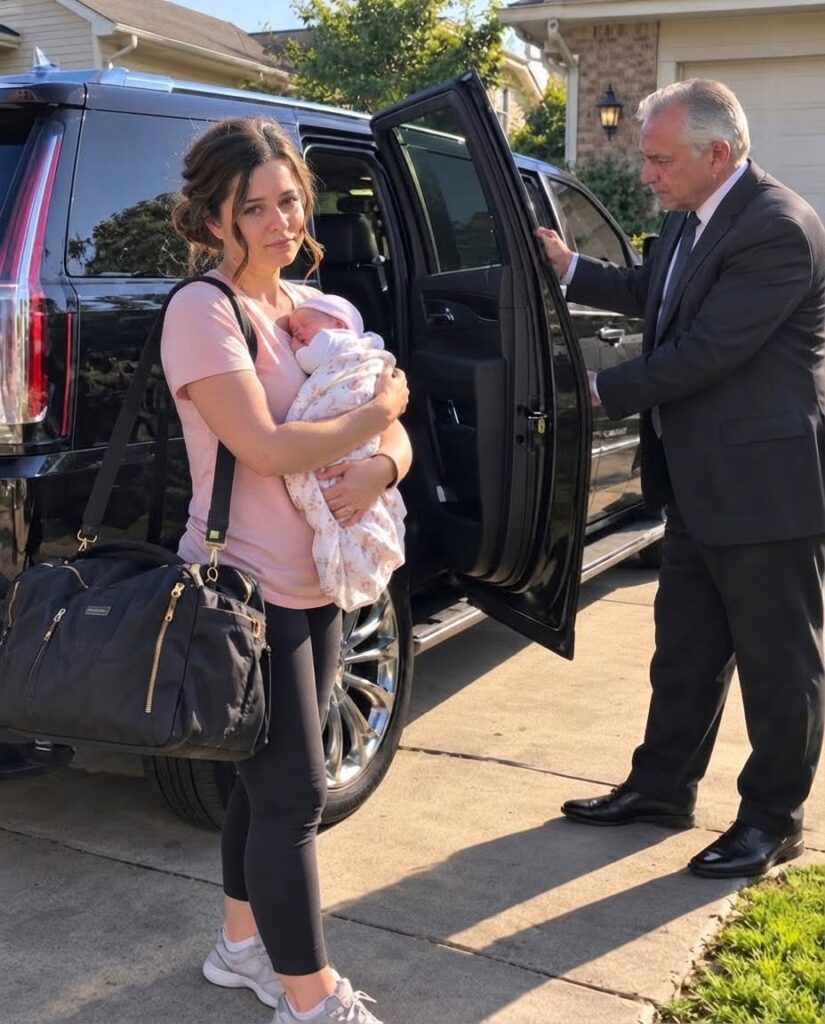
“In a minute. Mom waited all night.”
That moment should have told me more than it did.
For years, Beverly had treated me as though marrying her son had rescued me.
She called me “the teacher.”
Corrected my manners.
Chose things for our home.
And Roland always said the same thing afterward.
“That’s just Mom.”
I had learned to tolerate her.
What I had not realized was how often tolerating her meant disappearing myself.
Six days after giving birth, I was standing in our kitchen reheating soup a neighbor had brought me.
My hospital bracelet was still on my wrist.
Wren slept against my chest.
Roland came downstairs dressed for dinner.
“My sister is having everyone over.”
“What time are we leaving?”
He hesitated.
“It might be easier if you stayed home.”
His SUV was in the shop.
So he had been using my car.
The car seat was inside it.
So was Wren’s diaper bag.
Everything I needed if I had to take our newborn anywhere.
“You’re taking my car?”
“Just for a few hours.”
“And leaving us here?”
He looked irritated.
“It’s one family dinner, Simone. Please don’t make this difficult.”
Then he left.
A few minutes later, his sister posted a photograph.
Seven people around a dinner table.
Beverly.
Roland.
His sister.
Other relatives.
Seven plates.
The caption read:
Family’s all here!
There was no place for me.
No place for Wren.
Then Beverly privately messaged me:
He deserves one peaceful night away from you.
Something inside me became quiet.
Not angry.
Clear.
I looked down at my daughter and realized I had spent years pretending exclusion was merely awkwardness.
It wasn’t.
I packed.
There was one person I had not called in almost two years.
My father.
Malcolm Caldwell.
Growing up, he had provided everything.
Except himself.
He built a logistics company from almost nothing.
Worked constantly.
Missed dinners.
Recitals.
Graduations.
And when my mother died when I was sixteen, he was away on business.
He arrived hours too late.
I never forgave him properly.
He never forgave himself either.
We became strangers who shared a last name.
Six days after Wren was born, I had sent him one photograph.
His reply had been simple:
Is she healthy?
Then:
Are you?
At the time, I barely noticed the second question.
That night, I did.
I called.
He answered immediately.
“Simone?”
“Dad.”
My voice shook.
“Come get me.”
He asked only two questions.
“Is the baby safe?”
“Yes.”
“Are you safe?”
“Yes.”
Then:
“I’m sending Raymond. Thirty minutes. Don’t carry anything heavy.”
I went silent.
He knew I was six days postpartum.
“Simone?”
“Yes?”
“Thank you for calling me.”
Exactly thirty minutes later, Raymond arrived.
He had been my father’s driver since I was a teenager.
But he had also been the man who sat at graduations my father missed.
The man who held me in the hospital hallway when my mother died.
He looked at Wren and smiled.
“She has your mother’s nose.”
No one had said that before.
For six days, everyone had told me how completely she belonged to Roland’s family.
Raymond looked once and found mine.
My father had sent him with a brand-new infant seat.
I left Roland a note.
Wren and I are safe.
We’re staying with my family.
When you’re ready to explain why your mother counts as family and we don’t, you can call me.
Then I left.
My childhood home looked almost unchanged.
But upstairs, my mother’s old sewing room had become a nursery.
Cream walls.
A crib.
Books.
A rocking chair.
Paper wrens hanging above it.
My father had started preparing the room months earlier, after learning through my aunt that I was pregnant.
“Why didn’t he call?” I asked Raymond.
“Because he was waiting for you.”
My father had told him:
If she calls, I’ll be there. If she never calls, at least the room will be ready.
On the dresser was a small card.
Your room is ready. Everything else can wait until you are.
I cried.
At three in the morning, Wren woke hungry.
My father appeared hesitantly in the doorway.
“Do you need anything?”
He had practiced warming bottles before I arrived.
Six times.
That almost made me laugh.
Then he sat on the nursery floor.
For a long while, neither of us spoke.
Finally, he said:
“I should have been there when your mother died.”
He told me what I already knew.
He had thought there was more time.
There wasn’t.
Afterward, shame made him retreat further instead of coming closer.
“I thought I had lost the right to show up.”
He looked around the nursery.
“The only thing I knew how to do was build things.”
Then he said:
“I built an entire company so my family would never need anything.”
His voice cracked.
“And the only thing either of you needed was for me to be there.”
Years earlier, after suffering a heart attack alone in his office, he had finally begun changing.
Less work.
Therapy.
More life.
He could not undo my mother’s last day.
He knew that now.
“But if you ever needed somewhere to go,” he said, “I wanted to already be here.”
Then I handed him Wren.
He panicked.
“I don’t know how.”
“Support her head.”
He held her carefully.
She settled against his chest.
And my father began to cry.
“Hello, Wren.”
His voice shook.
“I’m your grandfather.”
Then:
“I’m sorry I’m late.”
He looked at her.
“I’m going to try not to be late anymore.”
Roland came to see me several days later.
He was shocked by my father’s house.
By the company.
By the fact that the woman his family had treated as socially beneath them had never needed their money at all.
But that was not the point.
“You never told me,” he said.
“No.”
“Why?”
“Because I wanted to know who you would be if you thought I had nothing.”
He looked down.
“And now you know.”
He apologized.
Then began blaming Beverly.
I stopped him.
“Your mother did many things.”
I kept my voice calm.
“But you took the car.”
He looked at me.
“You took the infant seat.”
“The diaper bag.”
“You left your wife six days after childbirth without transportation.”
“And you went to a family dinner where there were seven places set.”
I swallowed.
“None of them were ours.”
He covered his face.
“For six years, I did not need your mother to love me.”
My voice broke.
“I needed you to stand beside me when she didn’t.”
That was the failure he had to face.
Not Beverly’s personality.
His own silence.
My father spoke to Roland before he left.
He told him about missing my mother’s death.
How one easy decision—one more meeting, one more delay—had cost him something he could never recover.
“Families usually aren’t lost in one enormous decision,” Dad said.
“They disappear one easy choice at a time.”
Then he looked at Roland.
“Don’t become me.”
Roland began therapy.
At one session, the therapist asked him to draw his family.
Without thinking, he drew Beverly in the center.
His sister beside her.
Other relatives nearby.
Then he drew me and Wren small, off to one side.
“I stared at it,” he told me later.
“And I realized that was the dinner.”
His mother in the center.
His wife and child outside the table.
He started visiting Wren regularly.
Feeding her.
Changing diapers.
Learning things he had previously assumed his mother would teach me.
He stopped asking me to hurry back.
That mattered.
Beverly eventually apologized too.
Not just for the dinner.
For six years.
She admitted her own mother-in-law had humiliated her when she was young.
“I promised I would never become her,” she said.
Then:
“And I did.”
She asked to see Wren.
I agreed—with one condition.
“You hold her when I hand her to you.”
There was a pause.
“That’s fair.”
Roland and I eventually began rebuilding our marriage.
Slowly.
Not by pretending the past had disappeared.
Not because an apology erased what happened.
Because his behavior began changing consistently enough that trust had somewhere to grow.
We bought a smaller house.
I chose the paint.
We went to counseling.
My father began visiting every Sunday.
He no longer sent Raymond in his place.
“Raymond has done enough of my showing up,” he said.
“It’s my turn.”
One day, Roland showed me another family drawing.
This time there was a long table.
Everyone had a place.
Me.
Wren.
My father.
Roland.
Even Beverly.
At the head was one empty chair with a rose resting on it.
“Who is that for?” I asked.
“Your mother.”
He looked at me.
“Wren is named after her. She deserves a place.”
I couldn’t answer.
Months later, my father asked why I had called him that night.
“You had friends,” he said. “Hotels. Other people.”
I thought about the seven plates.
Then about the first message he sent after Wren was born.
Is she healthy?
Are you?
“Because you asked about me.”
He looked confused.
“You were the only person who asked whether I was okay too.”
Not only the baby.
Me.
Dad looked down at Wren holding his finger.
“It took me sixteen years to learn how to ask.”
Then he smiled faintly.
“I’m glad I finally got it right once.”
He didn’t get everything right.
Neither did Roland.
Neither did I.
But perhaps families are not healed by pretending people never failed.
Sometimes healing begins when someone finally sees exactly where they failed—
and decides to show up differently the next time.
My father could never return to the hospice room in time.
Roland could never put an eighth plate on that dinner table.
Those moments were gone.
But Wren was here.
I was here.
And the people who loved us were learning that love is not only what you provide.
It is where you place yourself when someone needs you.
These days, when my father visits, he stays the entire afternoon.
No driver standing in for him.
No meeting waiting somewhere else.
Just Grandpa on the living-room floor, reading badly in different voices while Wren laughs.
He spent most of his life building things.
Now he is learning to do something harder.
Stay.