When the marriage ended, I discovered that trust and protection were not the same thing.
Daniel understood the accounts.
The mortgage.
The paperwork.
I didn’t.
By the time the divorce was finalized, Lily and I had about eight hundred dollars, a car loan, and nowhere permanent to live.
Daniel kept the house.
I eventually stopped fighting.
Not because it felt fair.
Because sometimes survival means recognizing when fairness has become too expensive to pursue.
A woman named Grace rented me a small duplex after listening to my story instead of only looking at my credit.
Two bedrooms.
One bathroom.
A narrow kitchen.
And a covered porch.
It wasn’t much.
But it was ours.
That mattered.
Two years later, a violent summer storm rolled through town.
Lily was staying with Daniel.
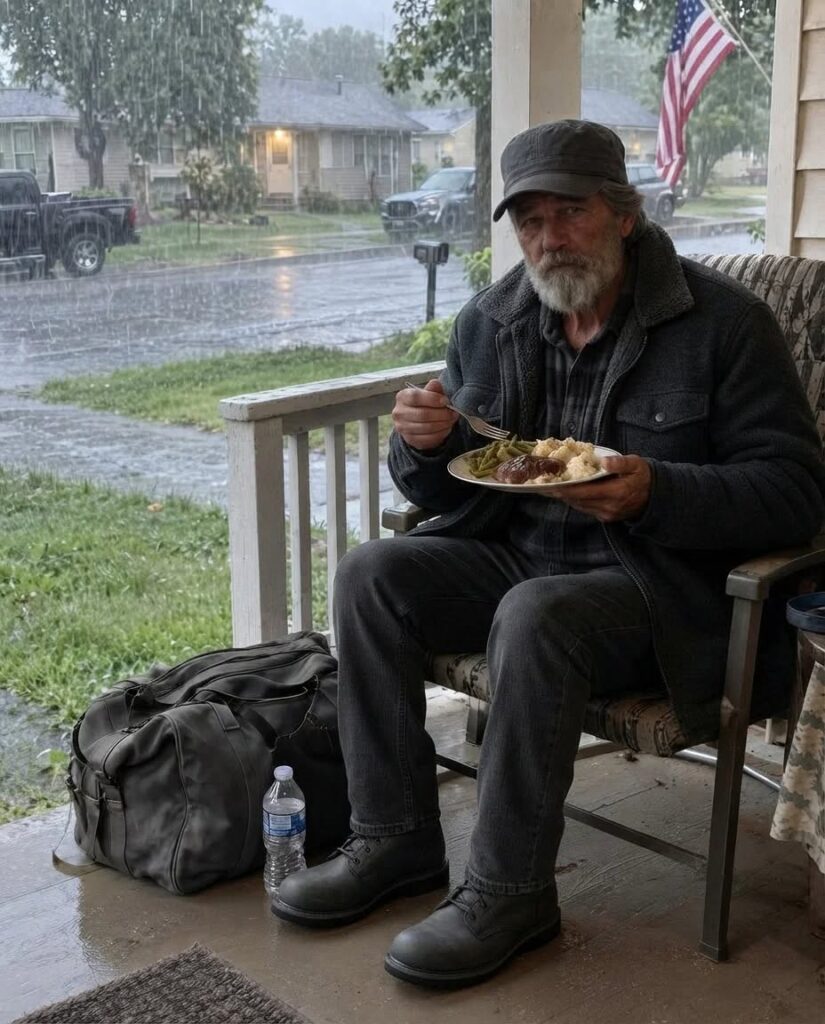
While closing the windows, I noticed an elderly man standing beneath an elm tree across the street.
He was soaked.
He held an old backpack tightly against his chest.
I opened the door.
“Sir?”
He looked up.
“You can come inside.”
He shook his head.
There was something painfully polite about him, as though life had taught him to apologize for taking up space.
Finally he asked:
“Would you mind if I stayed on your porch until the rain passes?”
“Of course.”
I gave him a towel, cushions, and the warmest blanket I owned.
Then I heated some chicken soup.
When I handed him the bowl, he looked at me.
“You probably have enough problems without taking care of an old man.”
He wasn’t wrong.
Rent was approaching.
My job felt uncertain.
Lily needed school clothes.
But that evening, I had soup.
A dry porch.
A blanket.
“Tonight,” I said, “I have enough for both of us.”
And I did.
The next morning, he was gone.
My blanket had been folded neatly on the porch.
Underneath it was an envelope.
Inside was a brass key and an address.
The man’s name was Albert.
His letter explained that he had been without stable housing for months.
His wife, Estelle, had died two years earlier.
Afterward, his relationship with his son became strained, and eventually his daughter-in-law changed the locks on the house where he had been staying.
Albert chose not to fight.
His son never asked him back.
Before Estelle died, they had rented a storage unit.
Albert had continued paying for it even while sleeping in shelters because he could not bring himself to sort through her things.
Until that night.
He wrote:
There was something inside he thought I should have.
A leather notebook Estelle had kept for years.
Recipes were only part of it.
She had written down what she knew about surviving difficult times.
How to stretch money.
How to feed people when the pantry was nearly empty.
How to keep moving when you did not know what came next.
Albert ended the letter with:
I hope your worries get smaller.
I sat on the porch holding the key for a long time.
That morning, I drove to the storage unit.
There was no hidden fortune inside.
Just the remains of an ordinary life.
Chairs.
Books.
Kitchen things.
A sewing machine.
Photographs.
And on the bottom shelf, a small wooden box.
Inside was Estelle’s notebook.
The first page said:
If you are reading this, I hope you needed it.
I did.
There were recipes written in the loose language of someone who had cooked for decades.
A handful of this.
Cook until it smells right.
Stop when you know it’s done.
But there were other pages too.
Money.
Hardship.
Children.
Fear.
One line stayed with me:
When you don’t know how to keep going, keep going anyway. The movement teaches you what comes next.
Another said:
Someone may take the object. They cannot take the work. And with the work, you can build again.
I thought about my old house.
The divorce.
The eight hundred dollars.
Driving away with Lily asleep in the back seat.
Daniel had kept many of the objects.
But perhaps Estelle was right.
He had not taken everything I had learned while building that life.
I took the notebook home.
When Lily returned, I told her about Albert.
She listened carefully.
Then she asked:
“Do you think he’s okay?”
“I hope so.”
She thought for a moment.
“We should do something good too.”
“What?”
“The shelter.”
She smiled.
“We’re good at soup.”
So we called.
The shelter manager explained that consistency mattered more than one dramatic donation.
That Friday, Lily and I made Estelle’s chicken soup.
A handful of this.
A little of that.
Cook until it smells right.
Lily decided when it smelled right.
We delivered it before school.
On the drive home, she asked:
“Why did Albert give us the notebook?”
I thought about it.
“Maybe he had carried something for a long time and finally became ready to put it down.”
“And we happened to be there?”
“Maybe.”
She smiled.
“I think Estelle would like that we made soup.”
That afternoon, I wrote my first note in the margin:
A ten-year-old made this and knew exactly when it smelled right. Estelle was correct. Somehow, you know.
Nothing about my finances magically improved.
Rent still came.
Bills still came.
My job was still uncertain.
But something had changed.
I no longer felt like someone with nothing.
I had a daughter.
A home.
Work.
A pot large enough to make soup for strangers.
And a notebook written by a woman I had never met.
Six weeks later, the shelter called.
Albert had returned.
He had received my message.
He was staying there for a while.
Helping in the kitchen.
Apparently, he made excellent stock.
At the end of his note to me, he wrote again:
I hope your worries have gotten smaller.
I smiled.
Maybe they had.
Or maybe I had simply stopped believing that worries were proof I was failing.
Over the following months, Lily and I kept using Estelle’s notebook.
Our first loaf of bread was terrible.
The second was better.
The third came out golden.
We donated much of the storage-unit furniture and books.
I kept Estelle’s sewing machine.
I didn’t know how to sew.
Not yet.
Estelle had written something beside her section on mending:
Some things should be repaired because replacement costs too much.
Other things should be repaired because they are worth saving.
The important part is learning the difference.
I suspected she wasn’t only talking about fabric.
Among her belongings were private letters and family photographs.
I did not read the letters.
Some things remain private even when possession changes hands.
I sent them to Albert through the shelter.
Later, he wrote that he had forgotten he still had a photograph of Estelle’s face.
He placed it beside his bed.
That mattered more than anything else in the storage unit.
Eventually, my job survived the budget cuts.
I opened a savings account.
Only my name was on it.
There wasn’t much money inside.
But it came from my paycheck.
My work.
My decisions.
When I signed the paperwork, I sat in my car afterward and stared at it for several minutes.
It was only a small account.
But after everything that had happened in my marriage, it felt like proof.
Not that I would never struggle again.
That I was learning to understand my own life.
To pay attention.
To build deliberately.
To know where things were.
To participate in the decisions that shaped my future.
Albert remained at the shelter.
He cooked.
Lily sometimes helped.
Estelle’s notebook slowly filled with our handwriting beside hers.
The first page still said:
If you are reading this, I hope you needed it.
I did.
I still do.
My worries never disappeared.
Rent still arrives.
Cars break.
Jobs change.
Children need things.
Life remains uncertain.
But Albert’s wish turned out to mean something different than I first understood.
Maybe the goal was never to live without weight.
Maybe it was to become strong enough to carry what belonged to us—
and kind enough to help someone else with theirs when we had something to spare.
That night in the storm, I thought I had given Albert very little.
Soup.
A porch.
A blanket.
But kindness is strange that way.
Sometimes you offer what seems small because it is all you have.
Then someone carries it forward.
Albert gave me Estelle’s notebook.
Lily and I made soup.
Albert found his way into another kitchen.
And somewhere along the line, a difficult season became a chain of people giving whatever they could.
Not enough to fix everything.
Enough to make the next step possible.
These days, that is enough for me.
Not loudly.
Not dramatically.
Quietly.
And quietly has become a very good way to live.