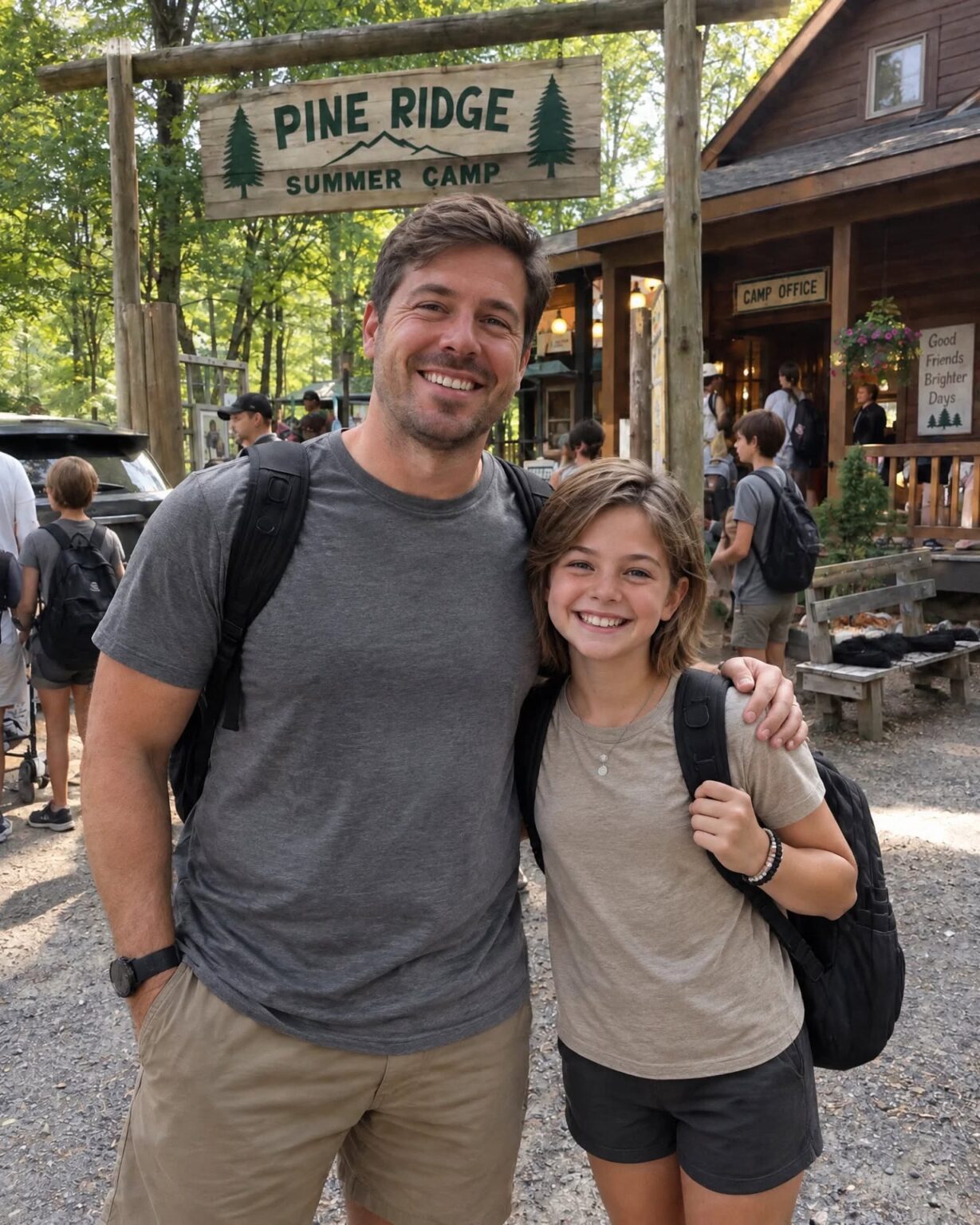
Then, on the morning she was supposed to leave, the hospital called me in unexpectedly.
“I can stay home,” Greta said quickly.
I thought she was trying to make my life easier.
“No way. You’ve been excited about this for months.”
My friend Owen offered to drive her.
I trusted him completely.
An hour later, he texted:
Greta’s checked in. Everything’s good.
Then the camp called.
“Greta is safe,” the director said. “But you need to come.”
When I arrived, Greta had been crying.
Owen sat beside her.
The camp director explained that Owen had asked staff to move Greta away from several girls.
He had shown them messages proving that those girls had been bullying her for weeks.
Nobody wants you in our cabin.
At camp you won’t be able to hide from us.
My stomach turned.
Then I learned something else.
Owen had known I was unaware of the bullying.
And Greta had asked him not to tell me.
“She didn’t want you leaving work because of her,” he said.
Suddenly, her words from that morning made sense.
I can stay home.
She had not been trying to help me.
She had been afraid.
I felt the familiar pull of a parent’s guilt.
I should have noticed.
I should have asked more questions.
But Greta did not need me punishing myself.
She needed me present.
I crouched beside her.
“This is not your fault.”
Then I turned to Owen.
“I’m grateful she trusted you. But once you knew she was this frightened, I needed to know.”
He nodded.
“I thought I could handle the immediate problem first.”
“You’re allowed to help her. You’re not allowed to quietly become her parent.”
Before we could say more, the mother of one of the girls arrived.
She had already seen the bullying messages.
“What my daughter sent Greta was cruel,” she said. “I’m not defending it.”
Then she held out her phone.
“But you need to see what Greta sent too.”
It was an embarrassing photograph of the other girl.
Greta had posted it with a cruel caption to a group chat.
I looked at my daughter.
“Did you send this?”
Her face collapsed.
“Yes.”
Owen stared at her.
“You didn’t show me that.”
“I knew you wouldn’t help me if you saw it.”
The bullying was real.
So was Greta’s retaliation.
One did not cancel the other.
Owen started defending her.
“She had been bullied for weeks—”
“Owen.”
I kept my voice calm.
“I’ve got this.”
He stopped.
I looked at the other mother.
“What Greta did was wrong. There will be consequences.”
Then I pointed toward the messages sent to my daughter.
“But her mistake does not erase what happened to her either.”
The camp director nodded.
“Exactly.”
Neither child needed to become the villain of the story.
They needed adults willing to tell the truth about all of it.
Greta whispered:
“I want to go home.”
Part of me wanted to take her immediately.
But she had wanted this camp for months.
If she left only because those girls had frightened her, they would have taken something from her.
And if she left without facing what she had done, she would avoid responsibility too.
So the camp created a plan.
Separate cabins.
Separate activity groups.
Staff supervision.
Each family would address its own child’s behavior.
Then I took Greta aside.
“If those girls weren’t here, would you still want to stay?”
She thought.
“Yes.”
“Then you don’t have to give up something you love because you’re scared.”
I paused.
“But staying also means admitting what you did was wrong. Being hurt does not give you permission to hurt someone else.”
She wiped her eyes.
“I know.”
“Do you still want to stay?”
“Yes.”
I hugged her.
“Okay.”
Later, Owen apologized.
“I overstepped.”
“You did.”
He nodded.
I softened.
“But I’m also glad she trusts you.”
That mattered too.
One mistake did not erase years of friendship.
“You can always be a safe adult for Greta,” I told him. “But if she is in serious trouble, you cannot promise to keep me outside it.”
“I understand.”
And I believed him.
A boundary did not require turning a good person into a bad one.
It simply made the responsibility clear.
Two weeks later, Greta ran toward me across the camp lawn.
She was sunburned, dirty, exhausted, and carrying a crooked clay turtle.
She talked almost the entire drive home.
Camp had not magically repaired the situation.
She never became friends with those girls.
But she had stayed.
Near home, she became quiet.
“Mom?”
“Yeah?”
“I knew sending that picture was wrong.”
I waited.
“I was tired of always being the one who went home upset.”
She stared at the turtle.
“I wanted her to know what it felt like.”
I understood.
There is a particular temptation in being hurt: the hope that if the other person hurts too, somehow the scales will become even.
They rarely do.
“I understand why you wanted that,” I said.
She looked at me.
“But it still wasn’t right.”
“I know.”
We drove quietly for another minute.
Then she said:
“Next time, I’ll tell you.”
I reached over and squeezed her knee.
“Good.”
That was enough.
I did not need Greta to become a child who never felt anger.
I needed her to become someone who knew what to do with it.
Someone who could ask for help before pain convinced her that becoming cruel was the only way to stop feeling powerless.