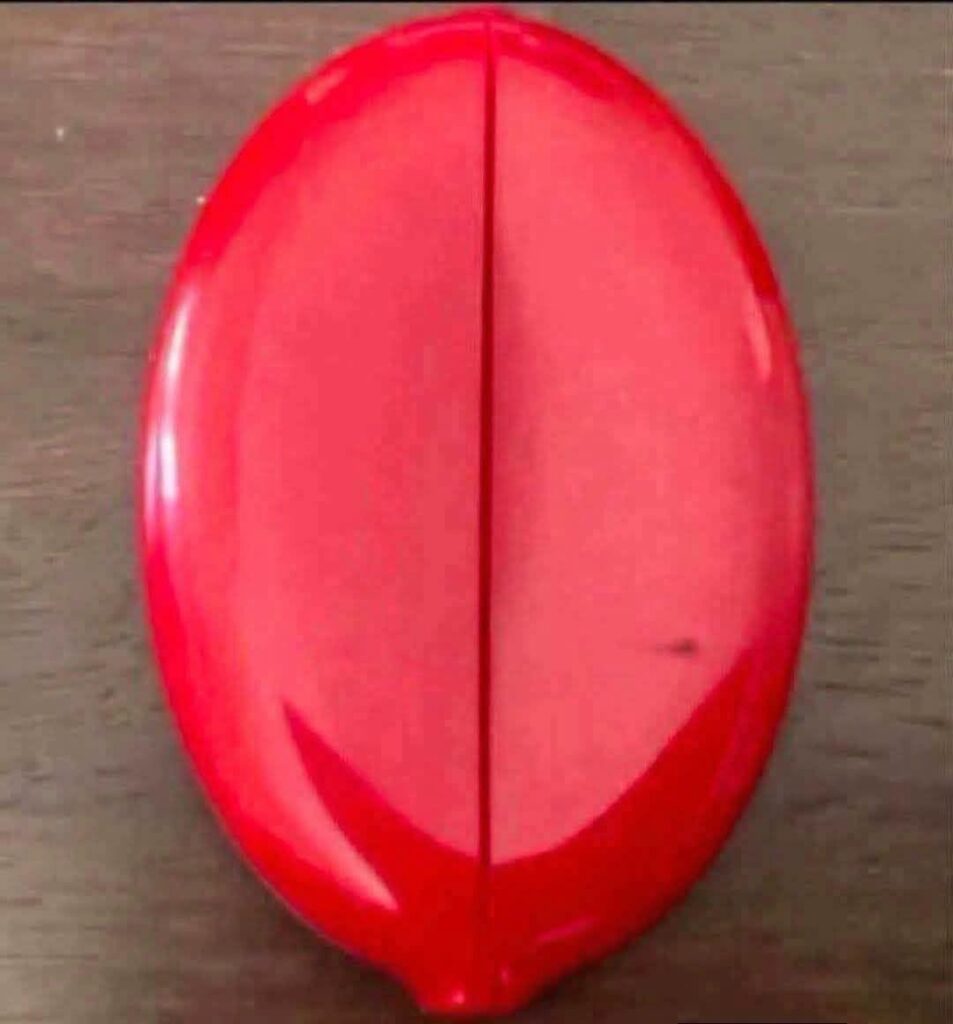
What makes this little purse interesting is the way it opens.
There are no zippers.
No buttons.
No snaps.
No Velcro.
Instead, the purse is made from flexible rubber or vinyl and has a narrow slit running along the center.
When the purse is sitting normally, that slit stays tightly closed, helping keep the contents safely inside.
To open it, the user simply squeezes both narrow ends with one hand.
That pressure forces the sides of the purse to bend outward, causing the center slit to open wide enough to reach inside.
Coins can then be removed or dropped in quickly.
Once the user stops squeezing, the flexible material returns to its original shape, and the slit closes again.
It is a remarkably simple design that works almost like a self-sealing pocket.
Why These Coin Purses Became So Popular
Squeeze coin purses became especially common from the 1950s through the 1980s in parts of North America and Europe.
At the time, carrying loose change was far more important than it is today.
Coins were regularly needed for public telephones, buses, parking meters, laundromats, vending machines, and countless other everyday services.
Having a small coin purse that could be opened quickly with one hand made perfect sense.
The design was inexpensive, compact, durable, and easy to carry in a pocket or handbag.
They Were Also Used as Advertising Giveaways
These purses became more than simple household accessories.
Businesses quickly realized they were perfect promotional products.
Banks, gas stations, insurance companies, hardware stores, restaurants, and other local businesses often had their names printed directly on the rubber surface.
Some included business addresses or telephone numbers as well.
The purses were then handed out as inexpensive advertising giveaways.
Because people used them frequently, the company name could remain in someone’s pocket or purse for years.
Today, those old advertisements can make certain vintage squeeze purses especially interesting to collectors.
They Can Still Be Useful Today
Loose change may not be as essential as it once was, especially with the rise of cards, smartphones, and digital payments.
But that does not mean the squeeze purse has become completely useless.
Its simple design still makes it perfect for storing small objects.
It can hold coins, tokens, guitar picks, tiny screws, earbuds, short charging cables, keys, or other small items that are easy to lose.
The self-closing slit also means there are no zippers or clasps that can break.
A Small Reminder of Everyday Design From the Past
Today, vintage squeeze coin purses are often appreciated just as much for their appearance as for their usefulness.
Many were produced in bright colors such as red, yellow, green, and blue.
Others feature old business logos, vintage typography, phone numbers, and advertising slogans that reflect the era in which they were made.
But perhaps the most interesting part is still the mechanism itself.
With nothing more than flexible material and a carefully designed slit, the purse opens when squeezed and closes automatically when released.
It is a simple solution to a simple problem.
And that simplicity is exactly what makes it memorable.
So if you ever come across one of these mysterious oval objects in an old drawer, flea market, or antique shop, you now know what it is.
It may look like a strange modern gadget, but it was actually designed decades ago to solve one of the most ordinary problems of everyday life: keeping loose change safely in one place.