Dad worked forty-three years at a paper mill.
Mom spent thirty-one years at a public library.
We grew up in a small house.
We did not take expensive vacations.
Dad drove the same truck until rust opened holes in the floor.
When I was young, I thought that was simply how they were.
Later, I learned where the money had gone.
College.
For my sister Fiona.
For me.
While looking through Dad’s filing cabinet one summer, I found another folder.
On the front, Mom had written one word:
SOMEDAY
Inside were old real-estate clippings from the Oregon coast.
Small cottages.
Ocean views.
On one, Mom had circled the porch and written:
Sam, look at that view.
That was when I understood.
My parents had once planned a different retirement.
Then they spent that dream helping us build ours.
I never forgot it.
Years later, my logistics company became successful.
I tried repeatedly to give them money.
They refused.
“We didn’t raise you so you could repay us,” Mom said. “Go live your life.”
Then Dad developed Parkinson’s disease.
It was early, but we knew what might come.
His balance could worsen.
Walking could become harder.
One day, after a medical appointment, I watched him hold Mom’s hand with his trembling right hand.
That was when I decided.
They had given us their someday.
I wanted to give some of it back while Dad could still enjoy it.
I found a house in Cannon Beach.
A downstairs bedroom.
A wraparound porch.
Dunes.
Sea grass.
And beyond them, the Pacific.
From the porch, you could see Haystack Rock.
I bought it.
But on my attorney’s advice, I kept legal ownership in my own name.
My parents received the permanent right to live there.
No rent.
No conditions.
Nobody could sell it, mortgage it, or remove them.
I remember thinking the protections were probably unnecessary.
I was wrong.
On their fiftieth anniversary, I drove Mom and Dad to the coast.
When we arrived, Dad looked at the house.
“Who lives here?”
I handed Mom the keys.
“Happy anniversary.”
She stared at them.
Then at me.
“Lucas… what did you do?”
“I bought you your someday.”
Her face changed immediately.
“The folder.”
I smiled.
“You knew?”
“For twenty-two years.”
She cried.
Dad slowly walked to the porch.
He placed both hands on the railing and stared toward the ocean.
Mom stood behind him.
“Sam,” she said softly.
He looked at her.
“Look at that view.”
That was the third time I saw my father cry.
For several weeks, they sounded happier than they had in years.
Dad walked the beach each morning.
Mom went with him.
They held hands.
Then Fiona arrived with her husband, Gregory, and their two sons.
A few days became a week.
A week became two.
Mom’s calls grew shorter.
Then they stopped.
When I finally spoke to Fiona, she told me I was overreacting.
Soon after, my sixteen-year-old nephew Owen texted:
Uncle Lucas, something is wrong. Dad keeps yelling at Grandpa. Grandma is scared. Please come.
Then Mom called.
Her voice was barely a whisper.
“Lucas… maybe you should come.”
I left immediately.
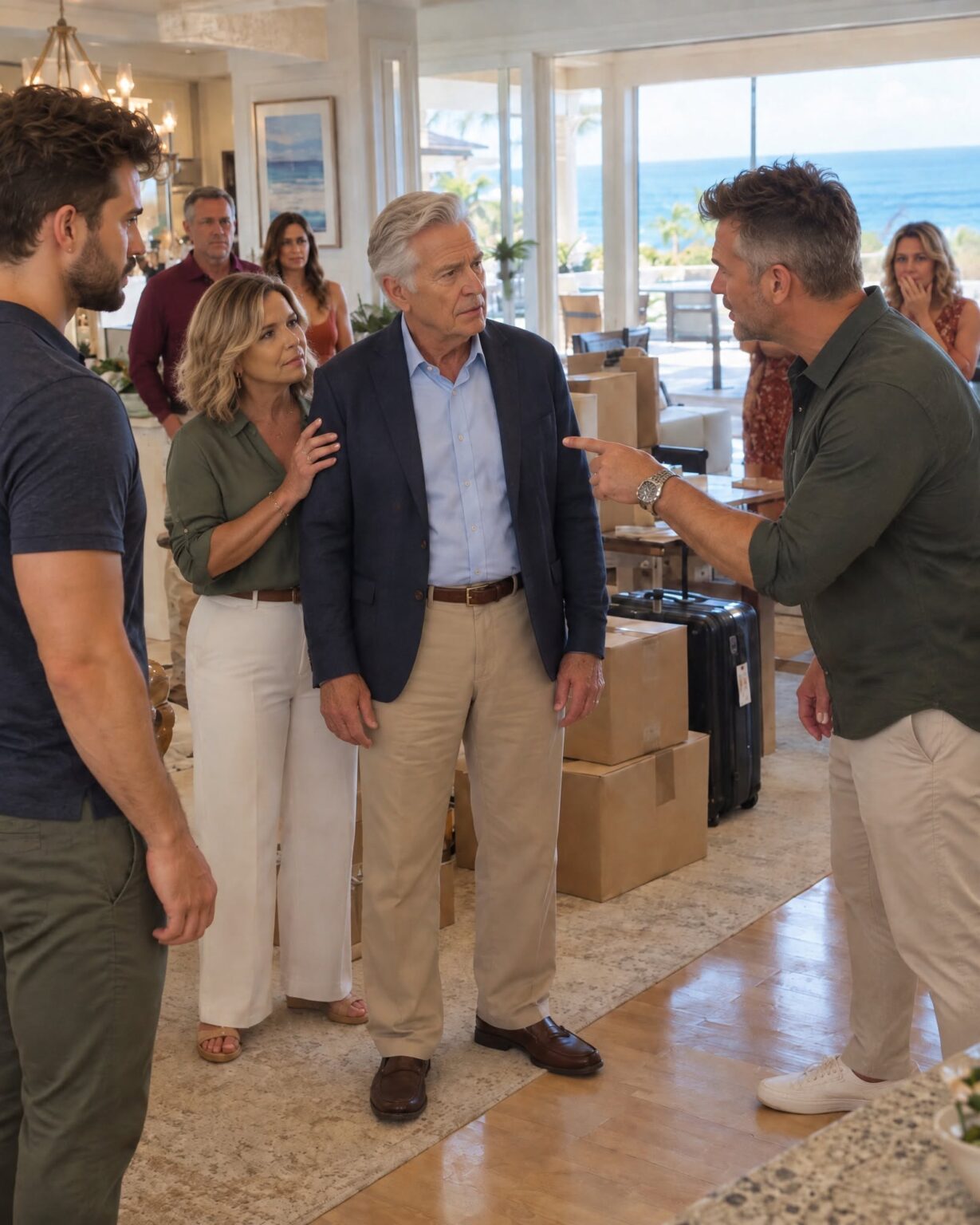
When I entered the beach house, Dad’s cane was on the floor.
A cardboard box sat beside him containing his clothes, medication, and a cracked family photograph.
Gregory stood in front of him.
“This is our house now,” he said.
“You and Irene need to leave.”
Fiona stood nearby.
She said our parents no longer needed so much space.
She and Gregory had already chosen an assisted-living facility.
Their plan was to use Mom and Dad’s savings to pay for it.
Then Gregory showed me the paperwork.
A deed.
A power of attorney.
Documents that would have given Fiona control over my parents’ finances, living arrangements, and medical decisions.
They only needed signatures.
Mom shook her head.
Dad looked exhausted.
I realized they had been pressured for days.
I asked Gregory whose house he thought he was standing in.
“Ours,” he said.
I walked to the writing desk, unlocked the bottom drawer, and removed the recorded deed.
I placed it on the table.
The owner’s name was mine.
Fiona went pale.
Gregory stopped speaking.
“I gave Mom and Dad the right to live here for the rest of their lives,” I said.
“Nobody can remove them.”
Then my attorney arrived.
She reviewed the documents.
The deed they wanted signed would have accomplished nothing because my parents did not own the property.
But the power of attorney was more serious.
So was the note attached to the senior-living paperwork:
Get Sam to sign tonight. Irene will follow.
My attorney asked Mom whether she had been pressured.
She began crying.
Gregory had taken her phone.
He had threatened to tell doctors Dad was incapable of caring for himself.
He warned that if they resisted, they might be separated.
Dad placed his trembling hand on Mom’s arm.
“Tell her, Reenie.”
So she did.
Owen had secretly returned her phone long enough for her to call me.
He had also sent the message himself.
When Gregory turned angrily toward his son, Owen stood up.
“I texted him.”
His hands shook.
“You were yelling at Grandpa.”
Gregory ordered him to sit down.
Owen said:
“No.”
A deputy eventually arrived.
Gregory was told to leave.
Adult Protective Services was notified.
Nobody shouted in triumph.
Nothing about the room felt victorious.
My parents had been frightened inside their own home.
That mattered more than proving anyone wrong.
Afterward, Fiona stayed.
She finally told me what had happened.
She and Gregory had lost their own house.
They were buried in debt.
They had been living in a motel.
She had become ashamed, jealous, and afraid.
When Gregory began suggesting that our parents should move, she knew something was wrong.
But she stayed silent.
“Why?” I asked.
She looked toward the ocean.
“Because if I challenged him, he would turn on me.”
“Did he hurt you?”
She was quiet.
“Never with his hands.”
That was enough.
“I’m sorry,” she whispered. “I don’t know who I became.”
I looked at her.
“Then decide who you become next.”
She said it was not that simple.
“It isn’t.”
I nodded toward the driveway.
“But tonight he told you to leave with him.”
She looked at me.
“And you said no.”
That was a beginning.
Later, I found Dad alone on the porch.
He looked ashamed.
“I almost signed.”
“But you didn’t.”
“For two weeks they pressured you. They frightened Mom. They took her phone.”
I took his trembling hand.
“And you still didn’t sign.”
He stared toward the water.
Then he told me something I will never forget.
Calling me had been his idea.
At seventy-five years old, it was the first time he could remember asking someone else to rescue him.
His father had taught him that a man should handle his own problems.
Never ask.
Never depend.
Then Gregory placed that cardboard box at his feet.
Dad realized that if he remained silent, he could lose his home and possibly his wife.
“So I asked,” he said.
“And you came.”
“I’ll always come.”
He nodded.
“I know that now.”
Then he asked me for a promise.
“When your turn comes… when you’re old, or frightened, or somebody has you backed into a corner… ask.”
His hand trembled in mine.
“Ask early.”
“Don’t wait until you’re standing beside a box.”
I promised.
A year later, Fiona had divorced Gregory.
She and the boys rebuilt slowly.
She went to counseling.
Dad eventually forgave her.
But he said something important:
“Forgiving someone doesn’t mean you stop paying attention.”
The family gathered again for Mom and Dad’s fifty-first anniversary.
No giant party.
Just us.
Fiona stood nervously at the bottom of the porch steps.
Dad waited above with his walker.
“Hi, Daddy.”
He lifted one trembling arm toward her.
She climbed the steps and hugged him.
“I’m sorry,” she kept saying.
“I know, Fee.”
He held her.
“I know.”
That evening, we stood on the porch with glasses of sparkling cider.
Dad raised his.
His hand shook enough that some spilled over the rim.
“To Lucas,” he said.
“Who gave us our someday.”
Then he looked at Fiona.
“And Fiona.”
She lowered her eyes.
“Who came back.”
Finally, he looked at Owen.
“And Owen.”
“Who said no first.”
Owen shrugged.
“It wasn’t that big a deal.”
Dad shook his head.
“It was.”
“You were sixteen. You knew something was wrong, and you spoke.”
He smiled faintly.
“Do you know how long it took me to learn that?”
Owen shook his head.
“Seventy-five years.”
Nobody needed another speech.
We watched the sun disappear over the Pacific.
People sometimes ask why I kept the beach house in my own name.
It was not because I distrusted my parents.
I trusted them completely.
I simply understood that kind, quiet people can become vulnerable when they would rather surrender something than create conflict.
Protection is not always control.
Sometimes it is simply making sure somebody else cannot exploit a moment of weakness.
Dad had spent his life teaching me without speeches.
He taught me by working.
Saving.
Repairing what broke.
Sacrificing without demanding repayment.
And eventually, he taught me something else.
Strength is not always standing alone.
Sometimes strength is recognizing the moment you no longer should.
I am forty-five now.
My hands do not shake.
Maybe one day they will.
Maybe they won’t.
But if the day comes when fear makes the room feel smaller and I need somebody beside me, I know what I will do.
I will ask.
Early.
Before I am standing beside a box.
I promised my father.
And I intend to keep it.