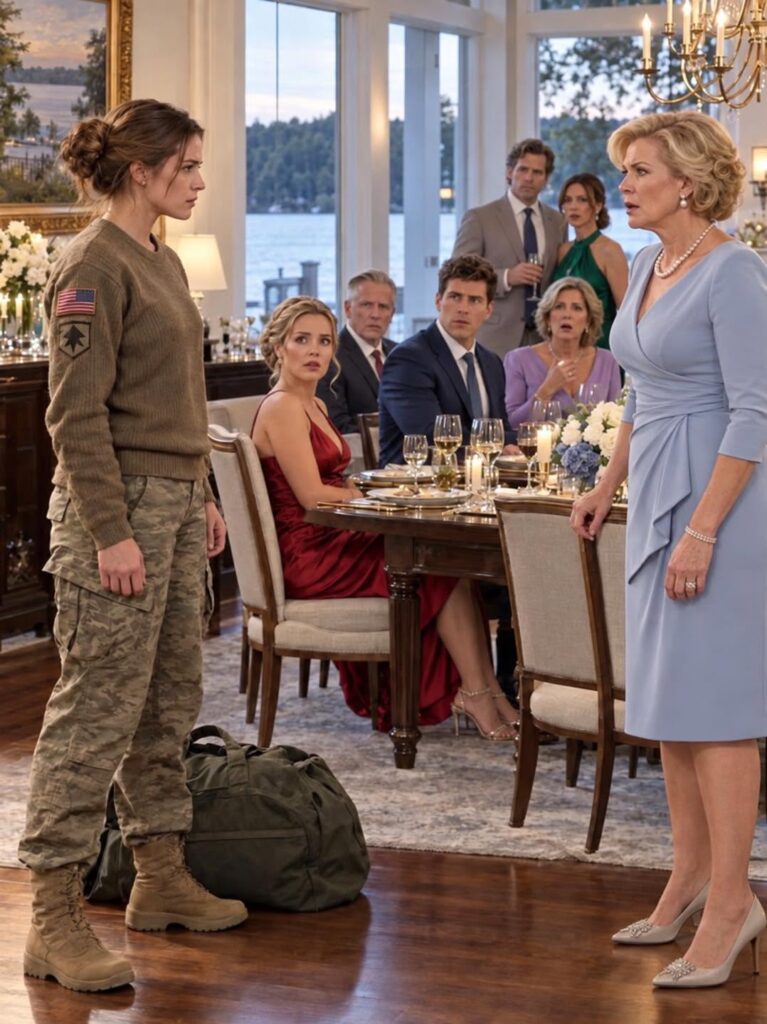
My sister Chloe said nothing.
Her husband Marcus laughed.
I stood there for a few seconds listening to people discuss me as though I were an uncomfortable footnote in my own family.
Then I walked into the room.
Silence came quickly.
Diane looked startled.
“Elena. We didn’t know you were here.”
“I know.”
I sat down.
That was all.
Arthur had adopted me when I was four.
He never called me his adopted daughter.
I was simply his daughter.
Diane had always made the distinction more carefully.
Different expectations.
Different forgiveness.
Different definitions of belonging.
When Chloe made mistakes, she needed support.
When I made them, they became evidence.
I had spent years believing that if I became capable enough, useful enough, accomplished enough, eventually the difference would disappear.
It never did.
The next morning, Diane asked me to sit down with Chloe and Marcus.
A thick folder waited on the kitchen island.
Marcus had a business problem.
They called it an opportunity.
The documents called it something else.
Nearly four million dollars in debt.
Missed payments.
Overvalued assets.
And a loan guarantee structured so that my ownership interest in Arthur’s company would take much of the damage if Marcus defaulted.
I read every page.
Then Diane said:
“Family supports one another.”
I looked up.
The word sounded different after the previous night.
Finally she said what she really meant.
“You owe this family, Elena. We took you in.”
The room went quiet.
“Arthur took me in,” I said.
She stared at me.
I picked up the pen.
Everyone relaxed.
Then I put it back down.
“No.”
One word.
Nothing more was needed.
Diane’s expression hardened.
“If you refuse to support us, perhaps we need to reconsider your place in this family.”
“Then put it in writing.”
I left.
Six days before Arthur died, he had given me an envelope.
I had never opened it.
His instructions were simple:
Open this if Diane ever asks you for money.
Inside was a note.
Go see Victor. Don’t tell Diane first. And don’t sign anything.
Victor had been Arthur’s lawyer for decades.
When I arrived at his office, he brought out several files.
“Your father was worried,” he said.
Arthur had spent years documenting financial irregularities involving Diane and Marcus.
Then Victor placed one final document in front of me.
Arthur had transferred the lake estate into an irrevocable trust.
The beneficiary was me.
I read the page twice.
“The house?”
“Yours.”
The estate was worth more than seventeen million dollars.
But what struck me was not the number.
It was the intention.
Arthur had seen enough to understand that one day I might need protection from the very people who claimed I owed them everything.
Then Victor told me something else.
Diane and Chloe had been collecting rental income from parts of the estate without legal authority.
Marcus had also begun presenting the property to investors as collateral for his struggling company.
He did not own it.
Neither did Diane.
Victor looked at me.
“Whatever happens next, don’t make it personal.”
I nodded.
That mattered.
I did not want revenge.
I wanted the truth established before somebody else’s desperation became my liability.
So we filed the necessary documents.
Ownership notices.
Audit requests.
Financial protections.
No threats.
No arguments.
Just records.
A few days later, Diane held a large gala at the lake house.
The same house she had recently told me I did not truly belong in.
Investors were there.
Business partners.
Friends.
People Marcus hoped would rescue his company.
I did not attend to humiliate anyone.
But false claims about the estate were being presented to people who were considering investing millions.
They needed accurate information.
Victor came with me.
When Diane saw us, her face tightened.
“You were not invited.”
“I understand.”
I handed the relevant documents to the attorneys and investors responsible for reviewing Marcus’s financing.
Within minutes, the mood changed.
Questions began.
Who owned the property?
Who had authorized its use as collateral?
Where had the rental income gone?
Marcus tried to explain.
Diane called it a misunderstanding.
But paperwork has little interest in social hierarchy.
The estate belonged to the trust.
The guarantees were unauthorized.
The financial problems were considerably worse than Marcus had disclosed.
One investor closed his folder.
Another began making calls.
The gala ended much earlier than planned.
I watched people leave.
I felt no satisfaction.
These were still people whose lives were beginning to collapse.
Some of that collapse was deserved consequence.
Some of it would inevitably touch people who had done nothing wrong.
There was nothing joyful about that.
Then Diane approached me.
For the first time, she did not look superior.
Only frightened.
“I did my best,” she said.
Part of me believed she meant it.
That was perhaps the saddest thing.
People can hurt others deeply while still believing they were reasonable.
Arthur had left another letter.
I read part of it later, privately.
He admitted something I had needed him to understand while he was alive:
He had spent too many years trying to keep peace instead of confronting what was wrong.
He loved me.
He had also waited too long to protect me openly.
Both things were true.
Learning to hold both truths mattered more than turning him into either a hero or a failure.
The financial investigations continued.
Marcus’s company collapsed.
Legal consequences followed.
Diane and Chloe eventually had to leave the estate.
I did not stand in the driveway celebrating.
When Diane asked quietly where she was supposed to go, I felt something unexpected.
Sadness.
Not enough to reverse the boundary.
But enough to remind me that another person’s wrongdoing does not require me to enjoy their suffering.
“You’ll need to work that out,” I said.
She nodded.
Then she left.
The house became quiet.
At first, the quiet felt strange.
I had spent so much of my life measuring moods, anticipating criticism, fixing problems, and proving that I deserved my place that peace almost felt suspicious.
Then, slowly, it began to feel like home.
Months later, I used part of the estate to create the Arthur Wright Foundation for veterans transitioning back into civilian life.
The guest wing became simple housing.
Clean rooms.
Good food.
Privacy.
A place to breathe.
The first group arrived carrying duffel bags and the particular exhaustion of people who had learned to remain alert long after danger had passed.
I recognized it.
One veteran apologized repeatedly for sleeping fourteen hours.
“You were tired,” I told her.
Another began repairing loose boards on the dock because he could not sleep.
Nobody asked him to stop.
People healed in different ways.
Watching them taught me something about my own life.
For years, I thought strength meant enduring.
Then I thought strength meant finally saying no.
Both were incomplete.
Real strength was knowing what deserved endurance and what required departure.
It was protecting yourself without becoming cruel.
Telling the truth without needing an audience to applaud.
Allowing consequences without turning them into entertainment.
And using what remained after pain to build something useful.
I still thought about Diane sometimes.
I no longer hated her.
That did not mean pretending she had treated me well.
Forgiveness did not require reopening every door.
Compassion did not require surrendering boundaries.
And understanding somebody’s wounds did not obligate me to become the place where they continued inflicting them.
Arthur used to tell me while we fished:
“Strong foundations don’t make much noise.”
I understand that now.
The greatest change in my life was not inheriting the house.
It was not watching Marcus’s lies collapse.
It was not finally proving that I belonged.
It was realizing I no longer needed permission from people who had spent years making belonging conditional.
I had confused being needed with being loved.
I had confused endurance with peace.
And I had spent far too long trying to earn dignity that was never theirs to grant.
Now, early in the morning, I sometimes stand on the back porch with coffee while the lake is still.
Lights glow from the rooms where veterans are rebuilding their lives.
There are no galas.
No performances.
No arguments about who belongs.
Just people learning how to become steady again.
Including me.
Peace did not arrive when everyone finally understood me.
It arrived when I stopped requiring them to.