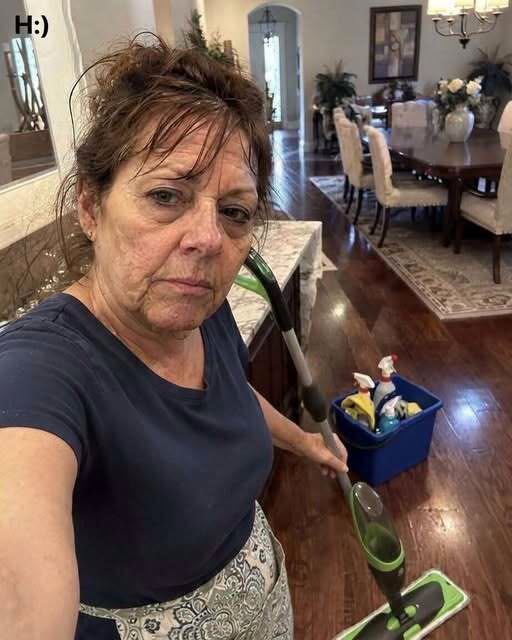
She knew which floorboard near the hallway creaked.
She knew Mrs. Whitaker liked the kitchen counters completely clear.
She knew which vase had belonged to George’s mother and therefore had to be handled with both hands.
She knew which windows collected dust fastest and which guest room almost never needed more than a quick touch-up.
After eight years, there were very few surprises left in that house.
And Carly preferred it that way.
She liked Mrs. Whitaker. She genuinely did.
But Carly had always been careful about one thing: boundaries.
Mrs. Whitaker was her client.
Carly was there to clean.
They talked, of course. Sometimes for ten minutes, sometimes longer if Mrs. Whitaker happened to be in a particularly chatty mood.
They discussed the weather.
Family.
Television.
Groceries.
Neighbors.
Sometimes George came up.
After his death, Carly noticed that Mrs. Whitaker mentioned him more often, usually in small ways.
“George always hated when I moved that chair.”
Or, “George would have laughed at this.”
Carly listened.
She responded kindly.
Then she returned to work.
She never wanted to mistake friendliness for friendship and accidentally make Mrs. Whitaker uncomfortable.
So when Mrs. Whitaker announced that she was selling the house and moving closer to her daughter, Carly assumed she understood exactly what would happen next.
Their Thursdays would end.
That was all.
On Carly’s final cleaning day, she worked a little more slowly than usual.
She polished the dining table, wiped the kitchen cabinets, vacuumed the stairs, and made sure everything looked especially nice.
When she finished, Mrs. Whitaker handed her the usual payment.
Then, just as Carly was preparing to leave, she said something unexpected.
“Could you come back Saturday?”
Carly paused.
“Saturday?”
“Yes. But don’t bring your cleaning things.”
That immediately caught her attention.
Mrs. Whitaker smiled but refused to explain further.
“Just come around eleven.”
Carly spent the next two days wondering what she wanted.
By Saturday morning, Carly had convinced herself that Mrs. Whitaker probably planned to give away some furniture or household belongings before the move.
So she cleaned out the trunk of her car.
Then she emptied the back seat too, just in case.
On the way over, she even stopped at a bakery and bought cookies.
When Mrs. Whitaker opened the door, Carly held up the box.
“I brought provisions.”
Mrs. Whitaker laughed.
“You always were prepared.”
Carly glanced toward the living room.
“So… what are we moving?”
“Nothing.”
Carly looked at her.
Mrs. Whitaker smiled mysteriously.
“Come sit down.”
On the coffee table was an old cardboard box.
It was worn at the corners and filled with photographs, envelopes, greeting cards, and folded letters.
Carly sat beside her.
Mrs. Whitaker lifted the lid.
“I wanted to show you something before I leave.”
She began pulling out photographs.
There was one of George standing beside a fishing boat.
Another showed Mrs. Whitaker and her daughter at Christmas.
There were birthday cards, anniversary cards, handwritten notes, and old photographs from years ago.
Then Carly noticed something strange.
Her own name.
She picked up a card.
Near the bottom, in Mrs. Whitaker’s handwriting, were the words:
“Carly came today. We talked for almost an hour.”
Carly frowned slightly.
Then she found another.
“Thursday tomorrow. Carly will be here.”
Another note mentioned something Carly had said about her nephew.
Another mentioned cookies Carly had once brought after George died.
Another described how Carly had stayed an extra fifteen minutes one afternoon because Mrs. Whitaker seemed unusually quiet.
Carly looked up.
“You wrote about me?”
Mrs. Whitaker gave a small shrug.
“Apparently quite a lot.”
Carly laughed uncertainly.
But then Mrs. Whitaker pulled out a Christmas card from her daughter.
Written inside was a sentence that made Carly pause.
“Tell Carly I said hello.”
Carly stared at the words.
“Your daughter knows who I am?”
Mrs. Whitaker smiled.
“Oh, certainly.”
“She knows my name?”
“She knows Thursday is Carly day.”
For a second, Carly did not know what to say.
Mrs. Whitaker looked down at the photographs.
“After George died, Thursdays became very important to me.”
Her voice had changed.
It was softer now.
“Most days were quiet. Too quiet.”
Carly felt something tighten in her chest.
Mrs. Whitaker continued.
“But on Thursdays, I knew someone was coming.”
Carly looked away for a moment.
She had never thought about it like that.
To her, Thursday had been work.
A familiar house.
A reliable client.
A routine.
But to Mrs. Whitaker, Thursday had apparently been something entirely different.
“You talked to me,” Mrs. Whitaker said. “You listened when I complained about silly things. You remembered when my doctor appointments were. You asked about George even after everyone else seemed afraid to mention his name.”
Carly swallowed.
“I thought I was just talking while I worked.”
“I know.”
Mrs. Whitaker smiled.
“That’s probably why it meant so much.”
For a moment, neither woman spoke.
Then Mrs. Whitaker added quickly, “But I need to tell you something else.”
Carly waited.
“I know my loneliness was never your responsibility.”
Carly immediately shook her head.
“That’s not what I was thinking.”
“I know. But I want to say it anyway.”
Mrs. Whitaker folded her hands together.
“You were working. You were kind to me, but you were working. I never wanted you to feel that you had to stay longer or become responsible for keeping an old woman company.”
Carly stared at her.
Then she laughed softly.
“What?”
“I was doing the same thing.”
Mrs. Whitaker looked confused.
Carly explained.
“All these years, I’ve been careful not to get too personal because I thought you might think I was crossing a line.”
Mrs. Whitaker blinked.
“Crossing a line?”
“Yes. You were my client. I didn’t want you to feel like I was forcing friendship on you just because I was in your house every week.”
Mrs. Whitaker stared at her for two seconds.
Then she began laughing.
Carly joined her.
For eight years, both women had been carefully protecting the exact same boundary.
Mrs. Whitaker had worried about asking too much.
Carly had worried about offering too much.
And somehow, neither of them had realized it.
When the laughter faded, Mrs. Whitaker became serious again.
“I am looking forward to moving.”
“I know.”
“My daughter has already planned everything. Apparently I’m going to become one of those mothers who gets dragged to farmers markets every Saturday.”
“That sounds dangerous.”
“Extremely.”
Carly smiled.
But Mrs. Whitaker’s expression changed.
“I’m excited.”
Then she hesitated.
“I’m also afraid.”
“Of what?”
“Losing everything familiar.”
Carly understood immediately.
The house.
The neighborhood.
The grocery store.
The routines.
Thursday.
Mrs. Whitaker looked at her.
“So I wanted to ask you something.”
Carly waited.
“Would you call me sometimes?”
The question was so simple that Carly almost laughed.
Instead, she felt her eyes suddenly sting.
Mrs. Whitaker quickly added, “Not because you have to.”
“I know.”
“And not every week.”
“I know.”
“And certainly not because I’m lonely.”
Carly smiled.
“Mrs. Whitaker.”
“Yes?”
“I cleared out my entire car before coming here.”
Mrs. Whitaker blinked.
“What?”
“The trunk. The back seat. Everything.”
“Why?”
“Because I thought you were giving me furniture.”
For one second, Mrs. Whitaker simply stared.
Then she burst out laughing.
“You thought I called you over here to unload my old furniture?”
“Yes!”
“I have terrible furniture!”
“I know, but I was trying to be polite.”
Mrs. Whitaker laughed so hard she had to wipe tears from her eyes.
Carly was laughing too.
Eventually, she looked down at the box between them.
“So instead of furniture, you’re giving me… friendship?”
Mrs. Whitaker smiled.
“If you want it.”
Carly’s answer came immediately.
“I do.”
And she realized, somewhat surprisingly, that she meant it.
Not because she felt sorry for Mrs. Whitaker.
Not because she felt obligated after eight years of employment.
But because she liked her.
Without the vacuum cleaner running.
Without invoices.
Without cleaning schedules.
Without wondering whether every conversation needed to end because there was another room to finish.
For the first time, Carly allowed herself to see the relationship outside of work.
Before she left that afternoon, she walked to the small hook near the kitchen and removed the house key she had carried for eight years.
She placed it gently on the table.
Mrs. Whitaker looked at it.
“Well,” she said, “I suppose that makes it official.”
Carly nodded.
“No more Thursday cleaning.”
“No more Thursday cleaning.”
Carly found a scrap of paper and wrote down her personal phone number.
Not her business number.
Her real one.
She handed it to Mrs. Whitaker.
“This one is different.”
Mrs. Whitaker looked at the paper.
“What’s the rule?”
Carly smiled.
“You call this number when you don’t need your house cleaned.”
Mrs. Whitaker’s eyes immediately filled with tears.
“Oh, Carly.”
“Don’t start.”
“I’m not starting anything.”
“You absolutely are.”
Mrs. Whitaker stood and hugged her.
It was the first time they had ever hugged.
For eight years, Carly had come through that door as the woman who cleaned the house every Thursday.
That afternoon, she walked out without a key, without cleaning supplies, and without another appointment on the calendar.
But somehow, she left with something much more meaningful.
For eight years, they had been employer and employee, both carefully keeping their distance because neither wanted to overstep.
Now the house was being sold.
The cleaning arrangement was over.
And for the first time, there was no professional boundary left to protect.
They were finally free to become friends.