She was a sweet kid, Emma enjoyed the company, and the school was already on my route.
Helping people had always come naturally to me.
When another parent broke her ankle, I handled pickups for weeks. I drove forgotten lunches back to school. I waited for late children without making a fuss.
I never kept score.
One afternoon, Emma asked:
“Why doesn’t Sophie’s mom ever drive us?”
“Because we help people when we can.”
Emma frowned.
“But you always help. Who helps you?”
I laughed it off.
At the time, I thought I was teaching generosity.
I didn’t realize I was also teaching her that generosity had no boundary.
Then Vanessa bought a new white SUV.
Cream leather seats.
Perfect interior.
She was obsessed with keeping it spotless.
We joked about it.
Then one Thursday morning, heavy rain came down.
I went outside to start my fourteen-year-old Honda.
Nothing.
The battery was dead.
School started in twenty-five minutes.
I called Vanessa.
“My car won’t start. Could Emma ride with you and Sophie today?”
There was a pause.
“Fine. Have her ready.”
Relief washed over me.
Vanessa pulled up a few minutes later.
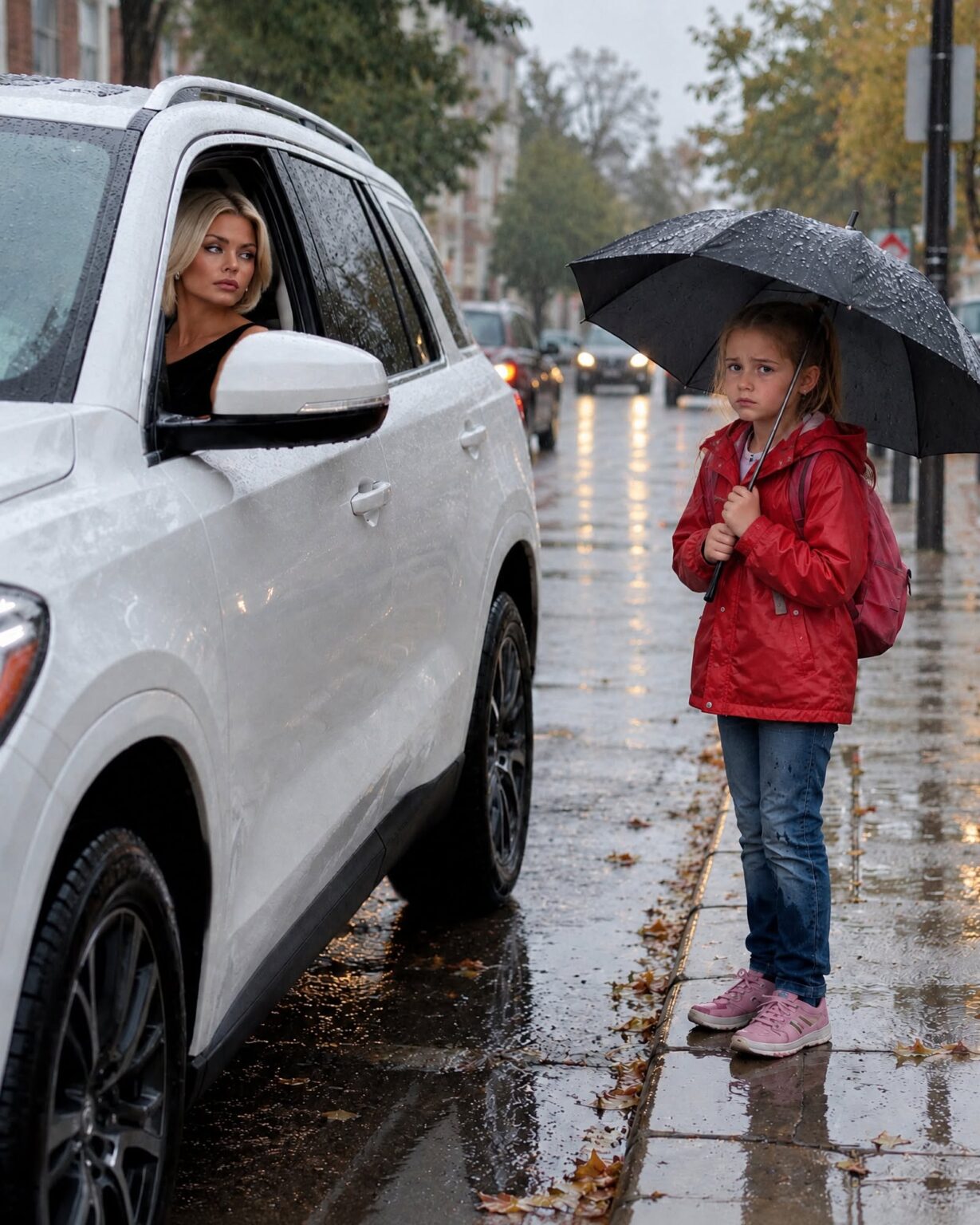
Emma ran toward the SUV under an umbrella, but one sneaker landed in a puddle.
Vanessa lowered the window.
She looked at Emma’s wet shoes.
Then at her cream seats.
“No.”
I thought I had misheard her.
“She’s soaked,” Vanessa said. “I just bought this car.”
I walked closer.
“Vanessa, I’ve driven Sophie every school morning for two years. I’m asking for one ride.”
She sighed.
“Sarah, don’t make this dramatic. I didn’t spend this much money on a car just to have somebody’s kid ruin the interior.”
Emma quietly moved one foot behind the other.
“Mom, it’s okay.”
That hurt more than anything Vanessa had said.
My daughter was trying to make herself smaller because her shoes were wet.
I put my hand on her shoulder.
“Come inside.”
Vanessa drove away.
Inside, Emma removed her shoes.
“I’m sorry. If I hadn’t stepped in the puddle—”
“No.”
I crouched beside her.
“You did nothing wrong.”
Her phone buzzed.
A message from Sophie.
I’m sorry. I told Mom you could sit on my jacket. She said no.
I stared at it.
Sophie had understood the situation better than the adult driving the car.
I ordered a rideshare and got Emma to school late.
That evening, while I was looking through car repair estimates, Vanessa messaged me.
Car fixed? Sophie needs picking up tomorrow. Pilates.
No apology.
No question about Emma.
No concern about whether my car was even repairable.
Just the assumption that the morning routine would continue.
I set the phone down.
For the first time in two years, I didn’t answer.
The next morning, Vanessa knocked on my door.
“Sophie is waiting.”
“I’m not driving today.”
She blinked.
“What?”
“The daily rides are finished.”
Her expression hardened.
“You’re punishing Sophie because you’re angry with me?”
“No.”
I kept my voice calm.
“Sophie did nothing wrong. I care about her.”
“Then why won’t you take her?”
“Because getting Sophie to school is your responsibility.”
Vanessa stared at me as if I had changed the rules.
Maybe I had.
Or maybe I had finally noticed what the rules had become.
“I have Pilates on Tuesdays,” she said. “Thursdays I have an early call. I can’t suddenly rearrange everything.”
For half a second, my mind automatically began solving the problem for her.
Maybe Mondays.
Maybe Wednesdays.
Maybe—
Then I stopped.
“For two years, I did you a favor.”
She crossed her arms.
“And?”
“Somewhere along the way, you stopped seeing it as one.”
She said nothing.
“My kindness did not become your entitlement just because I gave it consistently.”
That landed.
Not pleasantly.
But clearly.
I added:
“If Sophie genuinely needs help someday, she can call me. I won’t punish a child for an adult’s decision.”
Vanessa looked away.
“But the automatic rides are over.”
She left angry.
I closed the door and stood there for several seconds.
I didn’t feel triumphant.
I felt uncomfortable.
Boundaries often do when you have spent years avoiding them.
Later that morning, another parent called.
Emma had apparently told her friends why she had arrived late the day before.
The story had spread.
I immediately worried about Sophie.
“I don’t want people attacking Vanessa,” I said.
“They’re not,” Rachel replied. “But people are upset.”
She paused.
“You drove my boys every day for almost three weeks when I broke my ankle.”
“That was different.”
“No. It wasn’t.”
Another father offered Emma rides until my Honda was repaired.
Someone else knew a trustworthy mechanic.
Rachel offered to help with the battery.
I resisted.
“I can handle it.”
She laughed softly.
“Sarah, that is exactly what everyone says before you help them.”
I went quiet.
Then I remembered Emma’s question.
Who helps you?
Perhaps the answer had never been “nobody.”
Perhaps I had simply become so accustomed to being useful that I had forgotten how to receive.
Two days later, my Honda was running again.
Not because I demanded repayment.
Not because I listed everything I had done for everyone else.
People simply helped because they wanted to.
That mattered.
So did what happened with Vanessa.
I still believed in generosity.
I still believed a decent life required giving more than was strictly required.
But generosity loses something when it is demanded.
And kindness becomes unhealthy when one person must always provide it while everyone else simply expects it.
I did not regret those two years of driving Sophie.
She was a child.
She had done nothing wrong.
I was glad I had helped her.
What I regretted was allowing a favor to continue so long without noticing that gratitude had quietly been replaced by expectation.
Kindness should be given freely.
And when it is given freely, it should never become a debt the giver is forced to keep paying.
Sometimes saying no does not mean the kindness has ended.
It simply means responsibility has returned to the right person.