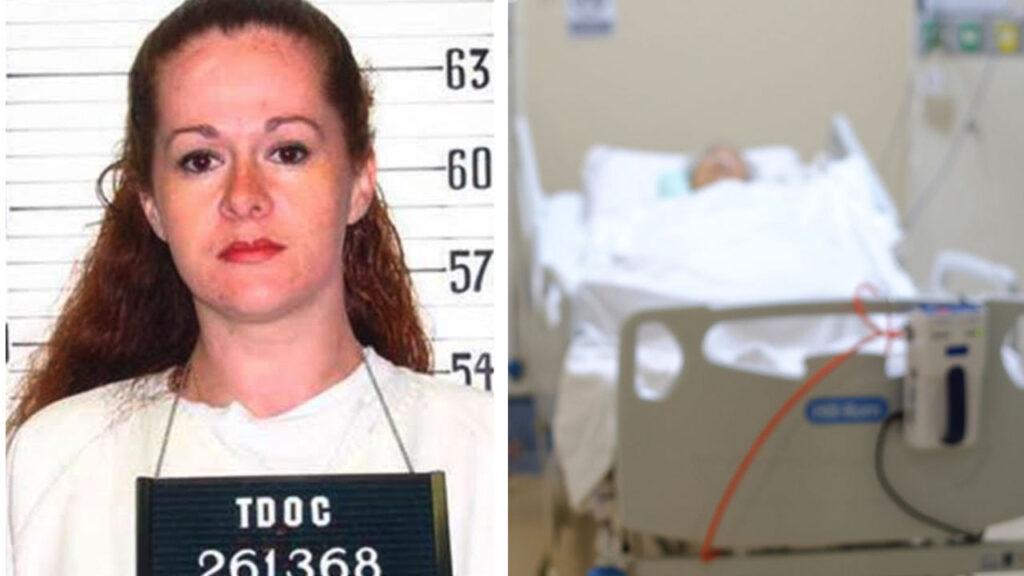
The procedure went badly wrong.
According to her attorneys, execution staff spent about an hour trying to establish intravenous access, using at least seven needles in the process. Pike was then given two doses of pentobarbital, the drug Tennessee uses for lethal injection, but she did not die.
Instead, she was transported to a Nashville-area hospital, where her lawyers say she has remained critically ill, unconscious, intubated and dependent on a ventilator.
News of her condition quickly triggered confusion on social media.
Some users questioned why doctors could not simply remove the ventilator and allow the original death sentence to be completed.
One person wrote:
<blockquote>“The fact a death row inmate had a botched execution and is on LIFE SUPPORT is crazy. Just pull the plug and the job is done, no?”</blockquote>
Others immediately pointed out the problem with that idea.
One reply said:
<blockquote>“If the hospital pull the plug they then become the executioner rather than the court and jail carrying out the execution.”</blockquote>
The commenter added:
<blockquote>“I think this along with the doctors oath of supporting life is the reason it won’t happen.”</blockquote>
Another person wrote:
<blockquote>“I think they can only legally end her life in the actual execution process, once that’s over they can’t just unplug her afterwards. I’m sure there’s laws about it.”</blockquote>
That distinction is important.
Once Pike was removed from the execution chamber and transferred to a hospital, doctors were no longer participating in an execution. They were treating a critically ill patient.
Hospital staff are governed by ordinary medical law and ethics. A valid death sentence does not automatically give doctors permission to intentionally end a prisoner’s life outside the legally authorized execution procedure.
Decisions involving ventilators and other forms of life-sustaining treatment are normally governed by medical judgment, the patient’s wishes or advance directives when known, authorized surrogate decision-makers, and applicable state law.
A death warrant is not itself a hospital order to withdraw treatment.
That means Pike’s status as a death-row prisoner does not erase the protections and medical standards that would ordinarily apply to another patient.
Her lawyers say hospital staff have been attempting to save her life and clear the pentobarbital from her system.
The hospital is therefore not simply continuing an execution that failed inside the prison.
The execution process stopped.
What happens medically afterward is a separate matter.
Pike’s attorneys have also revealed more about what they believe went wrong inside Riverbend.
In a court filing, they argued that the execution team failed to properly establish IV access and that the pentobarbital entered surrounding tissue instead of flowing correctly through Pike’s bloodstream.
They wrote:
<blockquote>“Apparently at no point did any member of the execution team realize that the IV lines were not correctly placed or that the veins had blown and that the pentobarbital was, in whole or in part, entering Ms. Pike’s body.”</blockquote>
According to the filing, the execution team then administered the backup dose rather than correcting the IV problem.
Pike’s attorneys say her arms were later found to be swollen, burned and blistered when she arrived at the hospital.
Attorney Randy Spivey said he counted at least seven needle attempts during the procedure.
One needle was reportedly bent at a 90-degree angle when it was removed, according to the court filing.
Witnesses also reported hearing Pike breathing loudly and making snoring sounds after the drugs had been administered.
Her attorneys say those sounds continued until officials eventually cut the audio feed from the execution chamber.
The state has not yet publicly established exactly why the execution failed.
However, medical experts have said that if pentobarbital leaks outside a vein and into surrounding tissue, it can cause severe chemical injuries while also preventing enough of the drug from entering the circulation to produce its intended effect.
That remains one possible explanation under investigation rather than a final official finding.
Pike’s attorney Luke Ihnen has asked the public to respect her privacy while she remains hospitalized.
<blockquote>“We are working closely with those closest to Christa to respect her wishes, safeguard her privacy and protect her rights as a patient during this extraordinarily difficult time.”</blockquote>
He added:
<blockquote>“We ask that the public and media respect that privacy as well.”</blockquote>
Her legal team has also asked a court to order Tennessee officials to preserve evidence connected to the failed execution, including records and materials that could become important in future litigation.
For now, Pike remains under a death sentence.
But that does not mean Tennessee can simply order hospital doctors to stop treating her.
Any future attempt to execute her would require the state to return to the legal execution process and would almost certainly face new constitutional challenges based on what happened during the first attempt.
Gov. Bill Lee has already halted Tennessee’s remaining executions for 2026 and ordered an independent review of the state’s procedures.
Pike’s case is also the second major execution failure Tennessee has experienced this year, adding further pressure on officials to determine what went wrong before another death sentence is carried out.
So while the question circulating online may sound straightforward, the answer is not.
Doctors treating Pike are not executioners.
They are responsible for caring for a critically ill patient.
The state may still have a legal death sentence against her, but carrying out that sentence and making medical decisions about life support are two entirely different processes.
And after what happened inside Riverbend, both the medical and legal questions surrounding Christa Pike are likely to become even more complicated before Tennessee can decide what happens next.