Inside, beneath his textbooks, she found six small velvet pouches, each tied shut and labeled with a different name in Alan’s careful handwriting. What she discovered inside those pouches would explain every muddy shoe, every exhausted morning, and every secret her grandson had been keeping.
A Backpack That Wouldn’t Leave His Side
Evelyn had raised Alan since the night his mother, Melissa, walked out when he was five. Melissa, then twenty-six, had told Evelyn she was tired of a life built around “a little moocher who can’t even tie his own shoes.” Alan, barefoot in the hallway, heard every word. His mother saw him standing there. She left anyway.
For the next eight years, Evelyn packed his lunches, checked his homework, and made sure he never felt like a burden. Alan grew into a quiet, thoughtful boy who never asked for anything—not toys, not new shoes, not help with a field trip fee. He had decided, long ago, that needing things was dangerous.
When Alan was twelve, he befriended an elderly neighbor named Gene Pruitt, a retired mailman who taught him to use a metal detector. Gene told him lost things belong to whoever misses them, and that the ground is full of items just waiting to be brought home. When Gene moved away to assisted living, he gave Alan the detector. He died a few months later.
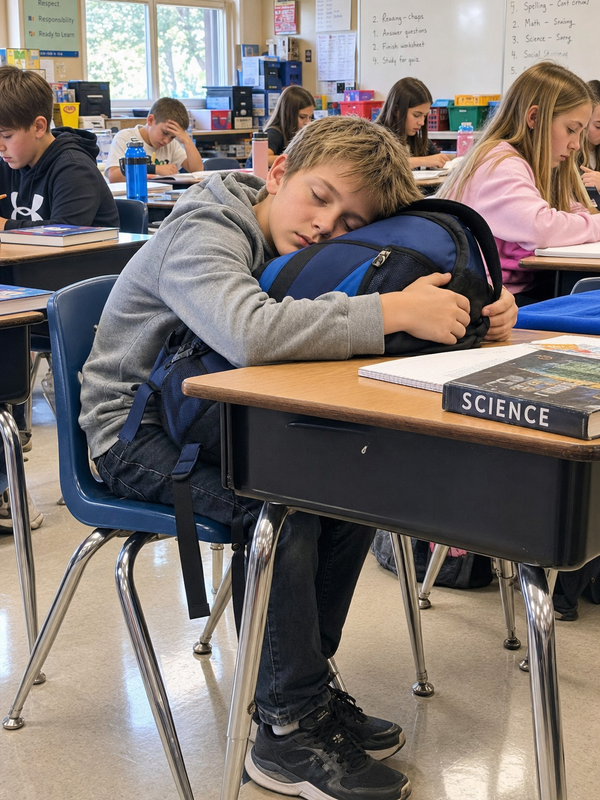
Six weeks before his teacher’s call, Alan began sneaking out before dawn. He came home with muddy sneakers despite a paved walk to school, fell asleep over his homework, and guarded his backpack so fiercely he once knocked over a glass of milk rather than let Evelyn move it. His teacher, Ms. Abernathy, worried he might be caught up with older kids using him for something he shouldn’t be doing.
What the Grandmother Found Inside
The morning Alan overslept and left his backpack behind, Evelyn opened it. Past his textbooks, she found six drawstring pouches labeled ELLIE, JAMES, R.D., LILY, GRANDMA, and MOM. Inside the one marked ELLIE was a woman’s wedding ring. Inside JAMES, a tarnished military dog tag. Inside R.D., a high school class ring. Inside LILY, a child’s silver bracelet.
Then she opened the pouch marked GRANDMA. A plain gold band fell into her palm—scratched, worn, engraved with three words: Always, Frank. Evie. It was her own wedding ring, lost at Lake Merriam on a Fourth of July twelve years earlier, after her husband Frank had died of pancreatic cancer.
Alan found her sitting in shock and confessed everything. For six weeks, he had ridden his bike to the lake before dawn, sweeping the beach with Gene’s detector, following his mentor’s belief that lost things are only borrowed until someone brings them home. He had been searching for his grandmother’s ring as a birthday surprise—and found it, along with four other items belonging to strangers.
Bringing Lost Things Home
Alan had already begun tracing the owners. The dog tag belonged to James R. Whitley, a local soldier who died in Vietnam in 1969; Alan and Evelyn delivered it to his sister, Margaret, who had waited fifty-seven years. The wedding ring belonged to Ellie Bishop, who had lost it swimming in 1965; they found her at Maple Grove Nursing Home, where she slid it back on her finger and whispered, “Hello, Tom.”
With help from Ms. Abernathy, they identified the class ring’s owner as Ronald “Ronnie” Dale, now living in Florida, who had lost it decades earlier while teasing his girlfriend, Susan—now his wife of forty-eight years. They mailed it back, and Ronnie sent a photo of the two of them, finally at peace.
The silver bracelet took longest to place. A Facebook post eventually connected it to a woman named Diane Foster, whose daughter Lily had lost it at the lake as a four-year-old. Lily, now twenty-one and in nursing school, received it by mail and sent a tearful video thanking the boy she’d never met.
A Mother’s Reckoning
One pouch remained: MOM. Inside was a gold locket, dented and scratched, its chain broken. Evelyn recognized it instantly—a gift she’d given Melissa years before, later filled with a newborn photo of baby Alan. Alan revealed he had watched his mother throw it from her car window into the creek at Riverside Park the night she left, and had spent days searching the gravel until he found it.
Evelyn called Melissa, now thirty-four and living in Arizona. Weeks later, Melissa arrived unannounced. Alan walked down the porch steps and handed her the pouch without ceremony. When she opened it and saw the locket, she went pale with recognition.
She admitted she had thrown it away that rainy night because keeping it would have meant she could never leave. Alan told her he didn’t want it back—it was hers, even if she’d discarded it once. Then he added quietly, “I’m not a moocher. I’ve been trying really hard not to be one my whole life. But I found out this summer that it’s okay to take things. As long as you bring them home.”
Melissa stayed three more days, sitting on the porch, not pushing. On her last afternoon, Alan showed her how to use the metal detector at the same creek where she’d once thrown the locket. She laughed holding up a bottle cap like treasure. Since returning to Arizona, she calls every Sunday and has taken up metal detecting herself, vowing to track down the owner of a man’s wedding ring she recently found in the desert.
One Year Later
Alan is fourteen now. He still rises before dawn to sweep Lake Merriam’s shore, and with Ms. Abernathy’s help he runs a website called Borrowed and Brought Home, where strangers from across the state write in asking him to watch for lost things bearing their families’ names.
Frank’s ring now hangs on a chain around Evelyn’s neck, and she no longer looks at her bare hand with sorrow. Recently Alan found a small silver rabbit charm in the sand—unengraved, unclaimed, belonging to no one. Unlike the others, he kept it, reasoning that some lost things without a name were meant to find him instead.
Walking home one morning, he told his grandmother he finally understood what his mother’s old insult had never meant. Needing someone wasn’t the problem, he said—it was what you did with what you were given. “I need you, Grandma,” he told her. “I’m going to keep needing you. And I’m going to keep bringing things home.”