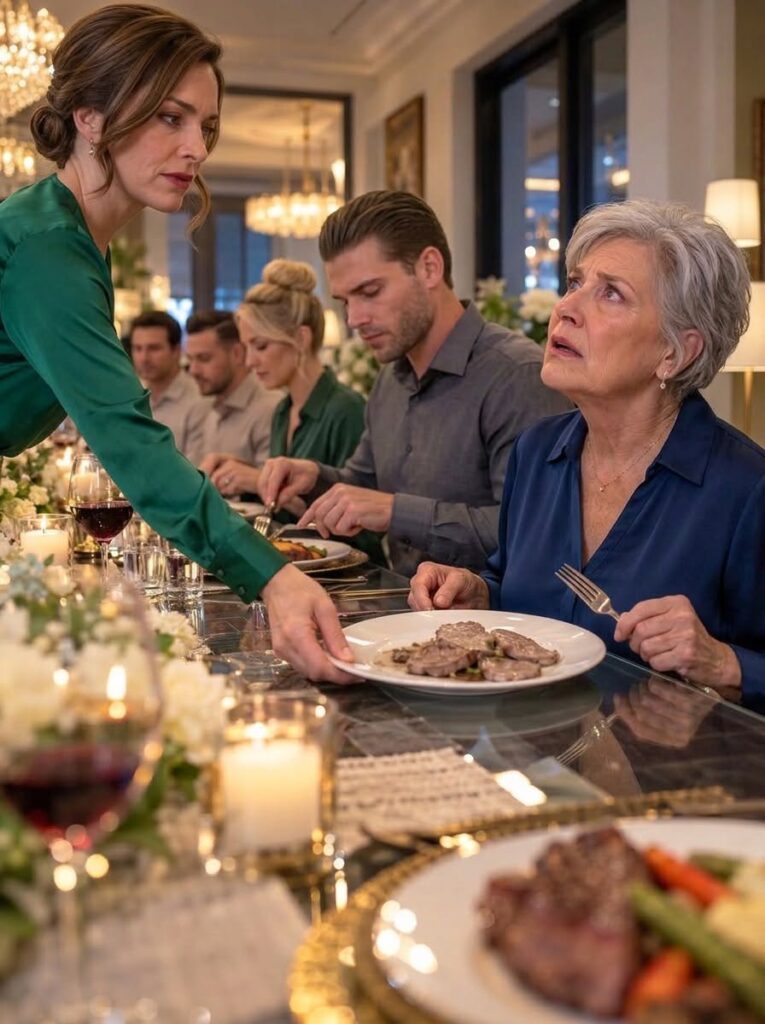
One thin, gray slice of meat.
Cold.
There was no napkin at my place.
I said nothing.
Daniel talked about renovations, school plans for the children, and a possible trip to Napa.
I knew exactly what some of those things cost.
I paid the grandchildren’s tuition.
I had helped buy their car.
Years earlier, I had provided the down payment for the house we were sitting in.
After my husband Charles died, helping Daniel had become almost automatic.
A missed bill?
I paid it.
A business failed?
I covered the gap.
A new emergency?
I transferred money.
At first, the help had been necessary.
Somewhere along the way, necessity had quietly become expectation.
When dinner ended, Daniel barely looked up from his phone.
“Drive safe, Mom.”
I sat in my car for a moment before leaving.
Then I drove home.
I had spent most of my career as a financial controller.
At work, every unexplained number required an answer.
With my son, I had somehow stopped asking questions.
That night, I opened the binder where I kept years of statements and receipts.
Mortgage payments.
Tuition.
Insurance.
Transfers.
Near the back was something I had tried not to think about.
An email.
Daniel had been asking how one of my investment accounts might be converted into something he could access jointly.
He had never asked me.
I had printed the email two weeks earlier and put it away, hoping there was an innocent explanation.
After dinner, I could no longer ignore it.
Before sunrise, I got dressed and drove to the bank.
I asked for Sophia, a senior banker I had met before.
She reviewed everything carefully.
I asked her to stop the automatic payments I had authorized for Daniel’s household, freeze shared cards, and secure my investment accounts.
Halfway through, she paused.
“Helen, did you try to access this account early this morning?”
“No.”
She turned the screen toward me.
5:42 a.m.
Someone had attempted a withdrawal from my investment portfolio.
A large one.
The bank had blocked it.
Sophia could not tell me who had submitted the request.
That mattered.
I had questions.
I did not yet have proof.
“Lock everything down,” I said.
She did.
The calls began before my tea was ready.
Daniel’s card had been declined during lunch.
Madison’s had failed at a spa.
Both demanded that I fix the problem.
Neither asked whether I was all right.
Then my granddaughter Lily messaged.
Grandma, are you okay?
I sat down before answering.
She was the first person to ask.
“I’m fine,” I told her. “Are you?”
Later that afternoon, Daniel and Madison arrived at my house.
They knocked.
Then knocked again.
I did not open the door.
For years, every urgent knock had meant another expense.
This time, they could wait.
The next morning, I visited my lawyer.
I reviewed my will, my accounts, and the protections around my home.
Then he told me something else.
Daniel had previously asked his office about power of attorney arrangements for me.
Nothing had been granted.
But once again, he had been asking about control over my affairs without speaking to me first.
I was seventy-three.
I drove myself across Los Angeles.
I managed my own finances.
I was not absent from my own life.
Daniel and Madison were waiting at my house when I returned.
This time, I let them inside.
Daniel started immediately.
The mortgage payment had failed.
School tuition was due.
Insurance needed to be paid.
“We can’t run a household like this,” he said.
I looked at him.
“That is precisely the problem.”
Madison stared at me.
“What does that mean?”
“It means you built a household budget around money that belongs to someone else.”
Daniel’s anger softened.
“Mom, we’re drowning.”
That frightened me more than the shouting.
I had paid for so much, for so long, that I no longer knew how much of their life depended on me.
I placed the printed email on the table.
“Why were you asking about access to my investments?”
He looked at it.
“I was exploring options.”
“And the power of attorney?”
“I thought maybe someday you’d need help.”
I kept my voice calm.
“Then you could have asked how I was doing today.”
He looked away.
I told him about the attempted withdrawal at 5:42.
For the first time, his face changed completely.
I could not tell whether he was surprised because he knew nothing about it or because he had not expected me to discover it.
So I did not accuse him.
I simply said:
“I need an explanation. Until I have one, nobody touches my accounts.”
Then the front door opened.
Lily came in.
She still had her backpack on.
“Grandma, can I tell you something?”
I nodded.
She looked frightened.
“I heard Dad talking about your house.”
Daniel went still.
Lily continued carefully.
“He said it might be easier if he could control your accounts. And that maybe the house could be sold.”
Madison immediately said she had misunderstood.
I looked at Daniel.
“Did you say that?”
He opened his mouth.
Then looked away.
That was enough for the moment.
I turned to Lily.
“Thank you for telling me.”
She should never have been placed in the middle of an adult conflict.
I told Daniel and Madison to take her home.
Before they left, I asked Daniel to look at me.
“This is my house.”
He did.
“The savings are mine too. You do not get to plan what happens to either of them as though I am already gone.”
He said nothing.
Then they left.
Daniel came back alone that evening.
No anger.
No demands.
He sat across from me.
“I messed up.”
I waited.
He admitted that my help had gone on so long that he had begun treating it as guaranteed.
He admitted saying terrible things about controlling the accounts and selling the house while angry.
He still could not explain the attempted withdrawal.
I told him that apology did not erase unanswered questions.
“I thought you wanted to help me,” he said quietly.
“I did.”
I looked at my son.
“For many years, I wanted to help you.”
He nodded.
“But helping you was never the same as giving you ownership of my life.”
He looked down.
After a while, he said:
“I should have thought about what all of this was costing you.”
I believed he was sorry.
But remorse is only the beginning of repair.
At the door, he asked:
“Do you think I can ever come here again without us talking about money?”
“I hope so.”
“When?”
“I don’t know.”
He nodded.
For once, he left without asking me for anything.
The next morning, I made tea beside the open kitchen window.
Nothing had magically become simple.
Daniel still had bills.
The bank still had questions to investigate.
My family still had work to do.
But the silence felt different.
For years, I had believed love meant making myself useful.
Pay the bill.
Solve the problem.
Prevent discomfort.
Keep everyone steady.
I had done so much carrying that I barely noticed when other people stopped carrying their own weight.
I still loved my son.
That had not disappeared.
But love did not require me to hand him my accounts.
It did not require me to pretend I was helpless so he could justify taking control.
And it did not require me to keep funding a life he and Madison could not afford.
Later, Lily sent me another message.
Hope you slept well, Grandma.
I smiled.
Then I wrote back:
I did. And you don’t have to worry about fixing things between the adults. That is our job.
I meant it.
That afternoon, I went for a walk.
I was still seventy-three.
Still a mother.
Still a grandmother.
Still uncertain about what would happen next.
But something important had changed.
I had stopped treating my own life as the family emergency fund.
And for the first time in years, I had left enough of it in my own hands to decide what came next.