And I didn’t discover it until I unknowingly sold them the tree they planted in my memory.
It started when I was eighteen.
My brother Mitch had recently begun dating Avery Lockheart, whose wealthy family lived in Mountain Brook, Alabama.
Two days before her first Easter visit, I noticed several family photographs missing from our hallway.
My mother said she was updating the frames.
Then she quietly moved my medication out of sight.
“Avery comes from a good family,” she explained. “They’ve already been through a terrible loss. We don’t need to burden them with your situation.”
I’d recently been hospitalized and was still receiving treatment.
I knew my mother was uncomfortable discussing it. But I never imagined she’d go this far.
That Saturday, Dad placed my car keys beside the sink.
“Be gone before eleven.”
I packed a bag and drove to my friend Casey’s grandmother’s peach farm.
Her grandmother, Ruth, took one look at me and handed me a pair of gardening gloves.
“Hands first. Questions can wait.”
I spent the weekend helping her thin peach trees.
Before I left, she showed me a tree everyone thought had died during the winter.
She scratched a small section of bark with her thumbnail.
Underneath was bright green.
“See that? Still alive. Just had a difficult winter.”
I remembered those words for years.
Unfortunately, I needed them.
What began as one Easter weekend became a routine.
Whenever Avery visited, I disappeared.
Sometimes for a day.
Sometimes for an entire weekend.
My mother removed my photographs and belongings from shared spaces. Eventually, she installed a lock on my bedroom door.
My car couldn’t remain in the driveway.
My mail had to be hidden.
When I asked why, Mom said Avery believed I lived and worked in Atlanta.
“Don’t make me a liar,” she warned.
I accepted that explanation because I couldn’t imagine the alternative.
By twenty, I was paying my parents $400 a month for a bedroom I regularly wasn’t allowed to use.
I started recording every forced departure in a yellow notebook.
Date.
Occasion.
Number.
Meanwhile, I worked at a garden center and spent most of my unwanted weekends helping Ruth.
She taught me grafting, pruning and orchard management.
Eventually, she introduced me to Ingred, an old friend who owned an orchard in Washington.
Ingred offered me seasonal work.
I wanted to accept.
But leaving Alabama felt impossible. My father’s insurance covered my medication and therapy, and my mother reminded me of that whenever I complained.
So I stayed.
And kept adding numbers to my notebook.
The first sign that something was seriously wrong came when my grandmother died.
Avery was attending the funeral.
My mother told me I couldn’t attend the church service.
“You can come to the graveside afterward.”
Someone eventually handed me a copy of the obituary.
It listed my grandmother’s surviving daughter.
Her grandson, Mitch.
But not me.
I confronted Mom.
She said it was an unfortunate mistake and accused me of making an already difficult day worse.
I wanted to believe her.
Instead, I wrote another entry in my notebook.
A year later, Avery walked into the garden center where I worked.
I recognized her immediately.
She’d never seen me.
She wanted a flowering dogwood for her church’s memorial garden.
“My boyfriend’s family lost someone,” she explained. “His mother finds Easter particularly difficult.”
I assumed she meant my grandmother.
I helped her select a beautiful tree and checked its graft.
On the nursery tag, I wrote my usual instructions:
Water deeply during the first summer. The graft is healthy. She’ll bloom.
Avery smiled.
“You look strangely familiar.”
I nearly introduced myself.
But years of following my mother’s instructions had made silence automatic.
I sold her the tree and watched her leave.
I had no idea what I’d just done.
By 2022, Mitch and Avery were preparing for their wedding.
My mother had already informed me that I wouldn’t be attending.
That Easter, another message arrived.
The Lockhearts are coming Saturday. Be gone before ten.
I opened my notebook.
Departure number 211.
I was twenty-six, had my own health insurance and no longer had a practical reason to stay.
Yet I still packed my bag and drove to Ruth’s.
That evening, I discovered I’d forgotten some medication.
The bottles were locked inside my bedroom.
Ruth looked at me.
“Go get what’s yours.”
So I drove home.
The Lockhearts’ car was still in the driveway.
I approached quietly, intending to retrieve my medication without causing an argument.
Then I heard voices near my bedroom.
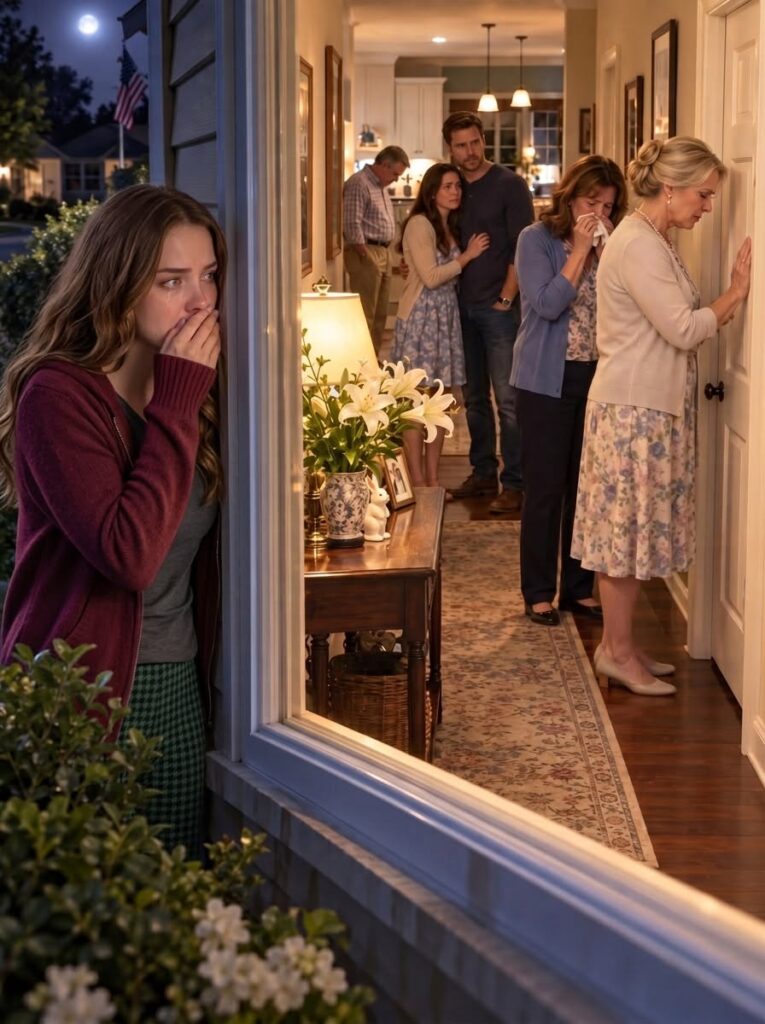
Avery’s mother, Suzanne, was standing outside the door.
My mother stood beside her, holding a tissue.
Suzanne gently touched the door.
“May I?”
Mom nodded.
Suzanne bowed her head and began praying.
My mother started crying.
“I still can’t bring myself to open this room.”
I stood outside, completely confused.
Why would someone pray over my bedroom door?
And why was my mother behaving as though entering it would be unbearable?
I waited until the visitors left.
Then I went inside.
On the dining table was a photograph of a flowering dogwood.
At its base stood a memorial stone.
In Loving Memory of Anastasia Dunaway.
My name.
My birth year.
And a date from eight years earlier.
Hanging from the tree was a familiar nursery tag.
My handwriting.
She’ll bloom.
I had sold Avery the tree planted in memory of my supposed death.
Suddenly, everything made sense.
The missing photographs.
The locked bedroom.
The funeral obituary.
The weekends spent away.
My family hadn’t told Avery I lived in Atlanta.
They had allowed her to believe I was dead.
For eight years.
I sat at the dining table until nearly midnight.
Then I found my mother’s keys, unlocked my bedroom and packed.
Medication.
Documents.
Clothes.
Ruth’s grafting knife.
My yellow notebook.
I left the bedroom door wide open.
Then I called Ruth.
“I found out why they keep sending me away.”
She listened without interrupting.
When I finished, she asked one question.
“Are you coming here?”
“Not for long.”
“Good,” she said. “It’s time you took that job in Washington.”
Before sunrise, I left Alabama.
I sent my parents one message.
I’m alive. Don’t contact me.
Then I drove west.
Ingred welcomed me at her orchard four days later.
She gave me seasonal work and a place to stay.
For the first time in years, I lived somewhere nobody asked me to disappear.
The work was demanding.
Long days.
Early mornings.
Weather that could destroy weeks of effort overnight.
But I loved it.
I became particularly good at grafting old trees.
Ingred noticed.
Eventually, she offered me a permanent position with health insurance.
I found a therapist.
Made friends.
And slowly stopped feeling guilty whenever I occupied space.
I even started seeing a mechanic named Callum, who worked on the orchard equipment.
He knew almost nothing about my family.
That was surprisingly peaceful.
Four years passed.
My family didn’t find me because they’d spent years searching.
They found me because someone finally noticed a contradiction.
Suzanne decided to establish a horticulture scholarship in my memory.
She contacted my former high school.
The application reached Mr. Witcom, my old horticulture teacher.
He recognized my name immediately.
He’d written me a recommendation for the Washington orchard three years earlier.
He contacted my father.
Shortly afterward, my mother called the orchard office.
I recognized her voice instantly.
“Anastasia.”
No greeting.
No question about whether I was happy or healthy.
“I need you to call Suzanne.”
I said nothing.
“She’s trying to establish some ridiculous scholarship. There’s been a misunderstanding.”
“A misunderstanding?”
Mom explained her proposed version.
According to her, I’d left home years earlier. The family hadn’t known whether I was alive. Suzanne had misunderstood their grief.
All I needed to do was confirm it.
Then, Mom promised, I could come home for Christmas.
I almost laughed.
She was offering me permission to return to the house she’d spent eight years making me leave.
“I’ll think about it,” I said.
Then I hung up.
Mitch contacted me two days later.
He finally admitted what had happened.
When he first started dating Avery, she’d told him about her brother, who had died in a car accident.
Mitch had mentioned my hospitalization.
Except he’d said:
“We lost my sister.”
Avery assumed I had died.
She cried and embraced him, grateful to have found someone who understood her grief.
Mitch didn’t correct her.
When our mother learned what he’d said, she decided preserving the misunderstanding would be easier than explaining it.
Then the lie grew.
The photographs disappeared.
My room became a place of mourning.
My absence became necessary.
Eventually, Avery’s family began grieving someone who was still alive.
Mitch’s voice broke.
“I didn’t know how to tell her.”
“You had eight years.”
“I know.”
“Why didn’t you ever tell me?”
He was silent.
That hurt almost as much as everything else.
He’d watched me pack my bags hundreds of times.
He’d apologized occasionally.
But he’d never told me why.
Now he wanted me to support our mother’s explanation.
His marriage depended on it.
I told him he needed to tell Avery himself.
And that I wouldn’t lie for him.
I contacted Suzanne directly.
I didn’t want a public confrontation.
I simply wanted her to know the truth.
We spoke over a video call.
At first, she could barely speak.
Then she asked me to explain.
So I did.
I showed her my yellow notebook.
Two hundred and eleven dated departures.
I explained the bedroom.
The funeral.
The medication.
And the dogwood.
Suzanne began crying when she recognized the nursery tag.
“You sold us that tree.”
“Yes.”
“You knew what it was for?”
“No.”
She covered her face.
For several moments, neither of us spoke.
Then she apologized.
She hadn’t known.
I believed her.
And for the first time, I realized that Avery’s family had been deceived too.
They had spent years grieving me.
I’d spent those same years believing they were ashamed of me.
Neither of us had known the truth.
Suzanne canceled the scholarship in my name.
She also asked whether I wanted the memorial tree removed.
I thought about that.
The dogwood was healthy.
It had been planted with genuine love, even if that love had been based on a terrible lie.
“Keep the tree,” I told her.
“But please remove the stone.”
She agreed.
Mitch eventually told Avery everything.
Their marriage went through a difficult period.
I didn’t involve myself in their arguments.
He’d spent years protecting his relationship at my expense.
Repairing it was his responsibility.
My father contacted me too.
He apologized for participating in the lie and admitted that he’d known I was alive after I left.
He simply hadn’t challenged my mother.
I wasn’t ready to forgive him.
But I appreciated that, for once, he hadn’t asked me to protect anyone.
Mom sent several messages.
Most explained why she’d done what she’d done.
None began with an apology.
I stopped reading them.
That spring, I was working among the apple trees when Suzanne sent me a photograph.
The memorial stone was gone.
The dogwood remained.
Its branches were covered in white blossoms.
She’d attached a short message.
I thought you’d like to see it blooming.
I looked at the photograph for a long time.
Then I opened my yellow notebook.
Two hundred and eleven departures.
Eight years of being told when to leave.
I turned to a clean page.
For the first time, I didn’t write another number.
I wrote one word.
Green.
Ruth had taught me years earlier that a tree could look dead after a terrible winter while remaining alive beneath its bark.
I’d spent so long being treated like someone who wasn’t there that I’d almost believed it myself.
But I’d been alive the entire time.
And now, finally, I was growing somewhere nobody expected me to disappear.