“Hope?”
I didn’t answer right away.
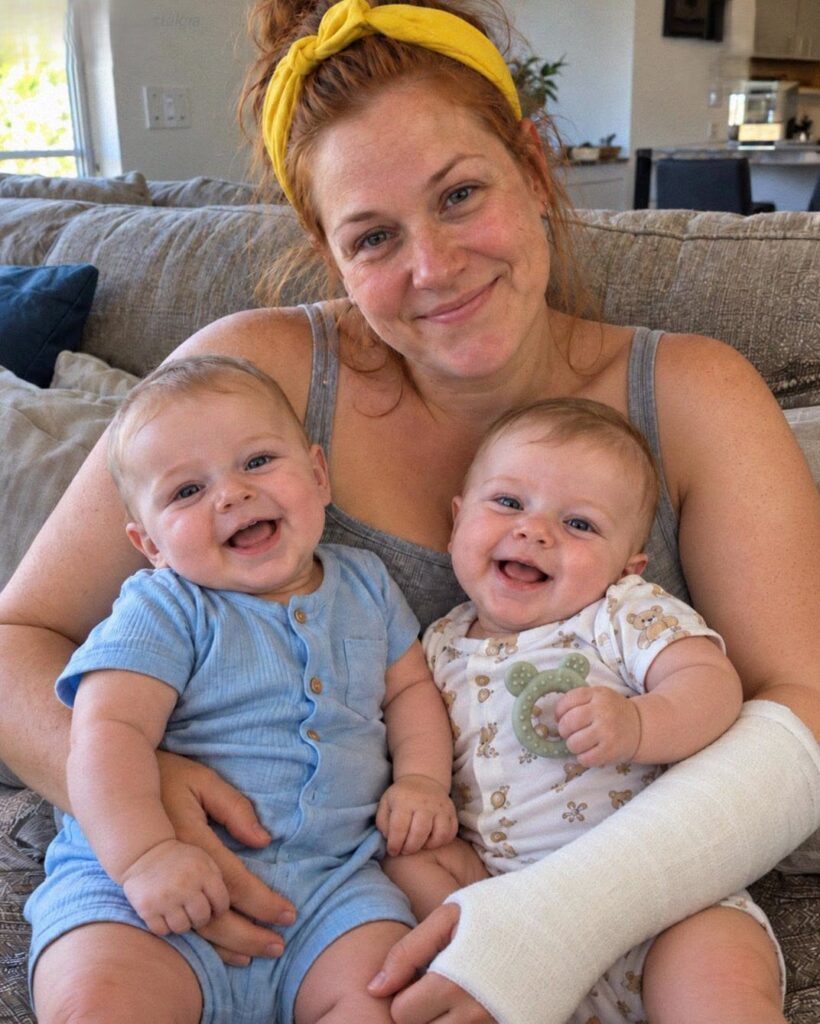
Derek was standing in the doorway of my mother’s living room, staring at Luke in her arms, Miles in mine, and the diaper bag I had packed for more than one night.
His face changed.
“Hope?”
I looked at him.
“Why are the boys staying here?”
“Because my arm is broken, Derek.”
“I know that.”
“Apparently you don’t.”
His eyes moved toward the folded paper on the coffee table.
The schedule he had refused to follow the night before.
Then back to me.
“You took my kids and left?”
“Our kids.”
His jaw tightened.
“Bring them home.”
“No.”
“Hope.”
“No.”
For five months, I had spent every day solving problems before Derek ever had to notice they existed.
Feedings.
Laundry.
Bottles.
Diapers.
Appointments.
Baths.
Night wakings.
Groceries.
Cooking.
Everything.
Then I broke my arm.
And for the first time, I could no longer do his half too.
Two days earlier, I had been sitting on the nursery floor trying to fasten Luke’s sleeper with my left hand.
My right arm was trapped in a cast.
Miles had started fussing behind me.
My tea sat untouched on the changing table.
Derek walked in from work, stepped around a basket of clean laundry, loosened his tie, and asked:
“What’s for dinner?”
I stopped fighting with the sleeper.
“My arm is broken.”
He glanced at the cast.
“I know.”
I waited.
He looked at me.
“So?”
“So what?”
I stared at him.
“I was hoping you might remember what kitchens are for. Or at least know how takeout works.”
He didn’t laugh.
“I worked ten hours today.”
“And I fell down the stairs yesterday.”
The doctor had put my fractured arm in a cast and told me not to lift Luke or Miles with it.
Miles started crying harder.
I looked toward him.
“Can you get him?”
Derek checked his phone.
“I haven’t even changed yet.”
“He doesn’t care what you’re wearing.”
“Hope.”
“What?”
“I just got home.”
“So did you stop being their father in the driveway?”
His mouth tightened.
“I pay the bills.”
“And?”
“I’m not coming home to start another shift.”
Another shift.
The words sat between us.
As though fatherhood were overtime.
“I need help for a few weeks,” I said. “Come home earlier when you can. Take a day if you have one. Work from home sometimes.”
“I have a job.”
“So did I before maternity leave.”
“Exactly. You’re home now.”
“With two babies.”
“You’re better at this anyway.”
“I’m better because I do it more.”
Miles started crying.
Derek sighed like the sound annoyed him.
“Can’t you just handle him?”
“With one arm?”
“You have another one.”
I went completely still.
Then he shrugged.
“You’re the one who wanted kids.”
My head came up.
“We wanted them.”
He rubbed his forehead.
“You know what I mean.”
“No, I don’t.”
I looked at him.
“You were showing me nursery ideas before I was even pregnant.”
“I’m exhausted, Hope. Moms don’t get sick days.”
I looked down at my cast.
“I’m injured.”
“That’s not my problem.”
Something in me changed.
Not dramatically.
Quietly.
“I’m asking you to help me.”
“You take care of them. That’s your job.”
Then he walked out.
Miles kept crying.
Luke wrapped both little hands around the edge of my cast.
I gently freed myself.
“I’ve got you,” I whispered.
I had been saying that for too long.
I’ve got it.
I’m fine.
My mother came over the next afternoon.
She found me wiping formula off the counter with my good hand while Luke kicked in his seat.
“Hope.”
“I’m almost done.”
She took the cloth away from me.
“Sit.”
“Mom, it’s sticky.”
“It’ll still be sticky in five minutes.”
I sat.
She found my tea in the microwave.
“You reheated this already?”
“Twice.”
Mom knew I cleaned when I was overwhelmed.
She made me a fresh cup.
“Where’s Derek?”
“Work.”
“And when he gets home?”
“He’ll be tired.”
She gave me a look.
“I’m fine.”
“There’s that voice you use when you’re lying to me.”
I looked away.
She didn’t lecture.
She washed bottles.
Made dinner.
Held the boys.
Then left after we ate.
That night, Miles woke first.
Luke followed.
I nudged Derek.
“Can you take Luke?”
He rolled onto his stomach.
“I have work.”
“So?”
“I have to be up in four hours.”
“So do I.”
“No, you don’t.”
I froze.
“What does that mean?”
“You can sleep when they sleep.”
I almost laughed.
Instead, I got up.
Luke was still crying when Derek pulled the blanket over his shoulder.
Three nights later, Mom called.
“My car won’t start. I can’t make it over.”
I looked at the twins.
Both badly needed a bath.
“It’s okay.”
“Don’t try bathing them alone.”
“I won’t.”
“Promise?”
“I’ll wait for Derek.”
When he came home, I met him in the kitchen.
“I need you to bathe the boys tonight.”
He dropped his keys into the bowl.
“I just walked in, Hope.”
“I know.”
“Can’t you skip it?”
“They need one.”
“Use a washcloth. That’s what tired mothers do.”
“Derek.”
He sighed.
“I’ve been working all day.”
“So have I.”
He looked at me as though I had said something ridiculous.
“Why should I have to come home and take care of the kids too?”
I stopped.
“Too?”
“What?”
“You said ‘too.’”
He frowned.
“So?”
“You think this is what I do after my day?”
“You stay home.”
“With Luke and Miles.”
“You stay home and do nothing all day.”
That sentence landed differently than the others.
For once, I did not defend myself.
I did not list everything I had done.
I did not remind him that I had not sat down for more than seven minutes all day.
I simply said:
“Okay.”
Derek frowned.
“Okay what?”
“Nothing.”
He stared at me.
“Don’t do that calm thing.”
“What calm thing?”
“The thing where you stop talking.”
He knew I hated conflict.
Usually, I kept talking until everyone felt better.
Mostly him.
That night, after the boys finally fell asleep, I sat at the kitchen table with my aching arm resting on a folded towel.
I opened a notebook.
Baths.
Evening bottles.
Carry boys upstairs.
One nighttime waking.
Those were not favors.
They were things I physically could not safely do.
The next evening, I slid the page across the table.
Derek looked at it.
“What’s this?”
“What needs to change while my arm heals.”
He read it.
“You made me a schedule?”
“I made us a plan.”
He pushed it back.
“I’m not doing shifts in my own house.”
“Then tell me what you will do.”
His expression tightened.
“Hope, I work all day.”
“I know.”
I tapped the paper.
“I can’t carry both boys. I can’t safely do baths. Last night I tried to settle Luke by myself because you wouldn’t get up.”
That got his attention.
“You shouldn’t have done that.”
“I shouldn’t have needed to.”
He looked away.
“Will you do these things until I’m cleared?”
“No.”
One word.
For days, I had called his behavior stress.
Exhaustion.
Miscommunication.
But “no” was not a misunderstanding.
“All right.”
He looked at me.
“What does that mean?”
“It means I heard you.”
I folded the paper.
Then I stood.
In the nursery, Luke stirred while I packed the diaper bag.
I froze until he settled.
Then I called Mom.
“Can the boys and I stay with you for a few days?”
She went quiet.
“Did something happen?”
“Nothing new.”
I swallowed.
“That’s the problem.”
Her voice softened.
“Do you want me to come get you?”
“Yes.”
“Are you leaving him?”
Derek was in the living room watching television.
“No.”
I looked at my cast.
“I’m trying to heal.”
That was the first time I said it without apologizing.
An hour later, Mom was holding the babies while I loaded bags into her car.
Derek came out of the garage.
“Where are you going?”
“Mom’s.”
“With Luke and Miles?”
“Yes.”
“For how long?”
“I don’t know.”
“Hope, you can’t just walk out.”
I looked at him.
“I asked you to help me stay.”
Then I got in the car.
At Mom’s, Luke fell asleep against her chest while Miles kicked beside me on the couch.
My phone rang.
“Bring them home,” Derek said.
“No.”
“I’m their father.”
“Then start acting like one.”
Silence.
Then his voice sharpened.
“Do you know what this makes me look like?”
There it was.
Not:
Are you okay?
Not:
Is your arm worse?
Not:
Do the boys have what they need?
It was about what he looked like.
“Tell people the truth.”
“What am I supposed to tell my mother?”
“The truth.”
“And what’s that?”
“Tell her I broke my arm.”
Silence.
“Tell her I asked you for help.”
More silence.
“Tell her you said moms don’t get sick days.”
“Hope.”
“Tell her you said taking care of the boys wasn’t your problem.”
“You’re humiliating me.”
And suddenly I understood.
“You weren’t embarrassed when you said it.”
“What?”
“You weren’t embarrassed while I was begging you for help.”
He went quiet.
“You’re only embarrassed someone might find out.”
My hand shook when I ended the call.
Mom noticed.
She reached toward Miles.
“Give him here.”
“I can hold him.”
“I know.”
That felt different.
Not:
You can’t.
Just:
You don’t have to.
So I let her.
Derek showed up the next evening looking angry.
“My mother called.”
“And?”
“She wanted to see you and the boys.”
I waited.
“I had to tell her you weren’t home.”
“What did you tell her?”
“The truth, apparently.”
That surprised me.
“She asked whether I’d been helping since you broke your arm.”
“And?”
“I told her you’re home with the boys and I’m working.”
I waited.
Derek rubbed the back of his neck.
“Then she asked why you had to leave the house just to get someone to help you.”
“What did you say?”
He looked away.
“Nothing.”
“Why?”
“Because I knew how it sounded.”
Before I could answer, Miles started crying.
Derek looked at me automatically.
“Hope?”
I stayed still.
“You’ve got him.”
“I don’t know what he wants.”
“Neither do I yet.”
“You usually know.”
“I usually find out.”
He hesitated.
Then picked Miles up.
The crying got louder.
“See? I’m making it worse.”
“You’ve held him for ten seconds.”
“What do I do?”
A hundred instructions lined up in my head.
Bounce slower.
Support his head.
Check the diaper.
Walk him.
But I didn’t give them.
“Start paying attention.”
Derek looked at me.
Then he started pacing.
Too fast.
Miles cried harder.
Derek slowed down.
A minute later, the crying softened.
“He’s stopping.”
“Yeah.”
Derek looked down at him.
“You make this look easy.”
“You told me I do nothing.”
His expression changed.
“I know.”
“Why?”
He swallowed.
“Because whenever I came home, you already knew what they needed.”
“And?”
“I didn’t.”
“You could have learned.”
“I know.”
“Then why didn’t you?”
His voice became quieter.
“Because I felt useless.”
That surprised me.
“Every time you asked me to do something, it reminded me I didn’t know how.”
“So you wanted me to stop asking.”
He nodded.
Miles curled his fist into Derek’s shirt.
“Being scared doesn’t excuse what you said.”
“I know.”
For months, I had wanted to see Derek holding one of our sons that way.
Now he finally was.
A few days later, he sent me a photograph of our spotless kitchen.
“Cleaned everything. Come home?”
I stared at it.
Then replied:
“What time does Miles usually take his last bottle?”
The typing dots appeared.
Stopped.
Appeared again.
No answer.
That evening, Derek came to Mom’s.
“What do you want me to do, Hope?”
“I want you to stop waiting for instructions.”
“I’m trying.”
“Then try without making me your manager.”
He looked frustrated.
“I cleaned the house. I thought you’d be happy.”
“I’d be happier if you knew why Miles cries differently from Luke.”
“Then teach me.”
For a second, I almost did.
The old version of me would have written another schedule before he finished that sentence.
Instead, I shook my head.
“No.”
He stared at me.
“Watch them.”
I pointed toward the boys.
“Learn them.”
His face tightened.
“Be here long enough to know.”
“And if I mess up?”
“You will.”
He looked surprised.
“So will I.”
I glanced at my cast.
“I’ve spent weeks feeling like I’m failing because I can’t even lift my own sons.”
“Hope…”
“Let me finish.”
He did.
“When this cast comes off, I get another chance to feel like their mom again.”
I looked at him.
“You can have a second chance too.”
“At us?”
“At being better than you’ve been.”
His face fell slightly.
“But I’m not dragging you there.”
Over the next few weeks, Derek started showing up differently.
He left work on time twice a week.
Added pediatrician appointments to his calendar.
Learned that Luke calmed faster against his chest.
Learned that Miles needed movement before sleep.
He still got things wrong.
I stopped rescuing him every time.
Three weeks later, my arm had healed enough that I brought some of our things home.
Not everything.
Derek noticed.
“You’re keeping clothes at your mom’s?”
“Yes.”
“Because you don’t trust me?”
“Because I’m learning to trust myself.”
He said nothing.
“If this falls apart again, I won’t wait until I’m broken before I do something about it.”
That night, Miles cried from the nursery.
I started to stand.
Derek was already moving.
“I’ve got him.”
He paused in the doorway.
“That’s his tired cry.”
Then he disappeared down the hall.
A minute later, Miles stopped crying.
I picked up my tea.
It was still warm.
For months, I had believed good mothers carried everything.
Then I broke my arm and learned something better.
A good mother does not have to prove how much she can survive.
A marriage is not one person working outside the house while the other quietly carries everything inside it.
And fathers should never have to be asked to be fathers.