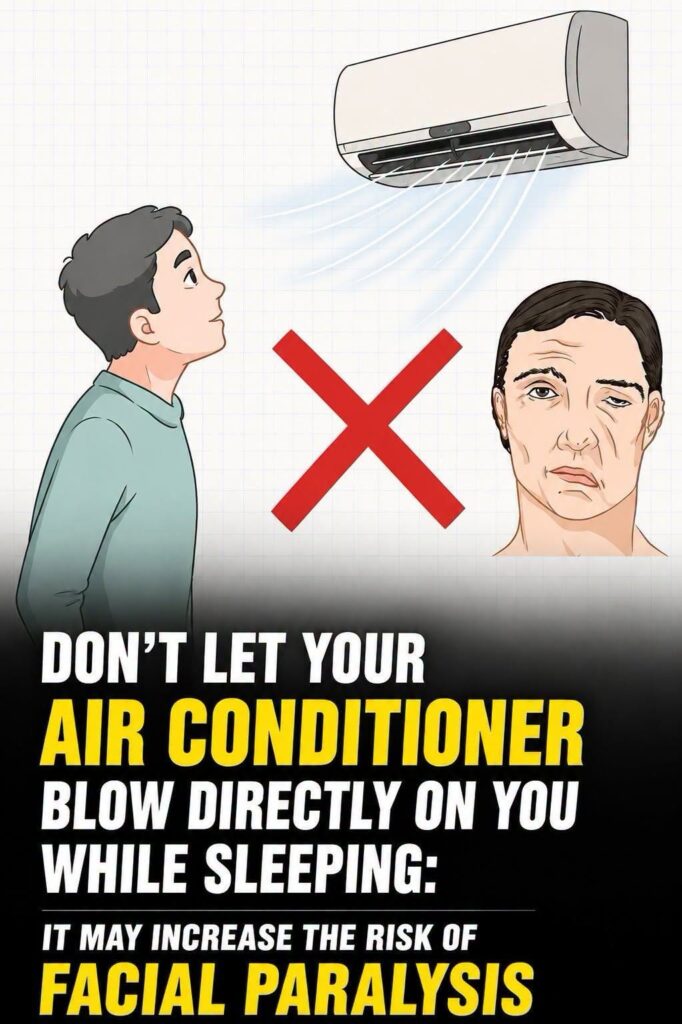
Facial paralysis, including Bell’s palsy, happens when the facial nerve becomes inflamed or stops functioning properly. This can cause sudden weakness on one side of the face, difficulty smiling, trouble closing one eye, or changes in facial movement.
In most cases, doctors do not consider cold air itself to be the direct cause.
Bell’s palsy is more commonly associated with viral infections, immune-system reactions, inflammation, or other underlying medical factors.
However, some experts believe that prolonged exposure to cold airflow may act as a possible trigger in people who are already vulnerable.
For example, sleeping for hours with strong cold air blowing directly onto the face may cause discomfort and sudden temperature changes around sensitive nerves and muscles.
That does not mean everyone who sleeps under an air conditioner is at risk.
Most people can safely use air conditioning at night without developing facial paralysis.
Still, certain individuals may be more sensitive.
Older adults, people with weakened immune systems, and those with conditions such as diabetes or circulation problems may already have factors that affect nerve function and the body’s response to physical stress.
For them, avoiding prolonged direct exposure may simply be a sensible precaution.
It is also important not to assume that facial weakness appearing after sleeping near an air conditioner was automatically caused by the cold air.
Facial paralysis can have many possible explanations.
Viral infections are commonly discussed in connection with Bell’s palsy.
Other possible causes of facial weakness can include nerve injury, complications following surgery, infections, and other neurological or medical conditions.
That is why sudden facial changes should not be ignored or blamed on the air conditioner without proper medical evaluation.
The good news is that using an AC more comfortably is simple.
Instead of allowing cold air to blow directly onto your face all night, adjust the vents so the airflow circulates around the room.
You can also use a timer or sleep setting so the unit does not remain at maximum cooling throughout the night.
Keeping the bedroom at a comfortable, stable temperature may also help prevent waking up with dry eyes, a stiff neck, irritated sinuses, or muscle discomfort.
Pay attention to sudden changes in facial movement as well.
Possible warning signs can include weakness on one side of the face, difficulty smiling normally, trouble closing an eye, drooping around the mouth, or unusual numbness or loss of control.
These symptoms often appear suddenly.
If that happens, seeking prompt medical attention is important.
Sudden facial weakness can have several possible causes, some of which require urgent evaluation, so it is better to be assessed quickly rather than assume the symptoms will disappear on their own.
In short, air conditioning itself is not considered a direct cause of facial paralysis.
For most people, sleeping in an air-conditioned room is perfectly normal.
But allowing very cold air to blow directly onto the face or body for hours may cause discomfort and could potentially act as an additional stressor in susceptible individuals.
A simple adjustment of the airflow can make sleep more comfortable while avoiding unnecessary prolonged exposure.