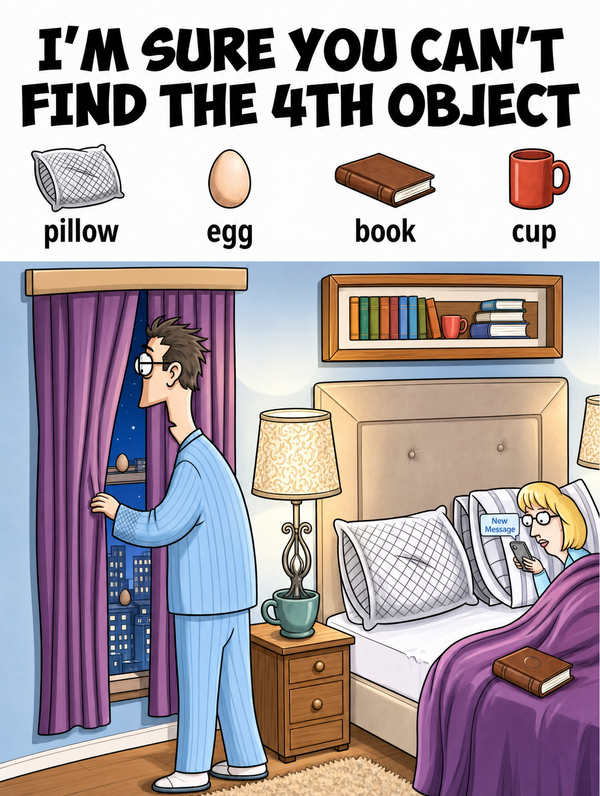
invisible, that is, until they realize it isn’t drawn as a literal egg at all, but hidden within the outline of another object altogether, which is exactly why so many viewers need a second and third look before the full picture finally clicks into place.
A Closer Look at the Bedroom Scene
The illustration shows a cozy bedroom at night. A man stands near the window looking outside, while a woman sits in bed scrolling on her phone. Scattered around them are pillows, books, lamps, and other household decorations.
Somewhere in that clutter, each of the four target objects is waiting to be matched to the sample images shown at the top of the puzzle. Some are obvious. Others are cleverly tucked into the scene’s design.
Finding the Pillow, Book, and Cup
The pillow is the simplest find. Several striped pillows sit on the bed, and one pattern closely matches the example shown in the puzzle. Because the pillows are front and center, most viewers spot this one almost instantly.
The book turns out to be hiding in triplicate. One book lies on the purple blanket at the foot of the bed, several more sit on the wall shelf above the headboard, and a smaller book rests on the windowsill near the man by the curtain. That windowsill book is easy to miss if attention stays fixed on the bed.
The cup causes more hesitation than expected. Many viewers first point to the green mug on the bedside table. But the puzzle’s reference image shows a red-brown mug with a handle, and that specific cup actually sits on the wall shelf, nestled between the books. Because it matches the sample so closely, the shelf mug—not the green one—is the accepted answer.
The Elusive Egg
The egg is where almost everyone gets stuck. There’s no literal egg anywhere in the bedroom, which is exactly the point. Instead of drawing one outright, the puzzle hides egg-shaped forms inside other objects.
One candidate is the decorative oval ornament on the front of the bedside cabinet, its rounded shape echoing an egg’s outline. The other candidate sits in the lamp’s design—an elongated oval built into the center of the lamp stand that many viewers find even more convincingly egg-shaped.
Because both elements carry a deliberate egg-like silhouette, puzzle solvers often disagree about which one counts as the true answer. That disagreement is part of why this particular object sparks so much debate online.
Why the Puzzle Fools So Many
The trick behind this brain teaser relies on a well-known quirk of perception called selective attention. People searching for an object usually expect it to appear in its normal, recognizable form—a book should look like a book, a cup like a cup, an egg like an egg.
But the artist bypasses that expectation by folding certain shapes into decorative details rather than drawing the objects directly. As a result, the brain scans right past the correct answer, even when it’s sitting in plain view.
The Final Answer
Pulling it all together, the most accurate solution looks like this:
- Pillow – on the bed, matching the striped example
- Book – visible on the blanket, on the wall shelf, and as a small book on the windowsill
- Cup – the red-brown mug on the wall shelf above the bed
- Egg – represented by the oval shapes in both the lamp stand and the bedside cabinet ornament
This puzzle works precisely because its objects aren’t hidden the same way. Some are real items simply placed in a busy scene, while others exist only as shapes borrowed from furniture and decor. The next time a hidden-object challenge comes along, it helps to look past the obvious form of each item and search instead for its outline, silhouette, and possible disguises hiding in plain sight.