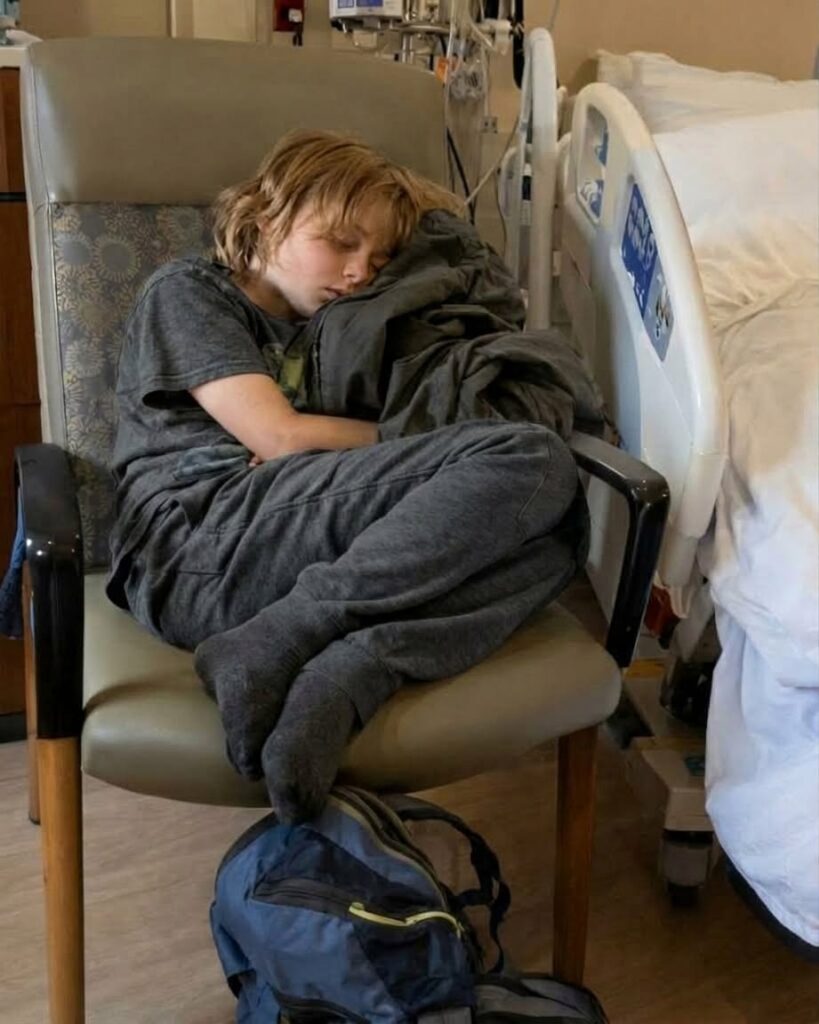
Knew which night-light he needed when he couldn’t sleep.
So seeing him curled beside me should have been comforting.
Instead, the first thing he said frightened me.
“Granny, next time Aunt Lisa comes, pretend you’re still asleep.”
I stared at him.
“Why?”
His hand tightened around mine.
“Because you need to hear what she says when she thinks you can’t.”
Footsteps approached.
Walter’s eyes widened.
“She’s coming.”
I closed mine.
My daughter Lisa entered.
“Still sitting here?”
Walter didn’t answer.
She sighed.
“You need to understand something. Even if Grandma wakes up, things might not go back to normal.”
“What does that mean?”
“You probably won’t be living with her anymore.”
Walter’s voice became small.
“I’m going home with Granny.”
“She had a serious accident, Walter. She’s getting older. Her eyesight is bad.”
“She wears glasses.”
“Clearly that didn’t help.”
My heart started pounding.
Then Lisa said:
“You should start getting used to the idea of living with me.”
After she left, I opened my eyes.
Walter was staring at me.
“That wasn’t the first time,” he whispered.
I was sixty-one.
Four years earlier, after my son Daniel died, I’d become Walter’s legal guardian.
Lisa had challenged that arrangement.
At the time, I thought grief had affected her.
She insisted Walter should live with her.
But Lisa barely visited him.
She was struggling with her business.
Constantly borrowing money.
And before Daniel’s funeral flowers had wilted, she was talking about guardianship.
Ultimately, Walter remained with me.
I tried to forget the fight.
Now, lying in that hospital bed, I wondered whether I should have paid more attention.
Then Walter mentioned something else.
“Aunt Lisa asked me about your glasses before the accident.”
“My glasses?”
“She asked if you always drove wearing the old ones.”
A memory returned.
The morning of the crash, I couldn’t find my usual driving glasses.
Lisa had been in my kitchen.
I’d complained that I was late.
She’d told me:
“Just use your old pair. You can see fine.”
I couldn’t.
The prescription was weaker.
I remembered blurry road signs.
A horn.
Metal.
Then nothing.
The next day, I asked the hospital social worker whether Lisa had raised the issue of Walter’s care.
“She has asked about temporary arrangements while you recover.”
“Has she mentioned becoming his guardian?”
“She has asked what would happen if you were unable to resume caring for him.”
“And my eyesight?”
The woman hesitated.
“Yes. That was mentioned.”
I felt cold.
Lisa had been building an argument while I was unconscious.
I still didn’t know why.
After I was discharged, I took a taxi home.
Walter came with me.
While looking for paperwork related to the accident, I remembered the security camera near my front door.
It covered part of the entryway.
Including the chair where I’d left my purse that morning.
We pulled up the recording.
There was Lisa.
She entered the frame.
Stopped beside my purse.
Opened it.
Walter leaned closer.
“Granny…”
Lisa removed my glasses case.
Then put it inside her handbag.
Neither of us spoke.
Walter finally whispered:
“Why did she do that?”
“I don’t know.”
But I intended to find out.
Before confronting her, I called an attorney.
That mattered.
I didn’t want to accuse my daughter of causing an accident based solely on suspicion.
I preserved the video.
I documented what Walter had heard.
And I reviewed Daniel’s estate paperwork.
That’s when I found something I’d forgotten about during the chaos after his death.
Daniel had created a trust for Walter.
The money wasn’t controlled by whoever raised him.
An independent trustee managed it.
But the trust could reimburse legitimate expenses connected to Walter’s care—education, medical needs and other approved costs.
Lisa couldn’t simply take the money.
Still, something about it bothered me.
I remembered her financial problems after Daniel died.
And how suddenly she’d wanted Walter.
So I called her.
“I need help with some paperwork for Walter.”
She came over that evening.
Immediately.
She noticed my new glasses.
“Those are better.”
“Yes.”
“You probably shouldn’t drive for a while anyway.”
I looked at her.
“Why did you take my glasses?”
She froze.
“What?”
“I have the video.”
Her face changed.
I continued.
“You opened my purse the morning of my accident and took them.”
“I didn’t—”
“Lisa.”
Silence.
Then she sat down.
“I was worried about you.”
“So you took the glasses I needed?”
“You shouldn’t have been driving!”
“Then why did you tell me to use the old pair?”
She looked away.
I felt something inside me break.
“Tell me the truth.”
She started crying.
“You were never going to listen.”
“About what?”
“That you’re getting older. That Walter needs someone younger.”
“I’m sixty-one.”
“You lose things constantly. Your eyesight has gotten worse—”
“So you decided to make it look worse?”
She said nothing.
That was my answer.
“You wanted me to cancel the drive.”
“Yes.”
“Why?”
“I thought if you couldn’t find your glasses again, if there were enough incidents, people would finally take my concerns seriously.”
“What people?”
She hesitated.
“Attorneys. The court.”
I stared at her.
“You were collecting reasons to challenge me for Walter.”
“I thought he’d be better with me.”
“Why?”
“He’s my nephew.”
“That didn’t answer me four years ago either.”
Her face tightened.
So I put Daniel’s trust documents on the table.
Her eyes immediately dropped toward them.
That was all I needed.
“You knew.”
Lisa closed her eyes.
“Daniel told me before he died.”
“And you knew the trust could pay legitimate expenses for Walter.”
“With approval.”
“Yes. With approval.”
She wiped her face.
“My business was collapsing back then.”
I couldn’t believe what I was hearing.
“You wanted Walter because you thought raising him would help your finances?”
“No!”
“Then explain it.”
“I would have taken care of him.”
“That isn’t the question.”
She stood.
“I was desperate.”
“And now?”
Silence.
“You saw my accident as another opportunity.”
“I saw you in a coma and realized someone had to take care of him.”
“For eleven days.”
“You could have died!”
“But I didn’t.”
Her voice rose.
“I didn’t cause the accident.”
“You removed the glasses I normally drive with and told me to use a pair you knew wasn’t strong enough.”
“I thought you’d realize you couldn’t see and turn around!”
“But I didn’t.”
She started crying harder.
“I didn’t know you’d crash.”
I believed that part.
And somehow it didn’t help.
“You didn’t intend for me to end up in a coma.”
“No.”
“You intended to make me look incapable.”
She couldn’t deny it.
“And you were willing to frighten Walter and use my hospitalization to strengthen that argument.”
“Mom—”
“Leave.”
“Please.”
“Leave.”
I didn’t know Walter had heard part of the conversation.
After Lisa left, he came downstairs.
“Am I still living with you?”
The question nearly destroyed me.
I pulled him close.
“As long as I’m healthy enough to take care of you and that’s what the court continues to allow, yes.”
“So Aunt Lisa can’t just take me?”
“No.”
That was the answer he needed.
The adult problems could stay with the adults.
What happened next wasn’t instant.
My attorney preserved the security footage and informed the appropriate people handling Walter’s guardianship.
Lisa’s previous and current efforts were reviewed.
The independent trustee confirmed that she had no authority over Walter’s trust and could not access its assets simply by becoming his guardian.
Most importantly, Walter wasn’t dragged into some dramatic courtroom confrontation.
The adults dealt with the evidence.
The video mattered.
Lisa’s actions mattered.
My medical recovery mattered too.
I completed follow-up evaluations and demonstrated that I was capable of caring for Walter.
Lisa did not become his guardian.
Our relationship, however, was another matter.
I couldn’t simply forget what she’d done because she was my daughter.
For years, that had been my weakness.
Every warning sign came with an excuse.
She was grieving.
She was struggling.
She was desperate.
She was family.
Eventually, excuses become permission.
I wasn’t giving it anymore.
Several weeks later, Walter found me searching the kitchen.
“You lost them again.”
“I didn’t lose anything.”
He held up my glasses.
“Beside the toaster.”
“I knew that.”
“You checked the refrigerator.”
“I was looking for milk.”
“We don’t need milk.”
I put on my glasses.
His face came sharply into focus.
He grinned.
“One day you’re going to lose me like you lose those.”
I pulled him toward me.
“No chance.”
He laughed and ran upstairs for his backpack.
I stood alone in the kitchen for a moment.
My eyesight had been imperfect for years.
But that wasn’t what I’d truly failed to see.
I’d spent too long believing that loving my daughter meant finding an innocent explanation for everything she did.
I could make those excuses when the only person paying for them was me.
I wouldn’t make them at Walter’s expense.