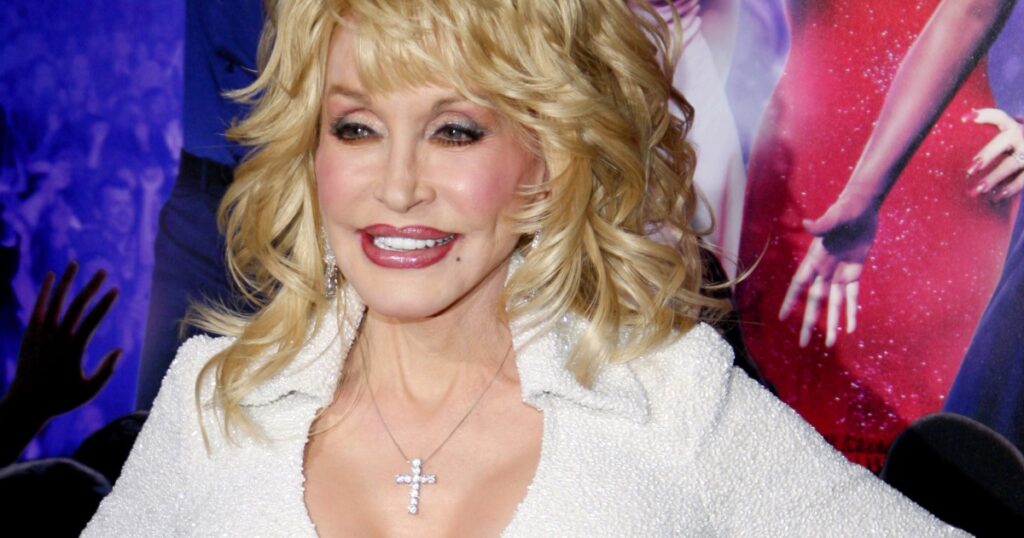
Parton surprised the crowd by appearing in person, cutting the ceremonial ribbon with rhinestone-covered scissors and immediately showing that her famous sense of humor was still very much intact.
Joking about competing travel-stop chain Buc-ee’s and its famous beaver mascot, she quipped:
<blockquote>“I couldn’t leave it to beavers.”</blockquote>
At the time, the appearance seemed like another classic Dolly Parton moment.
She smiled.
She joked with fans.
She worked the crowd.
And she did it all wearing the unmistakable glamorous style that had become part of her identity.
Still, looking back, there were small details that now carry more significance.
Parton appeared to move more slowly than she once had, and people around her seemed particularly attentive as she made her way through the event.
But nothing about that afternoon suggested that the crowd was witnessing a farewell.
Two months later, on August 25, Dolly Parton died at the age of 80.
Only then did the photographs and video from Cornersville take on an entirely different meaning.
What had looked like another public appearance from one of country music’s most recognizable stars became the final time Parton would greet fans at a public event.
The June appearance had already been unusual because Parton had been spending much less time in public.
By then, fans knew she had been dealing with health problems significant enough to affect some of her biggest professional plans.
But that afternoon, she remained unmistakably Dolly.
She joked about Buc-ee’s.
She promoted her new business venture.
She welcomed travelers.
And despite apparently taking careful steps, she still wore the towering heels that had been part of her public image for decades.
That detail stood out even more in retrospect.
For years, Dolly Parton in stilettos had been almost as recognizable as her blonde hair, rhinestones, and distinctive voice.
Seeing her carefully navigate the event while refusing to abandon that signature look seemed to capture something essential about the persona she had created.
Still, photographs from a public event could not reveal how Parton was actually feeling.
Nobody watching her that afternoon could have known exactly what was happening with her health.
She was simply there to open a travel stop, make people laugh, and celebrate another project bearing her name.
Even the travel stop itself was unmistakably connected to Parton’s story.
The location featured chandeliers decorated partly with rhinestones that had reportedly fallen from her stage outfits.
A laundromat for truckers was called the Wishy-Washy, a reference to the Nashville laundromat where Parton famously met her longtime husband, Carl Dean.
Lighting throughout the building was also inspired by some of her biggest songs.
Located off Interstate 65 around an hour south of Nashville, the travel stop was designed as a place where people could eat, rest, and feel welcome while traveling.
But the opening came during one of the most difficult periods of Parton’s life.
Her husband, Carl Dean, had died on March 3, 2025, after nearly six decades of marriage.
Parton later spoke openly about the emotional and physical toll of losing him.
She explained that she had spent significant time caring for Dean and had allowed her own health to become less of a priority.
Later, grief made rebuilding her strength even more difficult.
In September 2025, Parton postponed her planned Las Vegas residency because of what she described as “health challenges.”
The shows had originally been scheduled for December 2025 at The Colosseum at Caesars Palace before being moved to September 2026.
At the time, Parton told fans:
<blockquote>“As many of you know, I have been dealing with some health challenges, and my doctors tell me that I must have a few procedures.”</blockquote>
She also shared some details about what she had been experiencing.
Parton said she had dealt with recurring kidney stones for several years and explained that her immune and digestive systems had become “all outta whack.”
Her doctors, she said, were working to help rebuild and strengthen those systems.
She also described feeling “a little ‘swimmy’ headed” because of treatments and acknowledged that she could not responsibly meet the physical demands of a major live performance at that time.
Her health struggles were happening alongside profound grief.
At the opening of Dollywood’s 2026 season in March, Parton spoke candidly about how the loss of Dean and other pressures had affected her.
<blockquote>“I just kind of got worn down and worn out, grieving over Carl and a lot of other little things going on.”</blockquote>
She continued:
<blockquote>“I just got myself kind of where I needed to build myself back up spiritually, emotionally and physically. But all is good. It didn’t slow me down.”</blockquote>
There were other signs that Parton’s public schedule was becoming increasingly difficult to maintain.
She was unable to attend the announcement of Dollywood’s NightFlight Expedition attraction in person and instead appeared through video.
Later, she also missed the attraction’s opening after her doctor reportedly advised her to remain in Nashville because of continued health issues.
Speaking virtually to the crowd, Parton said:
<blockquote>“I’m still in Nashville, and I’m sorry about that.”</blockquote>
By May 2026, her long-awaited Las Vegas residency had been canceled altogether.
Parton tried to deliver the disappointing announcement with optimism, telling fans there was “good news and a little bad news.”
She said she was “responding really well to meds and treatments,” but admitted that she still was not physically prepared to perform at the standard she expected of herself.
Even as her health increasingly disrupted her schedule, Parton remained determined to keep working.
Months earlier, she had told fans:
<blockquote>“I don’t think God is through with me.”</blockquote>
Then she added:
<blockquote>“And I ain’t done working.”</blockquote>
Those words captured the determination she had displayed throughout her career.
Parton had spent decades building a life around music, performance, business ventures, philanthropy, and an almost constant connection with her audience.
But by the summer of 2026, public appearances had become increasingly rare.
That made the June 24 event in Cornersville particularly meaningful.
At the time, however, nobody knew how meaningful it would become.
Parton died on August 25 at age 80.
Later reports said she had died after a “brief battle with cancer,” although the specific type of cancer was not publicly disclosed.
Parton herself had never publicly announced a cancer diagnosis before her death.
Her sister Stella later shared another detail about Dolly’s final period.
According to Stella, Dolly told her that if doctors reached a point where there was no realistic hope for her own recovery, she would still be willing to participate in experimental treatments if what doctors learned from her case might eventually help someone else.
It was another detail that seemed consistent with the public image Parton had cultivated for decades—someone who continued thinking about other people even while confronting her own difficulties.
Across her extraordinary career, Parton sold more than 100 million records, earned 11 Grammy Awards, and became far more than simply a country singer.
She became one of the most recognizable entertainers in American culture.
Yet her final public appearance did not take place beneath the lights of a major concert arena.
There was no enormous stage.
No elaborate farewell performance.
No final awards-show tribute.
Instead, her last public appearance happened at a travel stop beside Interstate 65 in Tennessee.
Nobody in the crowd that June afternoon knew they were seeing Dolly Parton in public for the final time.
There was no goodbye speech.
There was no sentimental retrospective.
Nothing about the ribbon-cutting ceremony suggested that it would someday become part of the story of her final months.
There was simply Dolly.
She joked about beavers.
She welcomed travelers to a new business bearing her name.
She stood beneath the Tennessee sun wearing blue-and-pink fringe.
She cut a ribbon with sparkling scissors.
And she greeted fans while balancing in the high heels she had spent decades making part of her unmistakable image.
Looking back, it is tempting to search those photographs for clues.
Her public appearances had already become limited.
She had acknowledged significant health problems.
People around her appeared careful as she moved through the event.
But hindsight has a way of turning ordinary moments into signs that nobody recognized at the time.
The people standing in Cornersville could not have known what Parton had yet to reveal about her condition.
And photographs from a single afternoon could never fully explain what she was experiencing physically.
What those images can preserve is something simpler.
They preserve Dolly Parton as fans knew her.
Smiling.
Joking.
Covered in rhinestones.
Still showing up.
Two months later, she was gone, transforming what had seemed like an ordinary ribbon-cutting ceremony into an unexpectedly important final chapter.
Her last public appearance was not carefully designed as a goodbye.
It happened at a Tennessee travel stop surrounded by fans, with Dolly wearing fringe, rhinestones and high heels while making people laugh.
For a performer who spent a lifetime insisting on being unmistakably herself, it was a final public appearance that somehow felt completely fitting.