And the sapphire bracelet my grandmother had placed in my hand three days before she died.
Marcus stopped beside me.
“Smile, Evelyn. This is a public event.”
Celeste lifted her wrist.
“You don’t mind, do you? Marcus said old jewelry looks better on younger skin.”
I stared at my grandmother’s bracelet.
Then I remembered something she’d once told me:
Never beg for a place at a table you helped build.
So I smiled.
“Enjoy the evening.”
Marcus’s eyes narrowed.
He knew me well enough to understand that wasn’t surrender.
Not anymore.
The Whitmore Foundation gala had been part of my family’s life for decades.
My grandmother had helped build the organization.
After she died, Marcus increasingly presented himself as its natural successor.
He gave speeches.
Courted donors.
Appeared in photographs.
I handled the less glamorous work.
Trustee meetings.
Correspondence.
Programs.
Budgets.
For years, Marcus joked that I was “too sentimental” for business.
People believed him because I rarely corrected him.
That evening, he seated Celeste beside him at table one.
In my usual chair.
When a waiter hesitated, Marcus pointed toward the opposite end.
“Evelyn can sit there. She prefers observing.”
A few people laughed uncomfortably.
I sat down.
Mr. Alden, one of the foundation’s oldest trustees, was beside me.
He glanced toward Celeste’s wrist.
“Is that your grandmother’s bracelet?”
“Yes.”
His expression hardened.
“Does she know?”
“She will.”
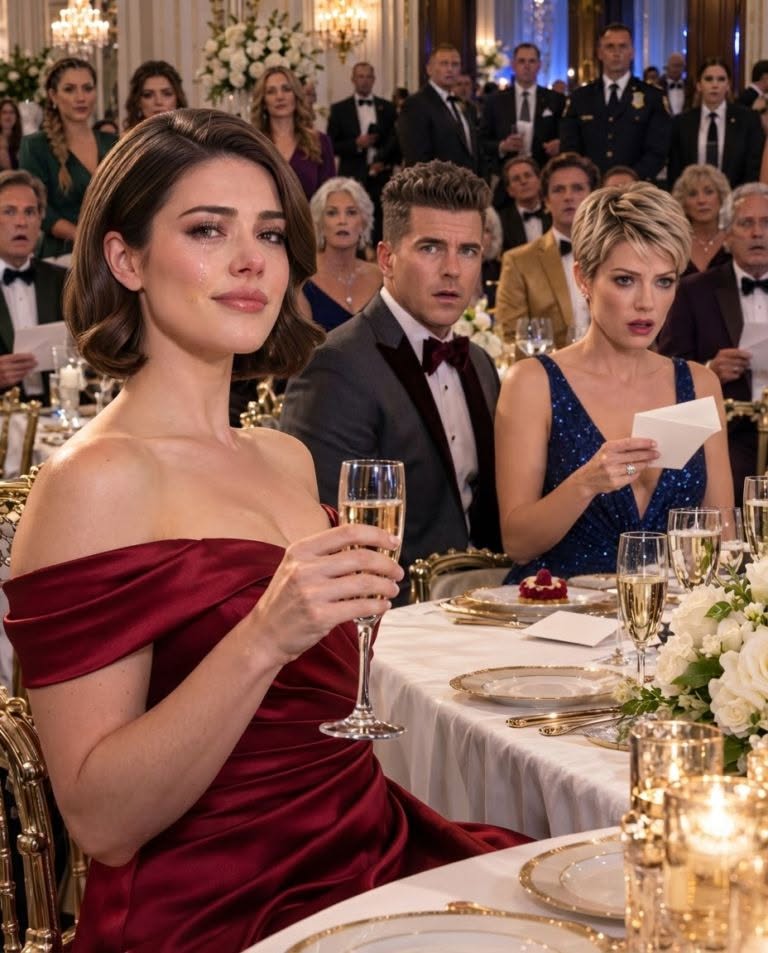
Halfway through dinner, Celeste raised her voice.
“Evelyn, I should thank you for the dress. Marcus said it was just sitting in your closet.”
“That happens to clothes.”
“And the bracelet is beautiful.”
“It is.”
She touched the wedding ring.
“Marcus has excellent taste.”
I looked directly at her.
“The bracelet belonged to my grandmother.”
Celeste’s smile faltered.
“Marcus said everything between you two was marital property.”
“He was mistaken.”
Marcus put down his fork.
“Enough.”
I turned toward him.
He lowered his voice.
“Don’t embarrass yourself.”
That sentence used to work on me.
So did calm down.
You’re being emotional.
Let me handle it.
For years, Marcus had convinced me that avoiding conflict was the same as preserving dignity.
Then my grandmother died.
And everything changed.
Two weeks after her funeral, her attorney asked me to come to his office.
My grandmother had left detailed instructions regarding several family assets and the foundation.
She’d also left me a note.
One sentence stayed with me:
If something feels wrong, don’t argue about it. Check the records.
So I did.
Not personally.
I hired professionals.
Independent counsel reviewed the trust documents.
A forensic accounting firm examined transactions connected to the foundation after several trustees raised concerns.
They found payments that required explanation.
Consulting contracts with vague descriptions.
Companies with little visible business activity.
Expenses that appeared unrelated to the foundation’s charitable work.
Some approvals contained my electronic signature.
I hadn’t approved them.
That was when the review became much more serious.
I didn’t accuse Marcus.
I didn’t confront Celeste.
I preserved everything and let the accountants continue.
Eventually, the trustees were informed.
Marcus had no idea.
He thought my silence meant I still didn’t understand.
Dessert arrived shortly before the annual address.
Marcus stood and adjusted his jacket.
This was supposed to be his moment.
He’d spent weeks preparing the speech.
Instead, Mr. Alden stood.
“Before we begin, the trustees have a brief governance announcement.”
Marcus slowly turned.
“What announcement?”
Mr. Alden continued.
“Following concerns identified during an independent financial review, the board met this afternoon.”
The room became very quiet.
Marcus looked at me.
I didn’t move.
“Effective immediately,” Mr. Alden said, “Marcus Vale has been placed on administrative leave from all foundation responsibilities while outside counsel and forensic accountants complete their review.”
Celeste stopped smiling.
Marcus remained standing.
“This is absurd.”
Mr. Alden didn’t respond.
Marcus looked around the table.
“You held a meeting without me?”
“You were recused from matters concerning transactions under review.”
Then Marcus looked at me.
“You did this.”
“No.”
I kept my voice low.
“The accountants found transactions that needed explaining.”
“You went through my accounts?”
“The foundation reviewed its accounts.”
He leaned closer.
“You have no idea what you’re doing.”
That sentence might have broken me once.
Instead, I asked:
“Then you should have no difficulty explaining the records.”
Celeste suddenly looked uncomfortable.
“Marcus, what records?”
He ignored her.
She touched the sapphire bracelet.
Then I saw something important happen.
For the first time all evening, she wasn’t enjoying wearing my things.
She was wondering what else Marcus had lied about.
I held out my hand.
“The bracelet.”
She stared at me.
“Excuse me?”
“It was specifically left to me by my grandmother. It isn’t Marcus’s property.”
Marcus interrupted.
“Don’t give her anything.”
Several people at the table looked toward him.
Celeste slowly removed the bracelet.
Then the ring.
She placed both beside my plate.
“The dress too?” she asked.
“Yes.”
Her face reddened.
“Marcus told me you were separated.”
I looked at him.
“We weren’t.”
Celeste turned toward him.
“You said she knew about us.”
He said nothing.
“You said the divorce was basically finished.”
Still nothing.
Suddenly, I almost felt sorry for her.
Almost.
Marcus left the gala before dessert ended.
Not in handcuffs.
Not surrounded by police.
Just furious and humiliated.
The actual consequences took much longer.
Over the following months, investigators reviewed contracts, bank records, emails and authorization logs.
Some transactions had legitimate explanations.
Others did not.
The foundation pursued recovery of money it concluded had been improperly spent, and matters that potentially violated the law were referred to the appropriate authorities.
My divorce attorney handled the rest.
There was no single dramatic moment when Marcus lost everything.
Real life is slower than that.
Lawyers wrote letters.
Accountants produced reports.
Trustees held meetings.
Banks produced records.
Marcus hired his own attorneys.
And eventually, the story he’d spent years constructing around himself began collapsing under documentation.
Celeste returned the gown.
She also returned several other items Marcus had given her that belonged to me or had been purchased through accounts under dispute.
I never spoke to her again.
The wedding ring went into a box.
I didn’t want it back on my finger.
The sapphire bracelet was different.
That stayed.
Six months later, the Whitmore Foundation reopened its children’s wing after a major renovation.
My grandmother’s name was above the entrance.
Before the ceremony, Mr. Alden found me standing beneath it.
“She would have liked this.”
“I think so.”
“And she’d be proud of you.”
I touched the bracelet.
“I think she’d mostly be annoyed it took me so long.”
He laughed.
“She was very good at being annoyed.”
That made me laugh too.
The following spring, I attended another foundation gala.
I wore the silver gown.
The same one Celeste had worn that night.
Several people recognized it.
Nobody mentioned Marcus.
Before walking into the ballroom, I stopped in front of a mirror.
Silver dress.
Sapphire bracelet.
No wedding ring.
For years, I’d believed dignity meant enduring humiliation without making a scene.
My grandmother had understood something I hadn’t.
Dignity wasn’t staying quiet while someone dismantled your place in your own life.
It was knowing when to stop asking for that place back.
I entered the ballroom alone.
And this time, when the cameras flashed, nobody had to tell me to smile.