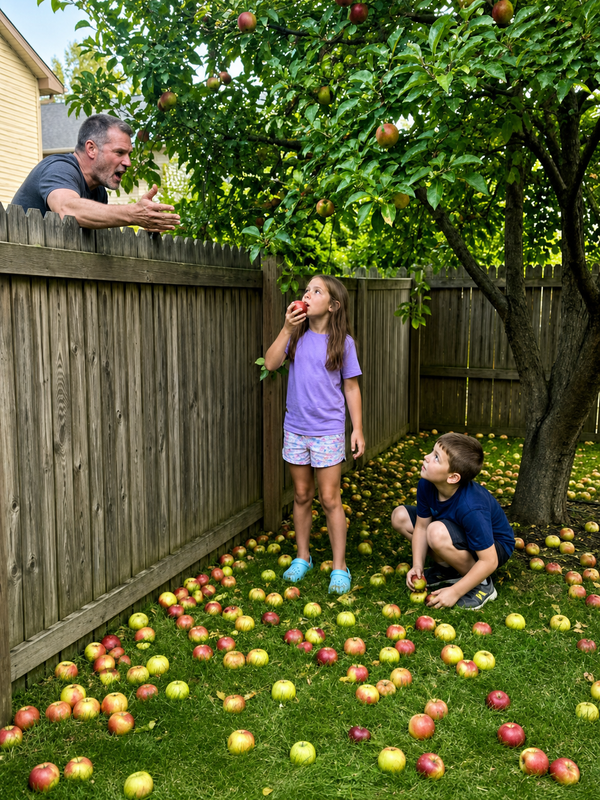
He looked straight at me and said, “Nice. Raising thieves young, are we?” Maya burst into tears. Leo just stood there with dirty hands and red ears, saying nothing, which somehow felt worse than crying would have.
The Fence-Line Demand
Dale is fifty-eight and has lived next door longer than we have. About a third of his apple tree hangs over our shared fence, and every August and September, fruit drops across our yard — into the flower beds, under the swing set, sometimes clear across the driveway. For six years I’d simply raked it up and bagged it without a second thought.
That Sunday, Maya and Leo were playing near the fence post when Dale came outside and told them the fallen apples were his and to bring every one to him. Confused, Leo pointed out the fruit had landed in their own yard. Dale told him it didn’t matter where it landed — it came from his tree.
They listened. Maya could only manage three apples at a time, so she made four trips across her own backyard while Dale stood on the other side of the fence, dropping each load into a bag. When I called his name, he didn’t even look up until the bag was tied shut — and that was when he called my children thieves.
I photographed the scene through the deck railing and sent the pictures to my husband, Rob, at work. He called within a minute, told me to send the photos to his personal email, and then said something that surprised me: don’t rake the yard this year. Leave every apple exactly where it falls.
When Rob got home, he knelt beside Leo, who was quietly arranging his Legos in careful rows the way he does when something’s wrong. Rob told him plainly that he hadn’t done anything wrong — he’d simply listened to an adult, the way kids are taught to. The problem, Rob said, belonged entirely to Dale.
Building the Case
Rob didn’t want to yell at Dale over the fence the way his own father used to argue with a difficult neighbor growing up — shouting matches that never actually fixed anything. Instead, he wanted something that would hold permanently. That meant documentation and, eventually, a lawyer.
Over the following weeks, we photographed the yard every few days, dated and organized, as the apples piled higher under the swing set and across the flower beds. Maya asked why we weren’t cleaning up like always. I told her Daddy was working on something, which was true, if incomplete. “Good,” she said. “He shouldn’t get to have them if he’s going to be mean about it.”
Rob found a lawyer, Priscilla Odom, who specialized in property disputes. She confirmed what Rob had suspected: fallen fruit legally belongs to whoever’s land it lands on, not to the tree’s owner. Dale had no right to demand it, and certainly no right to direct our children to hand it over.
She also explained the second piece — that overhanging branches can legally be trimmed back to the property line without the tree owner’s permission, as long as the work doesn’t cross onto their land or kill the tree. It was a right we’d simply never known we had.
Priscilla drafted a calm, formal letter outlining the law, describing what had happened to the children, and requesting that Dale never again give them instructions without going through Rob or me first. No threats, no lawsuit — just facts, laid out plainly on letterhead. We mailed it on a Thursday so Dale would have time to sit with it before any weekend encounter at the fence.
A Knock at the Door
The apples kept falling and kept lying there, untouched, for weeks. One Saturday I watched Dale pause in his own yard and stare at the drift of fruit stretching across our lawn — impossible, by then, to ignore. He said nothing and went back inside.
Five days after the letter arrived, Dale showed up at our front door — something he’d never done in six years of living beside us. He held the letter, visibly read more than once.
Rob told him plainly that the issue wasn’t really the apples. It was that Dale had made a six-year-old make four trips across her own yard carrying fruit to hand over, and then called her and her brother thieves. That was the part Rob couldn’t let go of.
Dale admitted he hadn’t thought about how it would land on a child — he’d been frustrated, thinking only about the work he put into the tree every year. Rob told him that frustration didn’t excuse directing it at kids, and that going forward, any request for apples needed to go through the parents, not the children.
Dale agreed. Two days later, he apologized to Leo and Maya in person at the fence, admitting he’d been wrong to call them thieves. Leo asked if Dale was still going to be mad about the apples. Dale said no — and meant it.
What Grew Back
The change wasn’t instant. Maya stayed wary of Dale for months, keeping her distance when he was outside. But slowly, something shifted. Dale began knocking lightly on the fence post before asking if it was a good time to collect apples, rather than assuming he was owed them.
Leo took to the new arrangement eagerly, filling a bucket kept by the back door and handing it over himself. Dale began leaving things in return — a jar of applesauce, once a warm pie wrapped in a dish towel. Maya, won over by the pie, eventually asked to invite him to dinner.
At that dinner, Dale told them about his late wife, Margaret, who had wanted the apple tree planted in the first place and had dreamed of one day making pies for the whole street. He said he’d never quite separated the apples from her memory, and that watching them go to waste each year had felt, in some way, like losing part of what they’d started together.
We never did call an arborist. The tree stayed exactly as it was, and the overhang that once caused years of quiet resentment became, instead, something shared.
Maya still keeps the first three apples that fall each September in a bowl on her windowsill, before any go to Dale or into a pie. When I asked her why, she looked at me as if the answer were obvious. “Because they’re mine,” she said. “And I like getting to decide.”