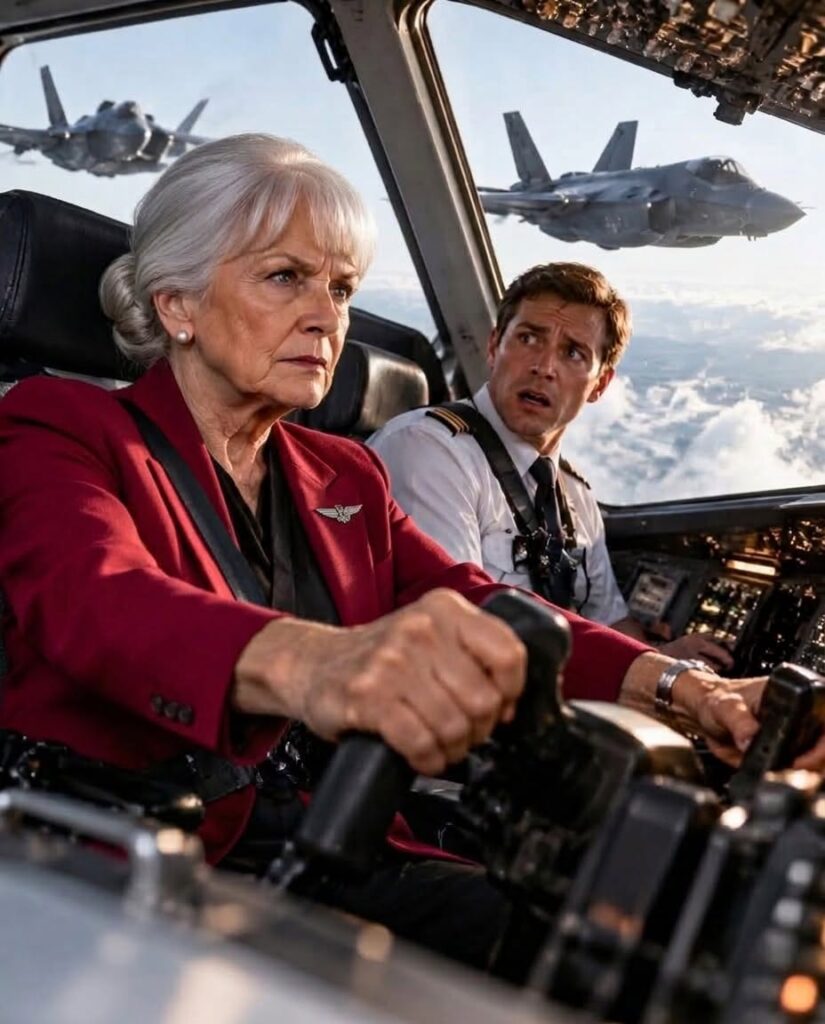
Pauline glanced toward the cockpit.
“Because I’ve heard it before.”
What the young pilot couldn’t know was that the gray-haired woman in the red jacket had once spent thousands of hours flying military and experimental aircraft.
And before the afternoon was over, he would be very glad she was on his flight.
Pauline had noticed the vibration before most passengers noticed anything.
The aircraft yawed slightly.
Then corrected.
Then did it again.
A flight attendant hurried through the cabin.
“Please remain seated. We’re experiencing a technical issue.”
Pauline listened.
Something was wrong with the left engine.
She had spent enough years around aircraft to recognize when an engine wasn’t producing stable thrust.
Then the cockpit door opened.
First Officer Mark Jensen stepped out.
He was pale.
Too pale.
Pauline stood.
“Is the captain all right?”
“Ma’am, please sit down.”
“Is he conscious?”
Mark stared at her.
That answered the question.
The aircraft lurched.
Several passengers screamed.
Mark grabbed a seatback.
Pauline lowered her voice.
“I used to fly.”
“That’s appreciated, but—”
“Military.”
He stopped.
“Test work too.”
Mark looked at her differently now, although not yet with belief.
“What aircraft?”
Pauline named several.
His expression changed again.
Those weren’t airplanes someone casually invented.
“Your credentials are current?”
“No. I’m retired.”
“Then I can’t just put you in the cockpit.”
“I didn’t ask you to.”
She pointed toward the cockpit.
“But if your captain is incapacitated and you’re handling an engine problem alone, you need another competent person up there more than you need me sitting in 14C.”
Mark disappeared into the cockpit.
Less than a minute later, he returned.
“Come with me.”
Pauline followed.
The captain was conscious but clearly unwell and unable to continue flying.
Mark had already declared an emergency and was coordinating with controllers.
Pauline sat in the available seat.
She didn’t take command.
She didn’t need to.
“Tell me what you need.”
Mark swallowed.
“Read the checklist.”
So she did.
Calmly.
Precisely.
No speeches.
No heroics.
Just two pilots dealing with a bad situation.
As the engine deteriorated, controllers began routing them toward the nearest suitable runway.
Because of their position and the nature of the emergency, military aircraft operating nearby were also alerted.
Eventually, two fighters appeared at a distance.
Passengers pressed their faces against the windows.
Pauline barely looked.
Her attention stayed on the instruments.
Mark’s hands were trembling.
“You okay?” she asked.
“I’m fine.”
“No, you’re not.”
He glanced at her.
“Neither would I be.”
That surprised him.
“You don’t look scared.”
Pauline gave him the faintest smile.
“That’s because I’ve had more practice being scared.”
The damaged engine continued losing power.
Mark worked the controls while Pauline handled checklists, communications when needed, and monitored the aircraft’s condition.
At one point he began correcting aggressively after another sudden yaw.
“Easy,” Pauline said.
He eased his input.
The aircraft settled.
Mark exhaled.
“How did you know?”
“I’ve made that mistake before.”
That answer seemed to calm him more than anything else she’d said.
Not I’m better than you.
Not I’ve survived worse.
Just:
I’ve made that mistake before.
They continued toward the runway.
The landing was hard.
But it was safe.
The aircraft touched down, rolled long and finally came to a stop surrounded by emergency vehicles.
For several seconds, the cockpit was silent.
Then cheering erupted behind them.
Mark leaned back.
His face was soaked with sweat.
Pauline removed her headset.
“You did well.”
He stared at her.
“I nearly told you to sit down.”
“You did tell me to sit down.”
Despite everything, he laughed.
Then his expression became serious.
“Who exactly are you?”
Pauline looked at the old silver aviation pin on her jacket.
“Nobody important anymore.”
That turned out not to be entirely true.
Emergency personnel boarded first.
The captain was taken for medical evaluation.
Passengers were escorted off.
Pauline expected to collect her handbag and disappear into the terminal.
Instead, an Air Force officer approached her.
“Mrs. Sanders?”
“Yes?”
“Were you Pauline Sanders with the Air Force flight-test program?”
She paused.
“It was a long time ago.”
The officer smiled.
“My commander would like to meet you.”
Mark was standing nearby.
He looked from Pauline to the officer.
“Wait.”
He pointed toward her.
“You were a test pilot?”
Pauline sighed.
“Among other things.”
“How many hours?”
“Enough.”
“What did you fly?”
“A little of everything they were willing to let me break.”
The officer laughed.
Mark didn’t.
He was realizing exactly how badly he’d misjudged the elderly woman he’d nearly sent back to her seat.
Pauline’s career wasn’t famous.
Much of her work had happened decades earlier, and some projects had remained classified long after she retired.
She had never become a household name.
There were no crowds waiting to salute her.
No secret aircraft hidden beneath a sheet.
No general standing on the runway with medals.
There was simply an old personnel record confirming that Pauline Sanders had been exactly what she’d claimed:
An experienced military aviator who had later participated in flight-test programs during the Cold War.
And on that particular afternoon, she had happened to buy a ticket on the right airplane.
Mark found her later while passengers waited for transportation.
“I owe you an apology.”
Pauline looked up from her coffee.
“For what?”
“I saw an elderly woman standing in my aisle and decided you couldn’t possibly know anything I didn’t.”
“That wasn’t your biggest mistake.”
He frowned.
“What was?”
“You let being embarrassed stop you from listening.”
Mark sat across from her.
She continued.
“You were under enormous pressure. Your captain became incapacitated. You had an aircraft problem and hundreds of people behind you.”
“I was terrified.”
“Of course you were.”
“I thought pilots weren’t supposed to admit that.”
Pauline smiled.
“Who told you that nonsense?”
He laughed quietly.
Then she became serious.
“Fear wasn’t the problem. Pride almost was.”
Mark nodded.
“I know.”
“But you corrected it.”
He looked surprised.
“When it mattered, you listened. Remember that part too.”
News of the emergency spread.
So did Pauline’s name.
Aviation journalists began digging.
Former colleagues called.
Old photographs surfaced.
One showed Pauline in a flight suit beside an experimental aircraft, decades younger but unmistakably the same woman.
Another showed a group of test pilots standing on a desert runway.
Pauline was the only woman among them.
For years, she’d been comfortable leaving that life behind.
Now strangers suddenly wanted interviews.
She declined most of them.
One reporter finally asked:
“Do you consider yourself a hero for what happened?”
Pauline shook her head.
“The first officer landed the airplane.”
“But you helped him.”
“Yes.”
“Then what should people take from this?”
She thought for a moment.
“Experience doesn’t always arrive looking the way you expect.”
Before they separated, Mark approached with his flight log.
He hesitated.
“This might sound ridiculous.”
“It probably will.”
“Would you sign it?”
Pauline laughed.
Then she took his pen.
She didn’t write anything grand.
Just:
Keep learning. Keep listening.
She handed it back.
Mark read it.
“I expected something about courage.”
“You already have courage.”
She tapped the book.
“Listening is harder.”
He smiled.
This time, there was no arrogance in it.
“Thank you, Pauline.”
She picked up her bag.
“Next time an old woman tells you your engine sounds terrible, at least hear her out.”
He laughed.
“I promise.”
Pauline walked toward the terminal.
No military band waited for her.
No cameras followed every step.
She was simply an elderly woman in a red jacket carrying an old handbag.
But Mark watched until she disappeared into the crowd.
Hours earlier, he’d looked at her gray hair and decided he knew what she was capable of.
Now he understood something that no simulator had ever taught him:
Sometimes the most experienced person in the room is the one everyone has already stopped noticing.