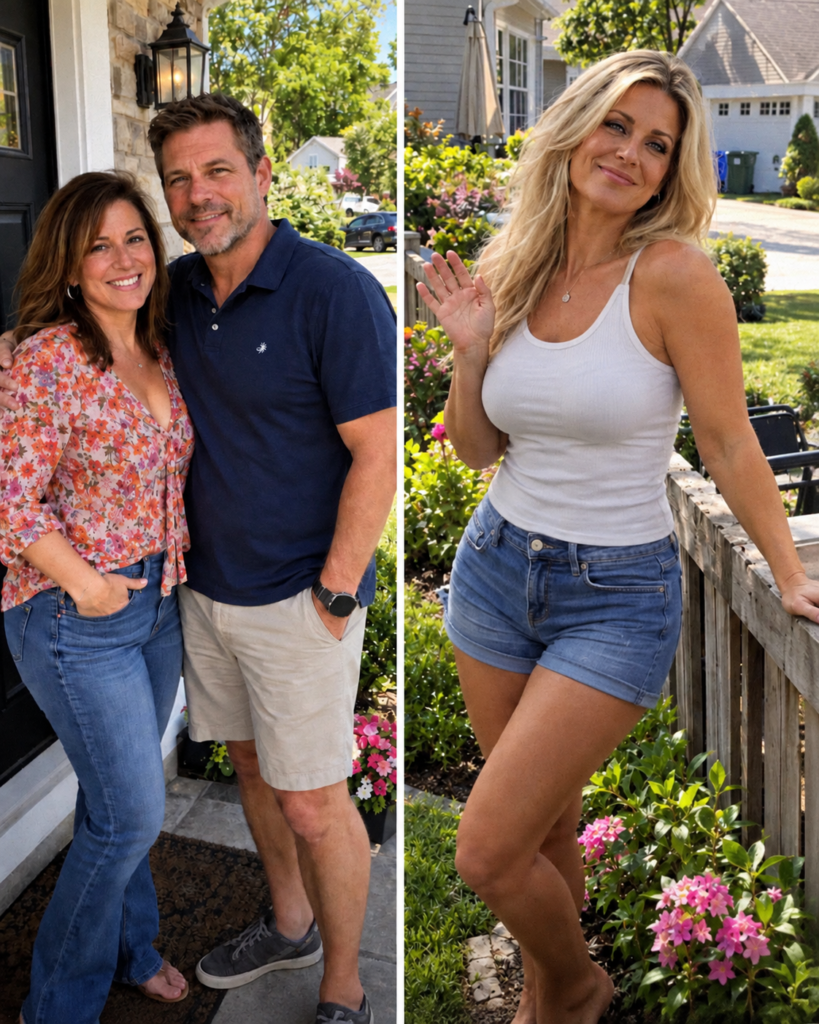
Beautiful.
Confident.
And, at least at first, seemingly lonely.
I actually felt sorry for her.
I baked her an apple pie as a welcome gift.
Helped her unpack a few boxes.
Invited her over for coffee.
Looking back, that was probably the first mistake.
Within weeks, Vanessa developed a strange dependence on my husband, Irvin.
Whenever something needed fixing, moving, opening, tightening, lifting, or checking, she called him.
Not a plumber.
Not a handyman.
My husband.
At first, the requests sounded harmless.
A jar she couldn’t open.
A smoke detector battery she couldn’t reach.
A loose cabinet handle.
Then she asked him to move a shelf eight inches to the left.
Two days later, she asked him to move it back.
Irvin was naturally helpful.
He stopped for stranded drivers.
Carried groceries for elderly neighbors.
Helped people before they asked.
He saw Vanessa as a newly divorced woman adjusting to life alone.
I saw the way she watched him.
One afternoon, I was carrying a casserole into her kitchen while Irvin tightened a cabinet hinge.
Vanessa leaned against the counter and smiled.
“Look at those forearms.”
I stopped.
Then she looked directly at me.
“Claire is the luckiest woman on the street. Though I bet she’s too busy with all that flour to notice.”
The flour comment wasn’t random.
I ran a bakery from our converted garage.
For six years, I had built that business one order at a time.
Cakes.
Bread.
Cookies.
Wedding orders.
Corporate events.
Vanessa knew exactly how much work I put into it.
That evening, I told Irvin what I thought.
“She isn’t helpless.”
He frowned.
“What do you mean?”
“She’s manufacturing reasons to get you alone.”
He actually looked surprised.
“You think she’s flirting with me?”
“I know she is.”
He laughed once.
“Nobody asks someone to move the same shelf twice because they desperately need help.”
That made him stop.
Then he nodded.
“Okay.”
He promised he would stop going over every time Vanessa invented some emergency.
I believed him because Irvin had never given me a reason not to.
Then Vanessa removed any remaining doubt.
A few days later, she came over while Irvin was at work.
We were sitting at my kitchen table.
She took a sip of coffee.
Then smiled.
“I’m going to take your husband.”
For a second, I thought she was joking.
I laughed.
She didn’t.
“You should probably start preparing for divorce,” she continued. “Men get bored after that many years.”
I stared at her.
“You came into my house to tell me this?”
“I’m being honest.”
She leaned back in the chair.
“Woman to woman.”
There was something so casual about the way she said it.
As if she were warning me that rain was coming.
I stood.
Picked up her coffee.
Carried it to the sink.
“Then woman to woman,” I said, “you should go home.”
That night, I told Irvin everything.
His expression changed the second I repeated her words.
“She actually said that?”
“Every word.”
He shook his head.
“Then I’m done helping her.”
And he meant it.
When she called about a strange noise in her garage, he told her to contact pest control.
When she texted about a sticking door, he sent her a handyman’s number.
But Vanessa didn’t stop.
She simply stopped pretending.
She leaned across the fence when Irvin was outside.
Brought cookies she claimed she had made too many of.
Found excuses to touch his arm.
Every time, he stepped away.
Then she announced a neighborhood barbecue.
Irvin got an invitation.
I didn’t.
He showed it to me.
“I’m not going.”
I looked out the window toward Vanessa’s house.
Then thought about all the little emergencies she had invented.
The jar.
The shelf.
The lights.
The hinges.
And suddenly, an idea formed.
“Actually,” I said, “I think you should go.”
Irvin stared at me.
“Why?”
“Trust me.”
He studied my face.
Then slowly smiled.
“Should I be worried?”
“Not about me.”
The next afternoon, Irvin went to the barbecue alone.
I waited half an hour.
Then walked next door carrying a large gift box.
Vanessa’s backyard was crowded.
Neighbors held paper plates and plastic cups.
Conversations slowed as I walked through the gate.
Irvin saw me first.
He had to hide a smile.
Vanessa didn’t.
“What are you doing here?”
“I brought you a hostess gift.”
I placed the box on the patio table.
“Open it.”
By then, half the yard was watching.
Vanessa lifted the lid.
Inside was a hammer.
A full screwdriver set.
Three types of batteries.
Lightbulbs.
A jar opener.
A basic home-repair guide.
And a printed list of four local handymen.
Her smile disappeared.
“Now you don’t need my husband anymore.”
A nervous laugh moved through the crowd.
Vanessa forced one too.
“Oh my God, Claire. This is so dramatic. I was joking.”
“No, you weren’t.”
The laughter died.
“You sat in my kitchen and told me to prepare for divorce because you were going to take him.”
Vanessa turned toward Irvin.
Maybe she expected him to save her.
Instead, he walked over and put his arm around me.
“Claire’s right.”
Vanessa’s face went red.
“Don’t call me for things around your house anymore. If something breaks, use one of those numbers.”
I didn’t make a speech.
I took Irvin’s hand.
We left.
By the time we reached our porch, people were already starting to leave the barbecue.
For about forty minutes, I felt incredible.
Then I started wondering what Vanessa would do after being humiliated in front of the neighborhood.
The answer came quickly.
First, petty complaints.
Someone reported our lawn mower being used at noon.
Then there was an anonymous note about our trash cans being visible from the street.
Annoying.
Harmless.
Then the real letter arrived.
I read it twice.
My bakery was ordered to stop operating from our property pending a compliance review.
I felt sick.
I had food permits.
Passed inspections.
Everything seemed legitimate.
What I didn’t have, I discovered after several frantic phone calls, was proper approval to use the converted garage itself for commercial activity.
Irvin had renovated it years earlier.
A contractor handled the work.
We both believed all the paperwork had been completed.
“I thought it was done,” Irvin said, holding the letter.
He looked pale.
“Claire, I swear.”
“I know.”
That was what made it worse.
Vanessa had not invented the problem.
She had found a real one.
I had a wedding cake for sixty people due in nine days.
A corporate order for two hundred cookies after that.
Ingredients had already been purchased.
Deposits had already been used for supplies.
My ovens were suddenly useless.
That evening, Vanessa came to our porch carrying a bottle of wine.
“I’ve come to make you an offer.”
Irvin folded his arms.
“What?”
She looked at me.
“Tell the neighborhood you lied.”
I stared at her.
“You misunderstood an innocent friendship,” she continued. “You embarrassed me because you were jealous. Publicly apologize.”
“No.”
Irvin stepped forward.
“Get off our porch.”
Vanessa smiled.
“You have until tomorrow morning to reconsider.”
She left the bottle of wine on the railing.
Then walked home.
The door had barely closed when Irvin rubbed both hands over his face.
“Don’t get angry.”
I looked at him.
“But maybe we should think about it.”
I stared at him.
“We know the truth,” he said quickly. “She knows the truth. Why risk six years of your business over an apology nobody important will believe?”
“Because then she learns she can hurt us until we say whatever she wants.”
“And if we don’t, you could lose everything you built.”
Neither argument was ridiculous.
That was the problem.
The next morning, Vanessa made good on her threat.
My phone started filling with messages from neighbors.
She had circulated screenshots between herself and Irvin.
“Can you come over? I need you.”
His reply:
“Give me ten minutes.”
Another:
“You’re a lifesaver. ❤️”
Irvin:
“Anytime.”
Standing alone, the messages looked warm.
Too warm.
I looked at him.
“You knew she was flirting with you.”
“I had no interest in her.”
“That wasn’t the question.”
He went quiet.
“Why did you keep going over?”
“Because I thought it was obvious I wasn’t interested.”
“It wasn’t enough for it to be obvious to you.”
That landed.
Two days later, one of my wedding customers canceled.
She said she had heard there was “trouble” with my bakery and couldn’t risk the order.
I stared at the message until the words blurred.
Vanessa wasn’t just embarrassing me anymore.
She was costing me money.
That night, I put my phone on the kitchen table.
“We post everything.”
Irvin frowned.
“Everything?”
“Full screenshots. Dates. Every conversation.”
He shook his head.
“No.”
“What do you mean no?”
“I mean we’re not turning our marriage into neighborhood entertainment.”
“She already did.”
“Then we don’t help her.”
I snapped.
“Your weak boundaries are part of the reason we’re here.”
The words hurt him.
I saw it immediately.
But I wasn’t wrong.
“I’m not protecting Vanessa,” he said quietly. “I’m trying to protect you. I built that garage.”
“And I’m the one losing customers.”
We sat in silence.
Both angry.
Both trying to protect the same life in completely different ways.
Then Vanessa texted.
“Last chance. Apologize publicly at the HOA meeting on the 14th. I’ll be expecting you.”
Irvin held out his hand.
“Give me your phone.”
He put Vanessa’s screenshots beside the original conversations on his own device.
Then stopped.
“Claire.”
“What?”
“Come here.”
Vanessa had not merely selected certain messages.
She had cropped them.
One of her screenshots showed her writing:
“Wish I had a man like you.”
But she had removed Irvin’s response:
“You’ll find one. I’ve already got the woman I want.”
Another showed:
“You’re the only man I can rely on.”
Missing from the screenshot was Irvin’s reply:
“You need to stop saying things like that. Claire is my wife.”
I stared at the phone.
Now we had proof.
But we still had a problem.
The messages could expose Vanessa’s dishonesty.
They could not make the garage legal.
She could lie about my husband and still be right about my business.
That was when the answer became obvious.
“I’m closing the garage.”
Irvin looked at me.
“That’s exactly what we’re trying to avoid.”
“No.”
I shook my head.
“That’s why she has leverage.”
He didn’t speak.
“She can only threaten us with something we’re still trying to hide from.”
So I did the painful thing first.
I called every customer.
Refunded orders I couldn’t fulfill.
Postponed what I could.
Then rented space in a licensed commercial kitchen across town.
It was expensive.
Fluorescent.
It smelled like bleach.
I hated it.
But it was legal.
Meanwhile, Irvin started the approval process for our garage.
Then he placed his phone beside mine.
“If she wants those messages discussed at the HOA meeting,” he said, “we’ll discuss them.”
“All of them.”
“No cropping.”
“No editing.”
When Vanessa texted again asking whether I was ready to “do the right thing,” I replied with three words.
“We’ll be there.”
The HOA meeting was held in the community room.
Vanessa spoke first.
She described herself as a lonely divorced woman who had accepted innocent help from a neighbor.
According to her, I had become jealous and humiliated her publicly.
She mentioned the bakery violation.
Then she mentioned the screenshots.
When she finished, I stood.
“She’s right about the garage.”
Vanessa’s head snapped toward me.
I continued.
“It wasn’t properly approved for commercial use.”
The room became quiet.
“That was our mistake.”
I looked around.
“I stopped baking there. Refunded the customers I couldn’t serve. Rented a licensed kitchen. We’ve already started the correct approval process.”
Then I looked directly at Vanessa.
“So there’s nothing left to bargain with.”
Her face changed.
“This isn’t about the bakery.”
“No?”
“It’s about your husband leading me on.”
I sat down.
Irvin stood.
“She’s partly right about me too.”
For a second, Vanessa looked triumphant.
Irvin continued.
“I should have set boundaries sooner.”
Her smile grew.
“I kept helping her after I knew she was flirting.”
Then he looked at the room.
“That was my mistake.”
Vanessa almost looked relieved.
“But being slow to establish a boundary is not the same as returning someone’s interest.”
He connected his phone.
Displayed the full conversations.
The room read the messages Vanessa had shared.
Then the missing replies.
“You’ll find one. I’ve already got the woman I want.”
“Claire is my wife.”
The room became very quiet.
Vanessa’s face tightened.
“Fine.”
Her voice cracked.
“But Claire still humiliated me in public.”
“I did.”
She blinked.
“What?”
“I humiliated you.”
She looked confused.
“Then why are you here if you’re not going to apologize?”
“Because you wanted everything discussed publicly.”
I held her gaze.
“So we’re discussing everything publicly.”
She looked around the room.
“I can still report the bakery.”
“It’s already closed.”
Her mouth opened.
Nothing came out.
“Until the garage is approved.”
And just like that, she had nothing left.
No secret.
No leverage.
No threat.
The meeting moved on.
No one cheered.
Nobody needed to.
The silence was heavier than applause.
Neighbors who had defended Vanessa stopped doing it.
People simply turned toward the next agenda item.
Vanessa gathered her things and left alone.
The months afterward were not magically easy.
The temporary kitchen cost a fortune.
Some customers never returned.
The approval process took longer than expected.
But eventually, the garage passed inspection.
The morning I turned the ovens back on at five o’clock, Irvin stood in the doorway holding two cups of coffee.
We both stared at the ovens warming.
Then he smiled.
“Welcome home.”
He changed too.
He stopped automatically becoming the neighborhood handyman.
Not because helping people was wrong.
Because he finally understood that good intentions were not enough when someone repeatedly tested the boundaries of our marriage.
Boundaries had to be visible.
Not assumed.
And I learned something just as important.
Vanessa had almost controlled us because we were terrified of what would happen if she exposed a real mistake.
The garage paperwork really was wrong.
Pretending otherwise would have kept her powerful.
The moment we admitted it, fixed it, and accepted the consequences ourselves, she lost the ability to use it against us.
For a long time, I thought winning meant exposing Vanessa.
It didn’t.
Winning was refusing to let her decide which truths we were allowed to face.
My marriage survived.
My bakery survived.
But neither came out exactly the same.
Irvin learned that being faithful was not only about saying no to an affair.
Sometimes it meant setting a boundary long before things reached that point.
And I learned that defending yourself does not always mean proving you did nothing wrong.
Sometimes the strongest thing you can say is:
“Yes. That part was my mistake.”
Then fix it.
Because once you stop being afraid of the truth, people lose the power to threaten you with it.