In the living room, our four-year-old twins, Mateo and Sophia, were building a tower out of colorful blocks.
Six years of marriage.
Six years of raising children.
Six years of making sure the bills were paid, the refrigerator was full, the school forms were signed, and Julian never had to worry about what happened behind the scenes.
And this was how he saw me.
A woman with no value because I worked from home.
Julian had recently been promoted to sales director at a medical supply company.
He earned around eighty thousand dollars a year.
Ever since the promotion, something had changed in him.
He had always been ambitious.
Now he had become arrogant.
“Look at you,” he said, staring at me.
“I spend all day around polished, successful people. Executives. Professionals. Then I come home and you’re standing here looking like a line cook.”
I said nothing.
He gestured toward the kitchen.
“Cooking. Cleaning. Stuck in this apartment.”
What Julian didn’t know was that I had spent years quietly protecting his ego.
I wasn’t unemployed.
I was a freelance graphic designer working with corporate clients in the United States and Europe.
Some months I earned eight thousand dollars.
Other months, twelve thousand.
Sometimes more.
I had quietly covered most of our household expenses.
Preschool.
Health insurance.
Utilities.
Groceries.
I had even transferred money into Julian’s personal account so he could send it to his mother, Teresa.
Why?
Because Julian loved being seen as the successful son who took care of everyone.
I let him have that image.
Apparently, my silence had convinced him the image was real.
I picked up the divorce papers.
He was asking for sole legal and physical custody of the twins.
According to the petition, I had no formal employment.
No verifiable income.
No ability to provide stability.
He wasn’t simply trying to end our marriage.
He was trying to erase my role inside it.
Julian stood there waiting for me to cry.
To beg.
To panic.
Instead, I picked up a blue pen.
And signed the acknowledgment form.
“I’m leaving with the children tomorrow.”
His smirk disappeared.
“Just like that?”
“You asked for this.”
“You’re not even going to fight?”
I capped the pen.
“Oh, I’m going to fight.”
Then I looked toward Mateo and Sophia.
“Just not tonight.”
What Julian didn’t know was that I had already been preparing.
For weeks, he had been coming home later.
Keeping his phone face-down.
Taking calls outside.
So I had quietly leased a bright three-bedroom apartment nearby in an excellent school district.
The next morning, I packed three suitcases.
Loaded the twins into the car.
And left.
That afternoon, I met my old college friend Chloe at a coffee shop.
She worked in HR at Julian’s company.
The moment I sat down, she pushed a thick envelope toward me.
“Before you convince yourself this is just about him falling out of love, you need to see this.”
Inside were photographs.
Julian holding hands with another woman.
Restaurants.
Hotels.
Weekend trips.
Her name was Victoria.
She was the daughter of an influential hospital executive Julian’s company desperately wanted to impress.
I kept turning through the pictures.
Then Chloe said something that made my hands go cold.
“There’s more.”
I looked up.
“Victoria can’t have biological children.”
I frowned.
“What does that have to do with me?”
“Julian has been telling people around the office that he plans to get full custody of the twins.”
I stopped breathing for a moment.
Chloe continued.
“He wants to present himself to Victoria’s family as the complete package.”
“What does that mean?”
“The successful executive. Devoted father. Two adorable children. Ideal future son-in-law.”
I stared at her.
My children.
Not his career.
Not his image.
My children.
He wasn’t suddenly fighting for custody because he had discovered some deeper devotion to fatherhood.
He was building a presentation.
And Mateo and Sophia were part of it.
Then Chloe showed me saved office messages.
Julian had already been telling people I was financially dependent.
Lazy.
Unmotivated.
Barely employed.
He wasn’t preparing for divorce.
He was preparing a story.
So I prepared mine.
The next morning, I printed three years of tax returns.
Client contracts.
Invoices.
Bank statements.
My documented annual income was almost twice Julian’s.
Then I hired Richard Vance, a family law attorney in downtown Chicago.
Richard spent nearly an hour reviewing the paperwork.
Then he looked up.
“Mariana, your problem has never been a lack of resources.”
He tapped the bank statements.
“Your problem is that you let your husband and his family behave as though your contributions were invisible.”
He was right.
I didn’t want Julian’s car.
I didn’t care about furniture.
I didn’t care about winning every marital asset.
I wanted my children safe.
That was it.
When Julian discovered where we were living, he showed up furious.
He walked through the apartment staring at the furniture.
The twins’ bedrooms.
My professional workstation.
Dual monitors.
Client files.
Design equipment.
“Where did you get the money for this?”
“I earned it.”
He actually laughed.
“You? Doing those little jobs online?”
I handed him a printed bank statement.
He read the numbers.
And for the first time since the divorce papers appeared, Julian looked unsure.
“You don’t know nearly as much about me as you think,” I said.
“You never bothered to ask.”
Then I said one word.
“Victoria.”
His expression collapsed.
“I can explain.”
“I’m not interested.”
“It isn’t what you think.”
“I know exactly what it is.”
I looked toward the hallway where the twins were playing.
“And I know why you want custody.”
His face hardened.
“You’re going to regret making this ugly.”
“No.”
I held his gaze.
“I’m going to make sure the children don’t pay for what you’re doing.”
Over the following two weeks, Julian started buying them expensive gifts during visitation.
Tablets.
Designer clothes.
An enormous electric ride-on car.
Then Mateo came home talking about how Daddy said the toy could stay at his house forever.
“If what?” I asked.
Mateo looked down.
“If I tell the judge I want to live with Daddy.”
My stomach tightened.
Richard warned me not to interfere with the temporary visitation arrangement while the court considered emergency orders.
I listened.
Until Sunday evening.
Julian brought the twins home just before dark.
Mateo immediately ran toward me and wrapped himself around my legs.
Sophia walked slowly behind him.
Crying.
“What happened?”
Julian barely looked at her.
“She’s upset over nothing.”
Then he checked his watch.
“Kids get emotional.”
He left.
I knelt beside Sophia.
When I unbuttoned her cardigan, I saw a dark mark on her upper arm.
My whole body went cold.
“Sophia, sweetheart, what happened?”
She looked at the floor.
Mateo answered from behind me.
“The lady did it.”
“What lady?”
“The lady at Daddy’s new house.”
Victoria.
Julian had stepped onto the balcony to take a work call.
Sophia tried to follow him.
Victoria grabbed her arm and pulled her back inside.
“She said Sophia was too noisy,” Mateo whispered.
He took his sister’s hand.
“And she said if we’re going to live there, we have to learn to listen.”
Something inside me became very calm.
Julian could insult me.
He could lie about my career.
He could tell people I contributed nothing.
But my daughter had come home with a visible mark.
That changed everything.
We went straight to urgent care.
The injury was documented.
An official report was filed.
Richard was called.
The next morning, we walked into family court.
Julian arrived in a three-piece suit.
His mother Teresa was with him.
So was his sister Daniela.
And an attorney who probably billed more per hour than some people earned in a week.
Teresa looked me up and down.
“Look at her,” she said loudly.
“Dressing like she’s somebody important now.”
I ignored her.
She still believed I was the helpless housewife she had spent six years dismissing.
She had no idea what Richard had in his briefcase.
The hearing began.
Julian’s lawyer spoke first.
He described Julian as stable.
Successful.
A dependable corporate executive.
Then he described me.
Unemployed.
Dependent.
Without a conventional career.
Without financial stability.
Julian sat there with his hands folded, wearing that same confident smile.
I let him.
Then Richard stood.
“Your Honor, Mrs. Lopez is not unemployed.”
The courtroom went quiet.
“She is an independent senior digital designer with substantial documented income.”
He submitted my tax returns.
Corporate contracts.
Bank statements.
Verified monthly deposits between eight and twelve thousand dollars.
Julian’s attorney stopped writing.
Teresa stared at me.
Daniela looked like she had never seen me before.
Then Richard continued.
“For the previous four years, Mrs. Lopez covered more than sixty percent of the household’s operating expenses.”
Preschool.
Insurance.
Groceries.
Utilities.
All documented.
Then came the transfers.
Money from my account.
Into Julian’s account.
Money Julian later sent to Teresa while pretending it came from him.
Teresa slowly turned toward her son.
For once, Julian wouldn’t look at her.
But Richard wasn’t finished.
“Financial standing, however, is secondary to the well-being of the children.”
He opened another folder.
The messages between Julian and Victoria appeared.
One read:
“Once I have full custody, we’ll have the complete family package. Your dad will see I’m executive material.”
Another:
“What if Mariana fights it?”
Julian’s reply:
“She can’t fight. She has no job, no money, and no resources.”
I watched his confidence disappear.
His attorney challenged the messages.
Richard produced a forensic report confirming the metadata.
Then the child advocate was called.
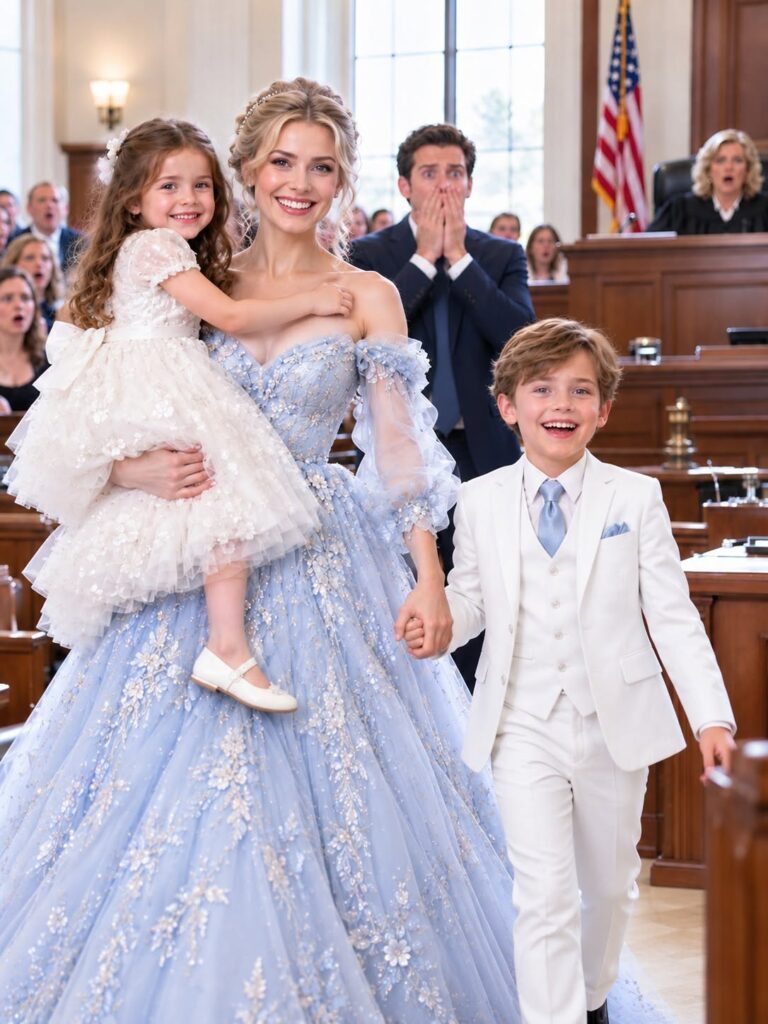
Mateo and Sophia entered through a side door with a counselor.
Sophia wore long sleeves.
Julian leaned toward Mateo.
“Hey there, champ.”
Mateo didn’t smile.
He held Sophia’s hand.
The judge spoke gently.
“You don’t need to tell me what Mommy wants or what Daddy wants. I only want you to tell me how you feel.”
Mateo looked toward the bench.
“I want to stay with Mommy.”
Julian’s face changed.
“Why?” the judge asked.
Mateo hesitated.
“Because Mommy stays when we’re scared.”
The room became very still.
Then Mateo continued.
“Daddy said if we lived with him, the lady would buy me a big electric car.”
“Do you want the car?”
Mateo shook his head.
“No.”
“Why not?”
“Because when Daddy went outside, Sophia cried.”
He tightened his grip on her hand.
“And the lady grabbed her really hard.”
The medical photographs were introduced.
Julian suddenly stood.
“Kids get marks all the time!”
Mateo jumped at the sound of his voice.
The judge ordered Julian to sit down.
Then my four-year-old son looked at his father.
“Daddy, you told me not to tell anybody.”
Everything stopped.
Julian stared at him.
The judge leaned forward.
“Your father told you to keep something secret?”
Mateo nodded.
“He said Mommy would get mad.”
“What else did he say?”
“He said if I told the judge I wanted to live with him, I’d get the car.”
Sophia began crying.
“I don’t want a new mommy.”
She leaned against Mateo.
“I just want my mommy.”
I had to look down because I couldn’t hold myself together.
Julian’s attorney requested a recess.
When they returned, his entire posture had changed.
His lawyer stood.
“My client is withdrawing his request for sole custody.”
Julian turned toward him.
“I did not agree to that.”
His attorney leaned closer.
Then spoke loudly enough for the judge to hear.
“I am advising you to accept this arrangement while the circumstances surrounding your daughter’s injury are investigated.”
Julian slowly sat down.
The judge granted me temporary sole physical and legal custody.
Julian was ordered to pay child support.
His visitation became supervised.
When the ruling ended, I cried.
Not because I felt like I had beaten him.
Because for months, I had imagined waking up in a home where my children’s bedrooms were empty.
I had pictured them somewhere else, scared, unable to reach me.
Now I could finally breathe.
In the lobby, Mateo dropped his crayons and ran into my arms.
“Did we win?”
I knelt down and pulled both children close.
“It wasn’t a race, sweetheart.”
Sophia looked up at me.
“Are we going home?”
I kissed her forehead.
“Yes.”
“We’re going home.”
Teresa was standing near the elevators.
For the first time since I met her, she had nothing cruel to say.
She saw the mark on Sophia’s arm.
Then looked at Julian.
“Did you know about that?”
Julian didn’t answer.
Teresa’s eyes filled.
“She’s your daughter.”
Even Daniela kept her head down.
Several days later, Chloe called.
Victoria had ended the relationship.
Once the custody hearing reached her family, her father wanted distance from Julian.
Within weeks, Julian was also removed from his sales-director position after an internal review.
The status he had valued so much disappeared almost as quickly as the life he had been trying to manufacture.
As for me, I finally did something I had postponed for years.
I leased a commercial loft downtown.
Then I opened my own boutique branding agency.
M&S Creative.
Mateo and Sophia.
On my first official day in the office, Mateo drew a picture.
Three people holding hands beneath a yellow sun.
“That’s us,” he said.
“Why did you draw us so big?”
He smiled.
“Because now we have lots of room.”
I thought about that sentence for weeks.
I believed I had only moved us out of an unhappy apartment.
But the twins taught me something bigger.
We had spent years making ourselves smaller around Julian.
Speaking carefully.
Avoiding conflict.
Protecting his ego.
Pretending his success mattered more than everyone else’s comfort.
Now we had room.
Room to speak.
Room to breathe.
Room to exist without apologizing.
Julian eventually completed counseling and began supervised visits.
He stopped making demands.
The excuses became fewer.
Maybe one day he understood what he had done.
Maybe he didn’t.
Eventually, I realized it no longer mattered.
I didn’t need his apology to move forward.
Financial independence hadn’t magically made me a better mother.
But it gave me options when my life changed overnight.
I could hire an experienced attorney.
I could provide a safe home.
I could refuse to let my children become props in someone else’s idea of success.
And my four-year-old son understood something his father had missed completely.
Mateo didn’t care about an electric car.
He didn’t care about a bigger house.
He didn’t care about expensive clothes.
When the judge asked what mattered, his answer was simple.
He wanted the person who stayed when he was scared.
The night Julian put those divorce papers on my kitchen table, he believed he was taking everything away from me.
He thought I had no career.
No money.
No power.
No future without him.
In reality, he had opened a door I had been too afraid to walk through.
Yes, I lost a marriage.
But I got something back.
My voice.
My work.
My dignity.
And most importantly, I protected my children from growing up believing that love means making yourself smaller so somebody else can feel important.