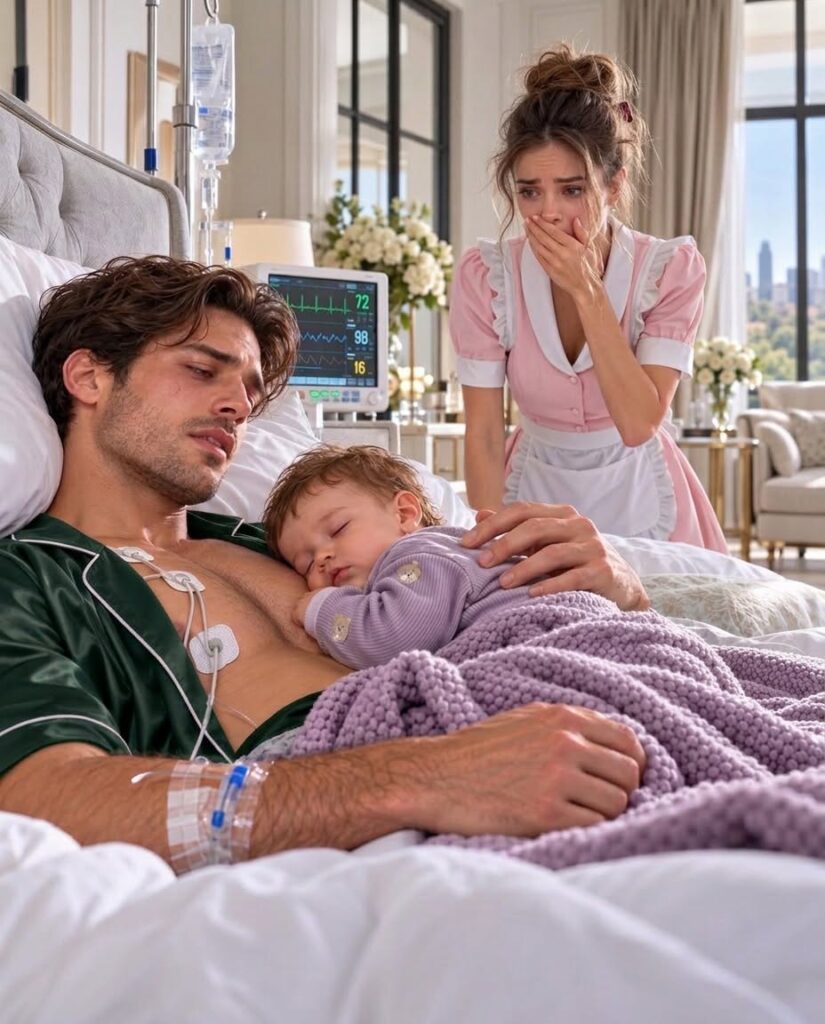
He couldn’t speak.
Couldn’t sit up.
Barely moved.
Yet when I placed my nine-month-old son Theodore against his chest for a moment, Raymond’s fingers slowly curled around the edge of the blue blanket.
“Mr. Winslow?”
His eyelids moved.
Then one eye opened.
He looked directly at me.
And I realized he had been conscious all along.
I was Raymond’s live-in caregiver because I desperately needed the job.
More importantly, it was one of the few positions that allowed Theodore to live with me.
Raymond was forty-six and extremely wealthy, having built a successful regional transportation company.
His nephew Christopher practically ran the estate while Raymond lay upstairs.
He also talked about Raymond’s death with disturbing ease.
Funeral arrangements.
Estate documents.
What would happen to the company.
Which properties might be sold.
I’d assumed that was simply how wealthy families handled impending death.
Now I wasn’t so sure.
That first night, Raymond could barely communicate.
One blink for yes.
Two for no.
By the following afternoon, he managed a few whispered words.
“Don’t tell Christopher.”
“Tell him what?”
“That I’m awake.”
I leaned closer.
“Why?”
Raymond swallowed painfully.
“Because I don’t think I’m dying naturally.”
That afternoon, Raymond’s physician arrived.
Dr. Wallace carried medication into the bedroom and administered something through Raymond’s IV.
I didn’t interfere.
I wasn’t a doctor.
But I watched.
Within minutes, Raymond’s responsiveness diminished dramatically.
His breathing changed.
The small movements he’d regained disappeared.
Dr. Wallace packed the medication away rather than leaving it with the other supplies.
“He’s deteriorating,” he told me.
“How long?”
“Perhaps five days.”
After he left, I wrote down everything I remembered.
Time.
Medication packaging.
What I’d observed before and afterward.
Then I waited.
Hours later, Raymond’s fingers began moving again.
That was enough.
I wasn’t going to experiment with his medication or attempt to diagnose him myself.
Instead, when Raymond could communicate again, I asked:
“Is there anyone outside this house you trust?”
One blink.
“Attorney?”
Another blink.
Raymond eventually whispered a name.
Harrison Vance.
His personal attorney of more than twenty years.
There was an old phone hidden inside Raymond’s desk.
We used it.
Harrison didn’t arrive with police officers and handcuffs.
He did something much more useful.
He arranged for Raymond to be evaluated independently.
Quietly.
Once another physician became involved, the situation changed quickly.
There were questions about Raymond’s treatment.
Questions about what medications had been administered.
Questions about whether his documented condition matched what was actually happening.
Harrison also made sure records were preserved before anyone could conveniently lose them.
Christopher knew none of this.
Whenever he entered the room, Raymond became still again.
One afternoon Christopher stood beside the bed and said:
“Not much longer now, Uncle.”
Raymond stared blankly at the ceiling.
Christopher left.
A few seconds later, Raymond whispered:
“I’ve never wanted to punch someone so badly in my life.”
Despite everything, I laughed.
It was the first time I’d heard him joke.
Then Christopher made a mistake.
Someone searched my room while I was away.
Things had been moved.
Among the trash, I found packaging from sterile swabs.
I immediately told Harrison.
I couldn’t prove who had taken anything or why.
But several days later, Christopher received a private laboratory report.
Whatever was inside terrified him.
He left the estate and returned later with Dr. Wallace.
That night, Raymond finally told me something he’d kept secret for almost thirty years.
“I had a son.”
I stared at him.
Raymond had been seventeen.
The child’s mother’s family had separated them and the baby eventually entered the foster-care system.
Raymond searched for years but never found him.
Then he buried the grief beneath work.
“What’s your son’s name?” I asked.
“I don’t know what name he uses now.”
My stomach tightened.
Because Theodore’s father had grown up in foster care.
Brandon.
Twenty-nine years old.
He had left us when Theodore was three months old because, in his words, he didn’t know how to be anybody’s son and certainly didn’t know how to be a father.
I looked at Raymond.
Then at Theodore.
“No.”
Raymond said nothing.
We had no proof.
Not yet.
But suddenly Christopher’s interest in DNA made sense.
Harrison arranged proper testing.
The initial results indicated that Raymond and Theodore were biologically related.
That still didn’t establish the entire family history by itself.
But combined with Raymond’s account and what we knew about Brandon, it gave Harrison somewhere to investigate.
More urgently, Raymond’s medical treatment was now under independent scrutiny.
He was transferred out of Dr. Wallace’s exclusive care.
His condition began improving.
Slowly.
First his hands.
Then his arms.
Eventually, he could sit upright.
The first time Christopher saw him out of bed, he stopped in the doorway.
Raymond was sitting in an armchair with a cane beside him.
“Uncle?”
“Hello, Christopher.”
Christopher looked as though he’d seen a dead man.
“What are you doing?”
“Recovering.”
Christopher’s eyes immediately moved toward me.
“She did this.”
Raymond almost smiled.
“Yes. Nora committed the terrible crime of noticing I wasn’t dead.”
“She’s manipulating you.”
“No.”
Raymond’s expression changed.
“I’ve spent weeks listening while people spoke around me as though I were furniture.”
Christopher went silent.
“I heard you discussing my estate,” Raymond continued. “I heard you asking how quickly things could be settled after my death. And I heard enough about my medical condition to know that investigators should hear the rest.”
Christopher looked toward Harrison.
“What investigators?”
“The ones reviewing what happened to me.”
Nobody arrested Christopher in the drawing room.
There was no theatrical confession.
The investigation took months.
Medical records were reviewed.
Financial transactions were examined.
Experts analyzed Raymond’s treatment.
Dr. Wallace’s records became especially important.
Investigators eventually found evidence that medication had been administered outside the treatment Raymond had supposedly been receiving, along with communications that raised serious questions about why.
Christopher obtained his own attorney.
So did Dr. Wallace.
What followed happened through interviews, warrants, hearings and eventually criminal proceedings.
I testified only about what I personally witnessed.
I didn’t need to know every detail.
I knew enough.
Raymond had been helpless.
People he trusted had treated his helplessness as an opportunity.
Eventually, serious charges were proven against both men.
Raymond never celebrated.
“Christopher was family to me,” he told me one afternoon.
“You don’t have to forgive him.”
“I know.”
He looked toward the garden.
“But prison doesn’t return the months I spent trapped inside my own body.”
By then, Raymond was walking again.
Not perfectly.
He still used a cane when tired.
But he was alive.
That was when I told him Theodore and I should leave.
He frowned.
“Why?”
“You don’t need a live-in caregiver anymore.”
“That is true.”
“And I don’t want you feeling that you owe us something.”
Raymond nodded.
“Then we’ll do this properly.”
He offered me a formal position with normal hours and salary if I wanted to stay.
If I preferred to leave, he would respect that too.
No enormous check.
No mansion suddenly placed in my name.
No reward for saving the millionaire.
Just a choice.
Then he placed an envelope on the desk.
Inside were the completed DNA results and supporting records Harrison’s investigators had located.
Brandon was Raymond’s biological son.
Theodore was his grandson.
Raymond stared at the papers.
“I missed twenty-nine years.”
“He may not want you in his life.”
“I know.”
“He left his own child.”
“I know that too.”
“Then what are you going to do?”
Raymond folded the report.
“Tell him the truth.”
They found Brandon several weeks later.
Raymond went to see him alone.
When he returned, I didn’t ask what happened.
The next morning, he finally told me.
“He slammed the door in my face.”
“I’m sorry.”
Raymond smiled faintly.
“Ten minutes later, he opened it again.”
That was how their relationship began.
Not with a tearful embrace.
With ten uncomfortable minutes on opposite sides of a closed door.
Then came text messages.
Short phone calls.
Longer ones.
Eventually Brandon asked about Theodore.
Later, he asked about me.
Several months after that, he visited.
When he walked into Raymond’s living room, nobody knew quite what to say.
Brandon looked at his father.
Then at his son.
Then at me.
“I didn’t come here expecting forgiveness.”
“Good,” I said. “Because you don’t have it yet.”
He nodded.
“I understand.”
That was the first honest conversation we’d had in a long time.
Nothing became perfect afterward.
Brandon didn’t transform overnight into a wonderful father.
Raymond couldn’t recover the decades he’d lost.
I couldn’t forget being abandoned with a three-month-old baby.
But nobody demanded that the past disappear before we could attempt something better.
The following spring, Theodore fell asleep in Raymond’s arms in the garden.
His cheek rested against the same place on Raymond’s chest where I’d placed him that first terrifying night.
Raymond froze.
“He’s asleep.”
“Then don’t move.”
He smiled.
“I’ve already spent enough of my life unable to move.”
Across the garden, Brandon was helping plant a young tree.
Raymond watched him for a while.
“I spent my entire life thinking legacy meant leaving behind money,” he said.
I looked at Theodore sleeping against him.
“And now?”
“Now I think it means leaving people something worth growing.”
That night months earlier, I’d entered Raymond’s room because my baby wouldn’t stop crying.
I thought I was placing Theodore on the chest of a dying man.
Instead, one tiny hand reached for a blanket.
Then another life began moving again.
Not perfectly.
Not all at once.
Just enough to tell us it wasn’t over yet.