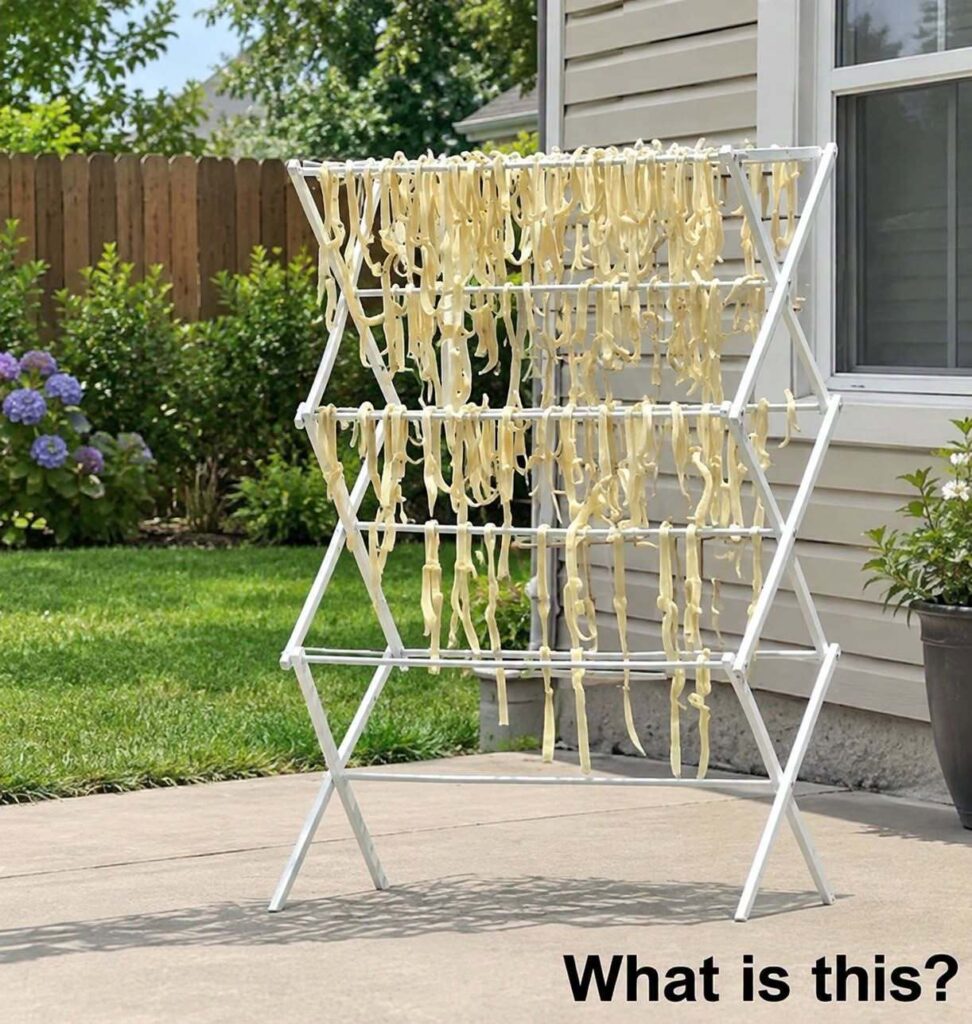
And why did the entire scene look so unfamiliar?
That is often what happens when we come across something we do not immediately understand. The brain dislikes uncertainty, so it begins filling in the missing pieces. A simple mystery can quickly turn into suspicion, and before long, imagination starts creating explanations that are far more dramatic than reality.
The longer something remains unexplained, the easier it becomes to build an entire story around it.
But in this case, the truth was surprisingly simple.
They were homemade noodles drying in the sun.
Suddenly, the entire scene changed.
The strands had not moved. Their shape had not changed. The surroundings were exactly the same.
What changed was the understanding behind what was being seen.
What had initially looked strange or even slightly eerie became familiar and almost comforting. Instead of something mysterious, it was simply part of a traditional food-preparation process.
Someone had prepared fresh noodles and hung them outside so that sunlight, fresh air, and time could naturally dry them before they were stored or cooked.
Once that explanation became clear, the scene took on an entirely different feeling.
There was something peaceful about it.
Rather than being unusual in a troubling way, the hanging noodles represented an old-fashioned routine that many families have practiced for generations. It was a simple method requiring little more than patience, good weather, and enough time for nature to do part of the work.
That is what makes moments like this so memorable.
The surprise is not only in discovering what the object actually is. The more interesting part is realizing just how strongly context affects perception.
Something completely ordinary can look mysterious when it is removed from the familiar environment in which we usually expect to see it.
Most people recognize noodles when they are sitting on a plate, boiling in a pot, or packaged inside a supermarket bag.
Seeing them stretched into long strands and hanging outdoors is very different.
Without knowing the purpose, the mind naturally tries to connect the unfamiliar sight with something it already understands.
And sometimes those connections can become surprisingly dramatic.
Yet reality is often far simpler.
There was no hidden mystery, strange discovery, or disturbing explanation behind those pale strands.
It was simply food being prepared the traditional way.
That realization also carries a useful reminder.
Not everything that looks unusual is dangerous, suspicious, or extraordinary. Sometimes we are simply seeing an ordinary part of someone else’s daily life from an unfamiliar perspective.
Curiosity is valuable because it encourages us to ask questions.
But curiosity becomes even more useful when it is combined with patience.
Before deciding what something must be, it is often worth waiting for more information.
Because sometimes the explanation that finally arrives is far less dramatic than anything imagination created.
And in this case, the strange sight that inspired so many questions turned out to be something remarkably simple:
Homemade noodles, quietly drying beneath the sun.