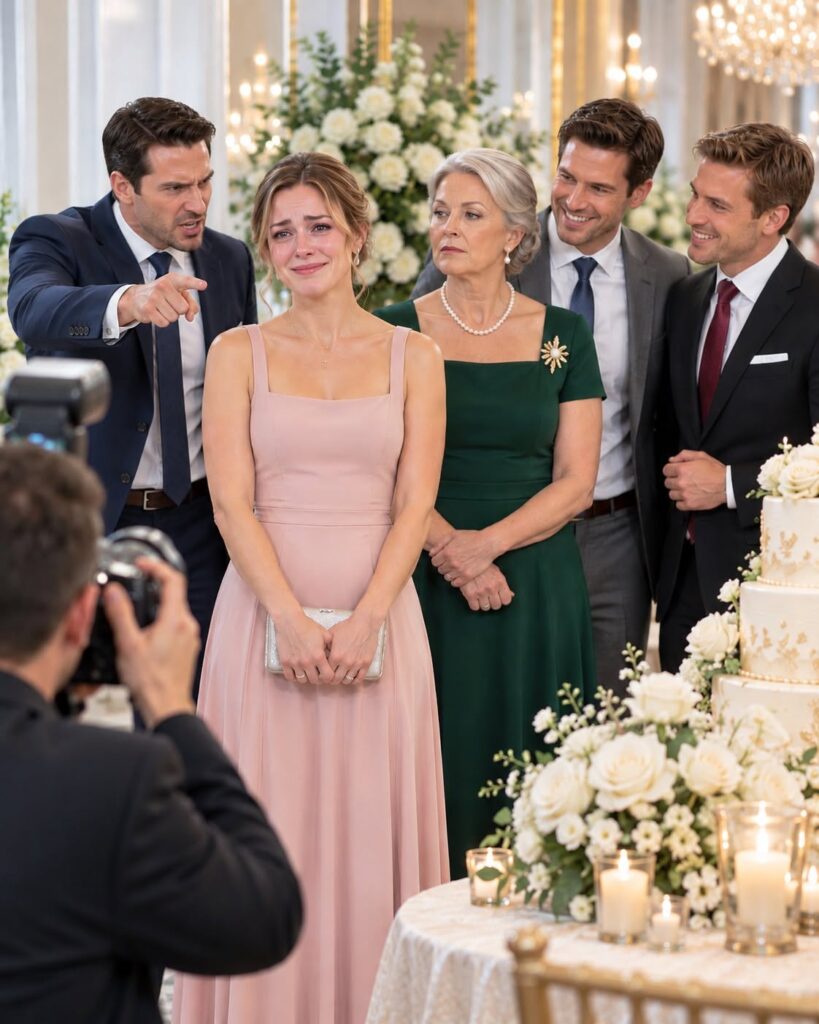
My brothers stood behind her.
There was an empty space beside them.
I assumed it was mine.
Then Mom touched her pearls.
“Just for this one,” she said. “Blood relatives only. You understand.”
I did.
Completely.
What made it almost funny was that I’d paid for nearly everything in the room.
The venue.
Catering.
Flowers.
Photographer.
Mom’s dress.
Several relatives’ hotel rooms.
Whenever I’d suggested splitting expenses with my brothers, Mom had objected.
“They have families, Clara. You’re good with money.”
Apparently, I was family when an invoice arrived.
Just not when the camera came out.
My oldest brother, Ryan, gestured toward the wall.
“Come on. Don’t make this weird.”
“I’m making it weird?”
“Mom just wants one bloodline picture.”
Bloodline.
I had joined the Bennett family when I was four.
My biological parents died, and my aunt—my mother’s sister—asked the Bennetts to take me in.
Dad never made a distinction.
He taught me to ride a bicycle.
Helped with homework.
Called me his miracle girl.
Every Christmas, he wrote my name on my stocking himself.
Mom was different.
She never openly said I wasn’t hers.
She didn’t need to.
Your brothers inherited Dad’s eyes.
Medical history is complicated with you.
And occasionally:
You’re lucky we chose you.
After Dad died, those reminders became less subtle.
Still, I was the person Mom called when the roof leaked.
When she needed someone at a doctor’s appointment.
When Ryan needed another “temporary” loan.
When Mason fell behind on something.
And when Mom decided she needed an extravagant sixtieth-birthday celebration she supposedly hadn’t wanted.
The photographer cleared his throat.
“Are you sure, ma’am?”
Mom smiled.
“Yes. Blood relatives only.”
Something inside me became remarkably calm.
I stepped aside.
“Take the picture.”
The camera flashed.
Mom smiled between her sons.
And I finally understood my place in the family exactly as they understood it.
Useful.
But optional.
Later, Ryan found me near the bar.
“You’re sulking.”
“No.”
“Then what’s wrong?”
“Nothing anymore.”
He rolled his eyes.
“Clara, you’re adopted. That’s not an insult. It’s just a fact.”
“So is the fact that I paid for this party.”
His expression changed.
“What’s that supposed to mean?”
“It means this is the last one.”
He laughed.
“You’re going to punish Mom over a photograph?”
“No.”
I looked across the ballroom.
Mom was showing relatives her cake.
“I’m going to stop financing people who don’t consider me family.”
Ryan lowered his voice.
“Dad would be ashamed.”
That got my attention.
“Don’t use Dad.”
“Why? You know I’m right.”
“No. I know you’re not.”
A few weeks earlier, Dad’s estate attorney had finally given me a personal letter Dad had left with my trust documents.
I had carried it in my clutch all evening.
Now I removed it.
Ryan frowned.
“What is that?”
“A letter from Dad.”
I unfolded it.
There was one passage I’d read so many times I practically knew it by heart.
Dad wrote that he had never considered me anything other than his daughter.
Not his adopted daughter.
His daughter.
He also explained why he’d structured part of his estate the way he had.
After his death, Mom would be well provided for.
But a separate family support trust would remain for medical needs, property expenses and other assistance.
I had been appointed trustee.
Dad trusted me because, as he wrote:
You have always been the one who helps without keeping score. I hope they never mistake your kindness for obligation.
For years, I had approved almost everything.
House repairs.
Insurance.
Medical expenses.
Mom’s housekeeper.
Club fees.
Occasional assistance to my brothers.
And, indirectly, much of tonight’s celebration.
Not because the trust required me to.
Because they were my family.
Ryan finished reading the passage.
His face changed.
“You control the trust?”
“I administer it.”
“Mom said the money was hers.”
“Some of it is. This isn’t.”
His eyes moved toward her.
Then back to me.
“So what are you saying?”
“I’m saying Dad didn’t leave me instructions to punish anyone who hurt my feelings.”
I folded the letter.
“He trusted me to decide what was reasonable.”
“And now you’re going to cut everyone off?”
“No.”
That seemed to confuse him more.
“Mom’s medical expenses will still be covered where appropriate. Necessary repairs. Genuine needs.”
I looked toward the ballroom.
“But I’m finished paying for luxuries while being reminded I’m not really one of you.”
Ryan’s jaw tightened.
“This is petty.”
“Then paying for your own luxuries shouldn’t be a problem.”
Mason joined us a few minutes later.
Ryan quickly explained.
Mason stared at me.
“All this because Mom wanted one picture?”
“All this because the picture finally made something clear.”
He scoffed.
“You’ve always been sensitive about being adopted.”
There it was again.
I smiled.
“Thank you.”
“For what?”
“For making the decision easier.”
Mom noticed the argument and came over.
“What is happening?”
Ryan handed her Dad’s letter.
She read it.
Her expression hardened.
“Your father was sentimental.”
“Yes.”
“He didn’t understand how complicated families are.”
“Maybe he understood ours perfectly.”
Mom looked around to make sure nobody was listening.
“You’re really going to use his money against your own mother?”
“No.”
I took the letter back.
“I’m going to use it for what it was intended for.”
“And who decides that?”
“I do, within the terms of the trust.”
Her eyes narrowed.
Then she said the sentence that finally removed any doubt.
“We took you in.”
Not I raised you.
Not You’re my daughter.
We took you in.
Like an obligation she’d fulfilled decades earlier and could still produce as an invoice.
I nodded.
“You did.”
Then I looked around at the flowers, champagne and gold-leaf cake.
“And I’ve spent most of my adult life trying to repay a debt Dad never believed I owed.”
Mom went silent.
“Enjoy your party,” I said.
“I mean that. It’s already paid for.”
I picked up my clutch.
“But there won’t be another one like this on my account.”
I didn’t storm out.
I didn’t cancel the cake.
I didn’t humiliate Mom in front of her guests.
The jazz band kept playing.
Dessert was served.
People danced.
Mom got exactly the birthday she’d wanted.
I simply stopped pretending afterward.
When the next club-membership renewal came through the trust, I declined it.
When Ryan requested another business loan, I declined that too.
When Mom needed legitimate repairs to her house, I approved them.
When she had medical expenses, I handled them according to the trust.
Necessary support continued.
Entitlement didn’t.
Mom called after the first few refusals.
“You’re punishing me.”
“No.”
“Then what do you call this?”
“Boundaries.”
“You never had a problem paying before.”
“You’re right.”
I paused.
“I had a problem saying no.”
That was different.
A month after the birthday, the photographs arrived.
There was the official family portrait.
Mom in the center.
Ryan and Mason beside her.
Their wives and children.
All blood relatives carefully arranged beneath the chandelier.
Everyone smiling.
There was no obvious sign that anyone was missing.
Unless you knew.
I didn’t frame it.
Instead, I found another photograph.
The photographer had taken it earlier that evening without my noticing.
I was standing alone beside Dad’s empty memorial chair.
His letter was in my hand.
I wasn’t crying.
I wasn’t angry.
I was simply standing straight.
I printed that one.
For years, I’d thought being included meant proving how useful I could be.
Pay the bill.
Solve the problem.
Answer the call.
Never complain.
Maybe some part of me believed that if I gave enough, eventually Mom would stop remembering that I hadn’t been born a Bennett.
Dad had understood something I hadn’t.
I never needed to earn the name.
He’d already given it to me.
Mom wanted a photograph of her bloodline.
She got one.
And I finally stopped paying admission to a family I’d belonged to since I was four.