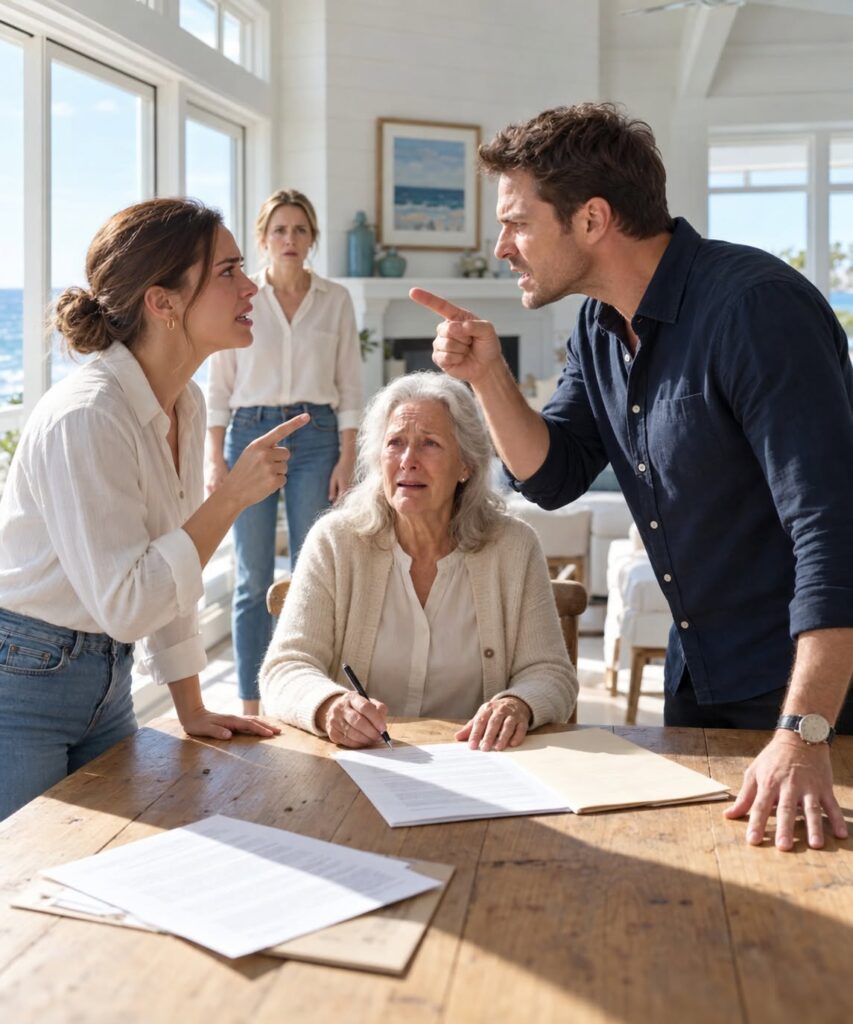
And on the table was paperwork involving the one thing I’d spent two years trying to protect:
Grandma’s $687,000 beach house.
“Take your hand off her.”
Carter spun around.
The pen dragged across the page.
“You’re overreacting,” he said. “Grandma wants to help her family.”
Then Grandma whispered:
“I don’t want to leave.”
Everything stopped.
The beach house wasn’t luxurious.
Weathered cedar. Blue shutters. Sand that somehow appeared on the floors no matter how often they were swept.
Grandpa had built it decades earlier.
After he died, Grandma Ruth started forgetting things.
Bills.
Names.
Whether she’d turned off the stove.
But she always recognized the house.
She called it the place where everyone came back.
While Grandma was still able to participate meaningfully in her estate planning, we worked with an attorney to place the property in a trust.
Grandma retained the right to live there.
I became trustee.
The structure was specifically designed to make it difficult for someone to pressure her into selling or borrowing against the property as her memory declined.
Carter hated it.
He called me controlling.
Melanie accused me of treating family members like criminals.
Then, the previous evening, Grandma’s caregiver sent me a message:
Something feels wrong. Melanie sent me home early. Carter brought paperwork.
I drove three hours before sunrise.
Now I understood why.
I opened my bag and pulled out the trust documents.
“What exactly are you asking her to sign?”
Carter crossed his arms.
“She’s helping us.”
“With what?”
“Our finances are none of your business.”
“They become my business when you’re trying to transfer trust property.”
Melanie finally spoke.
“Olivia, please. We’re in trouble.”
“How much trouble?”
She looked at Carter.
That told me enough.
I examined the papers.
They appeared to relate to a proposed sale of the house.
“You found a buyer?”
Carter said nothing.
“Does the buyer know the property is held in trust?”
His expression changed.
I looked at Melanie.
“Does the buyer know?”
She started crying.
Carter snapped:
“Your grandmother doesn’t need a beach house. She’s getting worse every month. That money could solve real problems.”
Grandma looked up.
“You’re selling my house?”
Carter sighed.
“Ruth—”
“My porch?”
That broke something in me.
Not because Grandma fully understood every legal detail.
She didn’t.
But she understood enough.
This was her home.
And she didn’t want to leave it.
I called the attorney who had helped establish the trust.
Carter became furious.
He insisted Grandma owned the house and could do whatever she wanted.
The attorney explained that the situation wasn’t nearly that simple, particularly given the trust structure and concerns about undue pressure on a vulnerable adult.
Then we discovered something worse.
Carter had apparently represented to the prospective buyer that the necessary authorization for the sale either existed or would be obtained.
There were documents carrying my name as trustee that I had never approved.
I stared at him.
“Did you use my name?”
Melanie covered her mouth.
“I didn’t know about that.”
“But you knew about the sale.”
She cried harder.
“Yes.”
“Why?”
“We’re drowning.”
Loans.
Credit cards.
Collection calls.
Debts Carter hadn’t fully disclosed even to her.
“We were going to find somewhere nice for Grandma,” Melanie said.
From behind us came a quiet voice.
“I am somewhere nice.”
Grandma.
Sitting in Grandpa’s sunroom.
Looking at the ocean.
Melanie turned toward her.
“Grandma—”
“You let him scare me.”
That was all she said.
She didn’t need anything else.
The proposed sale didn’t happen.
Our attorney contacted the buyer’s representatives and made clear that the transaction was disputed and that Carter had no authority to transfer the property himself.
We preserved the documents and messages we had.
Because of Grandma’s vulnerability and what the caregiver had reported, we also sought professional advice about protecting her from further pressure.
The allegations involving the questionable authorization were referred for investigation.
It didn’t mean Carter was instantly arrested.
It didn’t mean every accusation was automatically proven.
But it meant he could no longer pretend this was simply a family disagreement.
Most importantly, Grandma made one request very clear:
She didn’t want Carter in her home.
Melanie stood on the porch afterward crying.
“I thought the house could save us.”
I looked at her.
“No.”
She raised her eyes.
“You thought Grandma could.”
She had no answer.
Over the following weeks, we changed the locks and reviewed Grandma’s care arrangements with her attorney and professionals involved in her care.
The goal wasn’t to imprison her inside her own house.
It was the opposite.
To make sure she could remain there safely for as long as that continued to be appropriate.
Carter blamed me for everything.
His debts.
His problems with Melanie.
The failed sale.
The investigation into the documents.
Eventually, Melanie learned that some of their financial problems were worse than Carter had admitted.
What happened to their marriage after that was between them.
I stayed out of it.
I’d spent enough time cleaning up problems that weren’t mine.
Grandma stayed at the beach house.
That was what mattered.
That summer, I visited often.
Some evenings Grandma remembered exactly what had happened.
Other evenings she didn’t.
Once she asked why Melanie hadn’t visited recently.
I didn’t unload the entire story onto her again.
I simply said:
“She’s dealing with some things.”
Grandma nodded and returned to watching the ocean.
One evening we sat together on the porch swing.
The sun was disappearing over the water.
Grandma squeezed my hand.
“Your grandfather built this place so everybody would have somewhere to come back to.”
I looked at the weathered railing.
The blue shutters.
The sand gathering near the doorway.
For months, everyone had argued about what the house was worth.
$687,000.
Maybe more.
Maybe less.
But Carter had misunderstood something.
Protecting Grandma’s house had never really been about protecting an asset.
It was about protecting her ability to call somewhere home.
I squeezed her hand.
“The house is still here, Grandma.”
She smiled.
“So am I.”
And in the end, that was the only outcome I cared about.