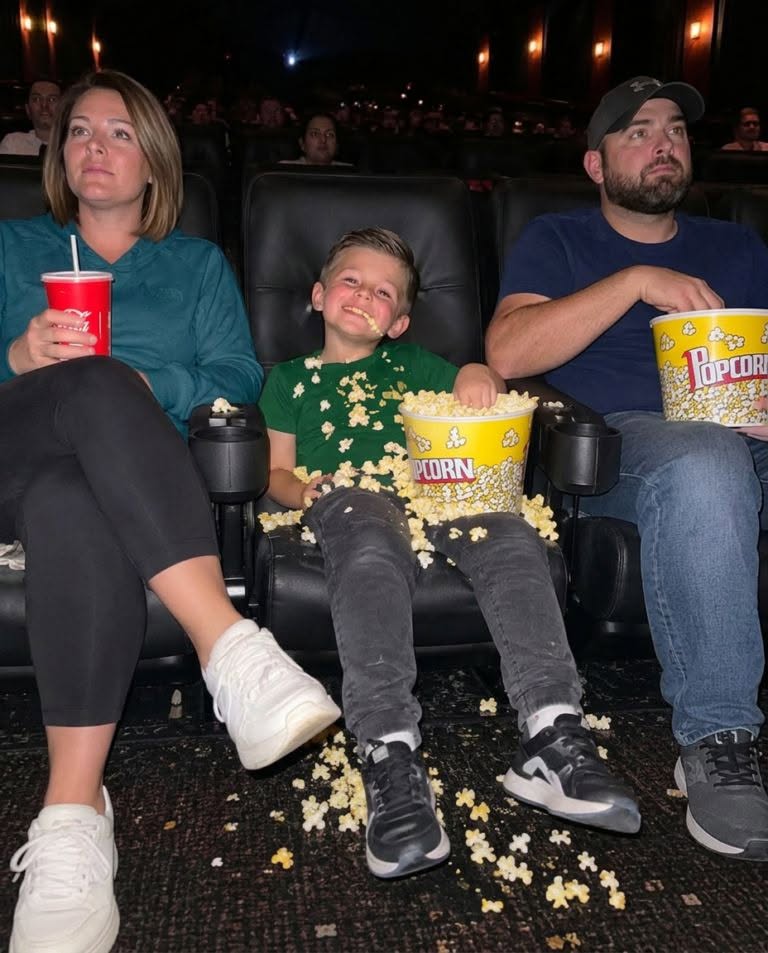
Beside me, my husband Owen carefully pulled out one piece.
He stared at it.
Then at me.
“Stay here.”
He stood and walked out of the theater.
I watched him disappear in disbelief.
Owen did not confront people.
Ever.
And there was a reason.
My husband is six-foot-two, works construction and is one of the gentlest people I’ve ever known.
But for most of our marriage, his gentleness had another side.
Fear.
Wrong restaurant order?
He ate it.
Mechanic overcharged him?
He paid.
Neighbor put a fence several feet onto our property?
“At least it’s a nice fence.”
When someone raised their voice, Owen became quiet.
His shoulders tightened and his thumb rubbed against his finger.
Years earlier, I’d finally asked:
“Why do you let people walk all over you?”
“Because the alternative is worse.”
“What alternative?”
He looked at me.
“Becoming my father.”
Frank had been an angry man.
Not constantly.
But enough.
Owen grew up learning that confrontation meant shouting, intimidation and fear.
So he built his entire personality around doing the opposite.
If Frank fought, Owen surrendered.
If Frank shouted, Owen went silent.
Then four years ago, Frank’s wife died.
Not long afterward, he developed dementia.
Eventually, he couldn’t safely live alone.
So despite everything, Owen brought his father into our home.
Watching him care for Frank was complicated.
Some days Frank was gentle and confused.
Other days fear made him angry.
Whenever his voice rose, Owen’s body reacted before his mind did.
That same thumb rubbing against his finger.
“Dad,” he’d say softly. “You’re safe.”
Sometimes I wondered whether he was talking to Frank or to the frightened boy he’d once been.
By September, caregiving had consumed our lives.
We hadn’t gone anywhere alone in seven months.
Then one night I asked Owen:
“If you could do one normal thing, what would it be?”
“Go to a movie.”
“That’s it?”
He smiled.
“The new Spider-Man.”
Then his expression changed.
“My dad used to take me to the movies.”
I waited.
“It was one of the only places where he usually didn’t yell.”
Three weeks later, I found an experienced memory-care worker willing to stay with Frank.
I bought two tickets.
Friday.
8:30.
Middle seats.
Owen even wore the Spider-Man shirt I’d bought him as a joke.
When he sat down with his giant bucket of popcorn, he smiled like a kid.
“This is perfect.”
Then a family sat behind us.
And everything started.
Their son, Ethan, looked about nine.
First he kicked my seat.
I politely asked his parents to stop him.
His father barely looked up from his phone.
“Ethan. Feet down.”
Three minutes later, it started again.
Then came the popcorn.
One piece.
Two.
A handful.
Some landed on my shoulders.
Some got trapped in my curls.
“Please stop throwing popcorn,” I finally said.
“He’s not throwing it,” his father replied. “He’s eating.”
“He’s missing by several feet.”
His mother sighed.
“He’s a child.”
I turned back around.
This was our first night out in seven months.
I wasn’t wasting it arguing.
Then Ethan kicked my chair again.
And again.
Something cold hit my neck.
Soda.
Even another couple nearby complained.
The father told them to mind their business.
Then Ethan kicked my seat hard enough to make me jerk forward.
Owen looked at me.
His thumb was rubbing against his finger.
I knew what was happening inside him.
Anger frightened Owen because anger sounded like Frank.
So I expected him to endure it.
Instead, he reached into my hair and removed another piece of popcorn.
He looked at it.
Then calmly said:
“Stay here.”
Four minutes later, he returned with the theater manager.
She had already watched from the aisle.
“We’ve received several complaints about kicking seats and throwing food,” she told Ethan’s parents.
“He’s nine,” his mother snapped.
“I understand. But he’s disturbing other guests.”
His father pointed at us.
“Then make them move.”
Owen finally spoke.
“No.”
His voice wasn’t loud.
It was simply steady.
“We’ve waited seven months for tonight. My father has dementia and lives with us. We hired a caregiver so my wife and I could spend two hours together.”
He pointed toward me.
“She has popcorn in her hair and soda on her clothes. She’s asked you politely several times.”
The father shrugged.
“That’s not my problem.”
“No,” Owen said.
Then he looked at Ethan.
“But she’s my responsibility.”
A pause.
“And he’s yours.”
The manager asked the family to leave.
Eventually, they did.
Owen sat beside me again.
But he wasn’t watching Spider-Man.
His hand was shaking.
Then he suddenly stood.
“Did you see how his dad grabbed him?”
I had.
“I’m going outside.”
This time, I followed.
We found them in the lobby.
Ethan was crying.
His father had him tightly by the arm.
“You embarrassed me in front of everybody.”
“Dad, that hurts.”
Owen stopped.
I watched his face change.
Then he walked forward.
“Hey.”
The father turned.
“What now?”
“Please let go of his arm.”
“This is my son.”
“I know.”
“Then stay out of it.”
“You’re hurting him.”
“I’m parenting him.”
Owen looked at his hand.
“Look how tightly you’re holding him.”
The man stepped toward Owen.
For one terrifying second, I thought this was exactly what Owen had always feared.
That confrontation inevitably became violence.
But Owen didn’t raise his voice.
Didn’t threaten him.
Didn’t move closer.
“I’m not going to fight you,” he said. “I’m asking you to let go.”
Then Owen looked at Ethan.
“When I was his age, my father used to bring me here.”
I stared at him.
Here?
“This exact theater,” Owen continued.
“One night, I spilled a drink. My dad got angry and pulled me outside.”
His voice shook.
“A woman saw what was happening.”
He paused.
“She looked directly at me.”
Then he said:
“And she walked away.”
The lobby had gone quiet.
“For twenty-nine years, I remembered her. I used to wonder why she didn’t say anything.”
Owen looked at Ethan’s father.
“I didn’t need her to fight my dad.”
His voice softened.
“I just needed one person to say, ‘Hey. Stop.’”
Silence.
Then the father opened his hand.
Ethan immediately rubbed his arm.
Owen crouched several feet away from him.
“You okay?”
Ethan nodded weakly.
Then Owen said something I didn’t expect.
“You aren’t a bad kid.”
Ethan looked up.
“Kicking seats and throwing popcorn wasn’t okay. But doing something wrong doesn’t make you a bad person.”
The boy’s face crumpled.
Owen gently asked:
“Were you trying to get somebody to notice you?”
Ethan started crying.
His parents had been fighting in the car.
Then they’d spent the entire movie on their phones.
“Nobody was watching it with me,” he whispered.
He looked toward me.
“When she kept turning around, that was the first time anybody looked at me all night.”
His mother slowly lowered her phone.
Owen nodded.
“Feeling invisible hurts.”
Ethan looked at him.
“You know?”
“Yeah.”
Owen swallowed.
“I do.”
His mother knelt and wrapped her arms around her son.
Even Ethan’s father looked different now.
Not transformed.
Not magically forgiven.
Just quieter.
They left a few minutes later.
Ethan turned at the door and waved.
Owen waved back.
Then his hand started shaking again.
“Can we go home?”
“Of course.”
We sat in our car without starting the engine.
Then Owen lowered his forehead against the steering wheel and cried.
Eventually, he pointed toward the far side of the parking lot.
“That’s where it happened.”
I looked over.
“The thing with your dad?”
He nodded.
“I knew this was the same theater.”
“Why didn’t you tell me?”
“Because I wanted to come back.”
He wiped his face.
“I wanted one good memory here. Spider-Man. Popcorn. You.”
Then he admitted something else.
When Ethan kept kicking my chair, Owen had become angry.
Really angry.
And that terrified him.
“For a second, I could hear my dad in my head.”
“So you got the manager.”
He nodded.
“And then I saw Ethan’s father grab him.”
Owen looked down at his hands.
“For my entire life, I thought I had two choices.”
“Become my father…”
He paused.
“Or never confront anyone.”
Tonight had shown him something else.
He could speak firmly without screaming.
Set a boundary without humiliating someone.
Protect another person without frightening them.
“You can stand up for someone without becoming cruel,” I said.
Owen looked at me as though nobody had ever put those two ideas together for him.
“I didn’t know that.”
When we got home, Frank was awake.
Our caregiver told us he’d been asking for Owen.
Owen went into his father’s room alone.
I stayed in the hallway.
“Went to the movies?” Frank asked.
“Yeah.”
“What’d you see?”
“Spider-Man.”
Frank smiled faintly.
“We used to watch those.”
“I remember.”
Then Frank became quiet.
“I wasn’t always good to you.”
Owen froze.
Dementia had taken so much from him, but apparently not everything.
“I remember the parking lot,” Frank said.
“The drink.”
Owen sat down.
Frank looked ashamed.
“My father was like that too.”
His hands trembled.
“I promised myself I’d never become him.”
A long silence.
“But I did.”
Then:
“I’m sorry, son.”
Owen didn’t rush to forgive him.
He didn’t pretend the past hadn’t happened.
Instead, he told Frank about Ethan.
About the theater.
About seeing another frightened nine-year-old.
“And somebody stopped his dad,” Frank said.
Owen nodded.
“Who?”
“Me.”
Frank stared at him.
Then squeezed his hand.
“Good.”
His voice cracked.
“Good.”
And then he said:
“I wish somebody had done that for you.”
Owen closed his eyes.
“Me too.”
Frank looked down.
“I wish somebody had done it for me.”
Neither man spoke for a while.
Then Owen reached over and hugged his father.
The next morning, Frank remembered none of it.
But Owen did.
Two weeks later, we went to lunch.
Owen ordered a burger without onions.
It arrived covered in them.
For a few seconds, he stared at the plate.
His thumb started rubbing against his finger.
Then stopped.
He raised his hand.
“Excuse me. I asked for no onions. Could I please get another one?”
“Absolutely,” the waiter said.
When he walked away, I stared at Owen.
“What?”
“You sent it back.”
He smiled.
“I don’t like onions.”
“You’ve eaten onions you didn’t want for eight years.”
“I know.”
That same week, he called his sister.
He calmly told her he needed her to spend one week with their father so we could finally have a break.
When she started listing reasons she couldn’t, Owen listened.
Then he said:
“You have children and a job. I understand.”
A pause.
“So do we.”
Another pause.
“He’s your father too.”
She agreed.
Afterward, Owen stood in the kitchen looking almost shocked.
Not because he’d won an argument.
There hadn’t been one.
He had simply said what he needed to say.
That night at the theater didn’t turn my husband into a confrontational man.
It did something better.
It taught him that the choice was never between silence and anger.
His father had been loud.
Owen had spent most of his life being quiet.
Neither one was the same thing as courage.
Sometimes courage is much simpler.
You see something wrong.
You stay calm.
And instead of looking away, you say:
“Hey. Stop.”