I was thirty-four weeks pregnant.
And completely alone.
Then someone knocked on my front door.
Hard.
I pushed myself out of bed, pulled on a robe, and made my way downstairs as quickly as my swollen feet would allow.
When I opened the door, Sheriff Brennan was standing on my porch.
His expression told me something was wrong before he ever spoke.
“Are you Marissa Cole?”
“Yes.”
He glanced toward the house next door.
My stomach tightened.
“What happened?”
“It’s Ruth Higgins.”
Ruth.
My eighty-two-year-old neighbor.
The woman who had lived beside me for nearly four years.
The woman who had lost her husband the previous winter.
The woman who still baked too much banana bread and left half of it on my porch because, according to her, “pregnant women should never be expected to bake for themselves.”
Sheriff Brennan removed his hat.
“I’m sorry. She was found dead early this morning.”
I stared at him.
“No.”
The word came out automatically.
Soft.
Useless.
He continued speaking, but I barely heard him.
Natural causes.
Likely during the night.
No signs of violence.
Then he said something that pulled me back into the moment.
“Before we go any further, there’s something you need to see.”
He turned and pointed toward my mailbox.
The red flag was raised.
“Open it.”
I looked at him.
“What?”
“Your mailbox.”
I slowly walked down the path.
Inside was a thick yellow envelope.
My name was written across the front in Ruth’s shaky handwriting.
MARISSA.
My hands started trembling before I even opened it.
Inside were stacks of hundred-dollar bills.
So many that I almost dropped the envelope.
Beneath the money was a folded letter.
I opened it.
“If you are reading this, dear girl, I am already gone.”
My vision blurred.
I kept reading.
Ruth wrote that she had watched me struggle for months.
She knew Kyle had left.
Everyone on our street knew.
He disappeared three months after I found out I was pregnant, leaving behind half the mortgage, unpaid bills, and one final text message saying he “wasn’t ready for this kind of life.”
Ruth had seen me working extra hours.
She had seen me selling furniture online.
She had seen me standing in the grocery store calculating prices on my phone before putting things back.
I had never told her how bad things were.
Apparently, I hadn’t needed to.
Then I reached the sentence that made me sit down on the curb.
“This money is not charity. It is a gift from one tired woman to another who still has a long road ahead.”
The envelope contained forty thousand dollars.
And according to Ruth, she wanted me to have every cent.
My mind immediately went back to the day before.
It had been brutally hot.
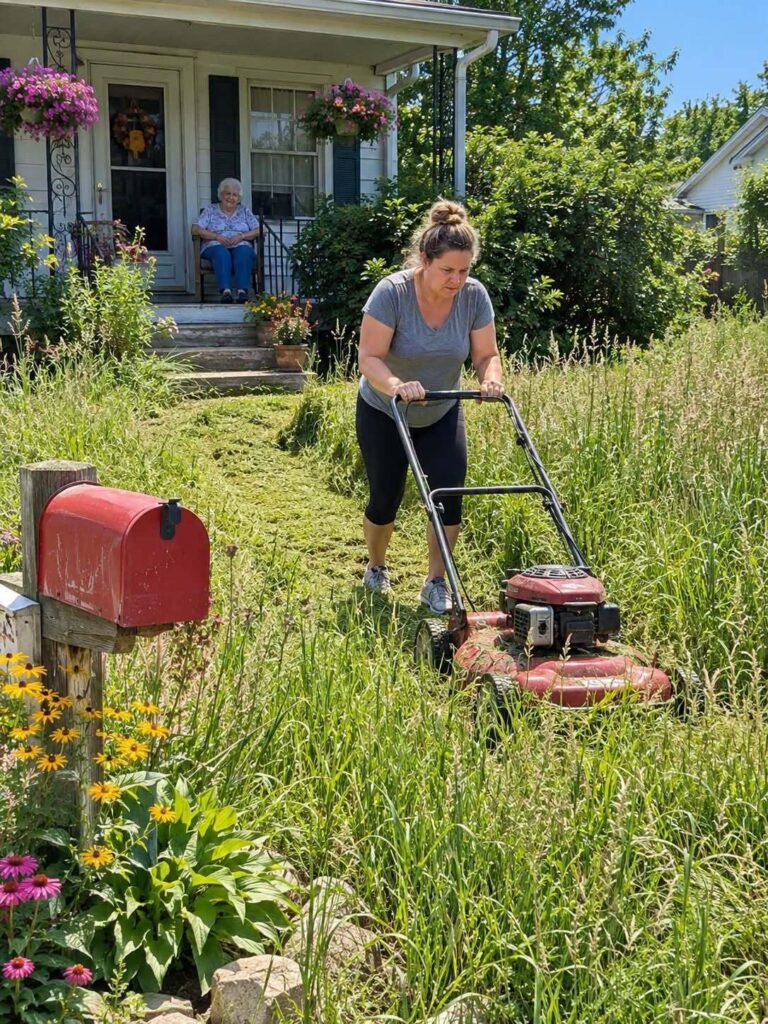
I had come home from a doctor’s appointment and found Ruth in her front yard wrestling with an old lawn mower.
Her grass had gotten embarrassingly high.
She was sweating through her blouse and stopping every few feet to catch her breath.
“Ruth, what are you doing?”
She waved me off.
“What does it look like?”
“It looks like you’re trying to give yourself a heart attack.”
“I’ve had this lawn longer than you’ve been alive.”
“And the lawn will survive another day.”
She tried to protest.
I took the mower from her.
At thirty-four weeks pregnant, mowing someone else’s lawn was probably not the smartest decision I had ever made.
It took me nearly three hours.
My back hurt.
My ankles swelled.
By the end, I was sweating almost as badly as Ruth had been.
But when I finished, she stood on her porch staring at the yard as if I had given her something enormous.
Then she took my hand.
“You’re a good girl,” she said.
I laughed.
“I’m a sweaty girl.”
She squeezed my fingers.
“No. A good one. Don’t forget that.”
I didn’t understand why she sounded so serious.
That night, sometime around ten, I happened to look through my bedroom window.
I saw Ruth walking slowly across the street.
She was wearing her pink robe.
Something was tucked under her arm.
She stopped at my mailbox.
I almost went downstairs.
But exhaustion won.
I assumed she was leaving another note.
By morning, she was dead.
Sheriff Brennan’s voice brought me back.
“There’s another problem.”
Of course there was.
“What?”
“Ruth’s nephew arrived this morning.”
I knew Travis.
Barely.
He visited Ruth occasionally, usually when he needed something.
“He says forty thousand dollars is missing from Ruth’s property.”
My grip tightened around the envelope.
“He thinks I stole this?”
“He says the money was stored in a locked box in Ruth’s shed.”
I handed him the letter.
“You need to read this.”
He did.
Slowly.
His expression changed as he reached the end.
According to Ruth, the money had belonged to her husband, Walter.
For nearly fifty years, Walter had tucked away cash from side jobs, overtime shifts, and holiday bonuses.
He had always said it should someday go to someone who truly needed a second chance.
After Walter died, Ruth decided she would choose that person herself.
She chose me.
Not because I was family.
Not because I asked.
Because I had been kind to her when there was nothing in it for me.
That afternoon, Ruth’s attorney, Harold Pike, came to my house.
He carried a leather briefcase and looked exhausted.
“Mrs. Higgins planned this very carefully,” he told me.
Three weeks earlier, Ruth had written the letter.
Harold witnessed it.
So had another person from his office.
It had been notarized.
The strange part was that Ruth had deliberately left the recipient’s name blank.
“She told me she would know when she knew,” Harold explained.
“And apparently yesterday, she knew.”
Travis was furious.
He claimed Ruth had been confused.
He claimed she had been manipulated.
He claimed I had somehow pressured an elderly woman into giving me money.
I had known about the money for less than twelve hours, and suddenly I was being treated like a criminal.
Then I remembered something.
My doorbell camera.
I opened the app.
The footage from the previous evening was still there.
At 7:43 p.m., Travis appeared.
He walked directly toward Ruth’s house.
He stayed for almost forty minutes.
When he left, he looked angry.
Then, several hours later, another figure appeared.
Ruth.
Pink robe.
Slippers.
Yellow envelope tucked against her side.
The camera caught her crossing slowly toward my mailbox.
She opened it.
Placed the envelope inside.
Then she raised the red flag.
Before turning away, she looked toward my house.
For just a second, she smiled.
That footage changed everything.
There was no theft.
No mystery.
No question about who had placed the money there.
Travis’s accusations collapsed.
Harold confirmed the gift was legally valid.
The forty thousand dollars was mine.
But I never got the chance to thank Ruth.
A few days later, I attended her funeral.
I stood near the back of the church, one hand resting under my belly, listening while people talked about her kindness.
Halfway through the service, I felt a sharp pain.
Then another.
At first, I ignored it.
By the fourth contraction, I knew.
My water broke before the final hymn.
My daughter was born five weeks early.
She was tiny.
Fragile.
Terrifyingly small.
But she survived.
When the nurse asked me her name, I didn’t hesitate.
“Ruth Odessa.”
Ruth, for the woman who had saved us.
Odessa had been Ruth Higgins’s middle name.
I used part of the money to catch up on the mortgage.
I bought a crib.
A car seat.
Diapers.
Formula.
Everything I had been panicking about for months.
The rest went into savings for my daughter.
For the first time since Kyle left, I could breathe.
Two years passed.
One rainy afternoon, I was carrying groceries into my house when I noticed a young woman struggling across the street.
She had a crying baby on one hip and was dragging an overstuffed garbage bag toward the curb with the other hand.
The bag ripped.
Clothes spilled everywhere.
She looked exhausted.
Embarrassed.
Close to tears.
I put down my groceries and crossed the street.
“Let me help.”
She started apologizing.
I laughed.
“Don’t. I’ve been there.”
Her name was Kayla.
She had moved into the neighborhood only a few weeks earlier.
We gathered her things.
I carried the heavy bag.
Before leaving, I wrote my number on a piece of paper.
“If you ever need anything, call me.”
She looked surprised.
“You don’t even know me.”
For a moment, I saw Ruth standing on her porch again.
Pink robe.
Gentle smile.
“You’re right,” I said. “But sometimes that doesn’t matter.”
That night, I told my daughter about the woman she had been named after.
I told her that Ruth’s greatest gift hadn’t really been the money.
The money saved us, yes.
But the kindness came first.
And kindness was the part that lasted.
Some gifts are not supposed to stop with the person who receives them.
Sometimes they are meant to move through people.
From one frightened woman to another.
From one tired mother to the next.
Ruth had helped me when I felt like the entire world had turned its back.
Years later, when I saw someone else struggling, I finally understood what she had really left me.
Not forty thousand dollars.
A responsibility.
A reminder.
When life gives you the chance to make someone else’s burden a little lighter, you take it.
And then, when your time comes, you pass it forward.