Eleven years is long enough to become part of the building.
I was Margaret Collier.
Apartment 3B.
I was the woman people trusted with spare keys.
The neighbor who signed for packages.
The person new tenants asked when they couldn’t find the recycling bins.
I knew where the maintenance forms were kept because I’d actually read them.
And in eleven years, I’d never had a serious dispute with another resident.
I paid my rent.
Watched people’s pets.
Watered plants when neighbors traveled.
Accepted deliveries.
I was reasonable.
Dependable.
Predictable.
Then Daniel Hartley moved into 4B and apparently decided to discover exactly how far “reasonable” could be stretched.
Daniel arrived fourteen months earlier.
He was around forty and seemed pleasant enough.
He carried groceries in reusable bags and somehow filled his apartment with houseplants before he’d finished unpacking his furniture.
When we first met, I gave him the same card I gave most new residents.
Building manager.
Emergency maintenance.
Recycling schedule.
Quiet hours.
“Wow,” he said. “You’ve got the whole place figured out.”
“Eleven years.”
He smiled.
“Then I know who to ask.”
I remember walking downstairs thinking:
Good.
This one will be easy.
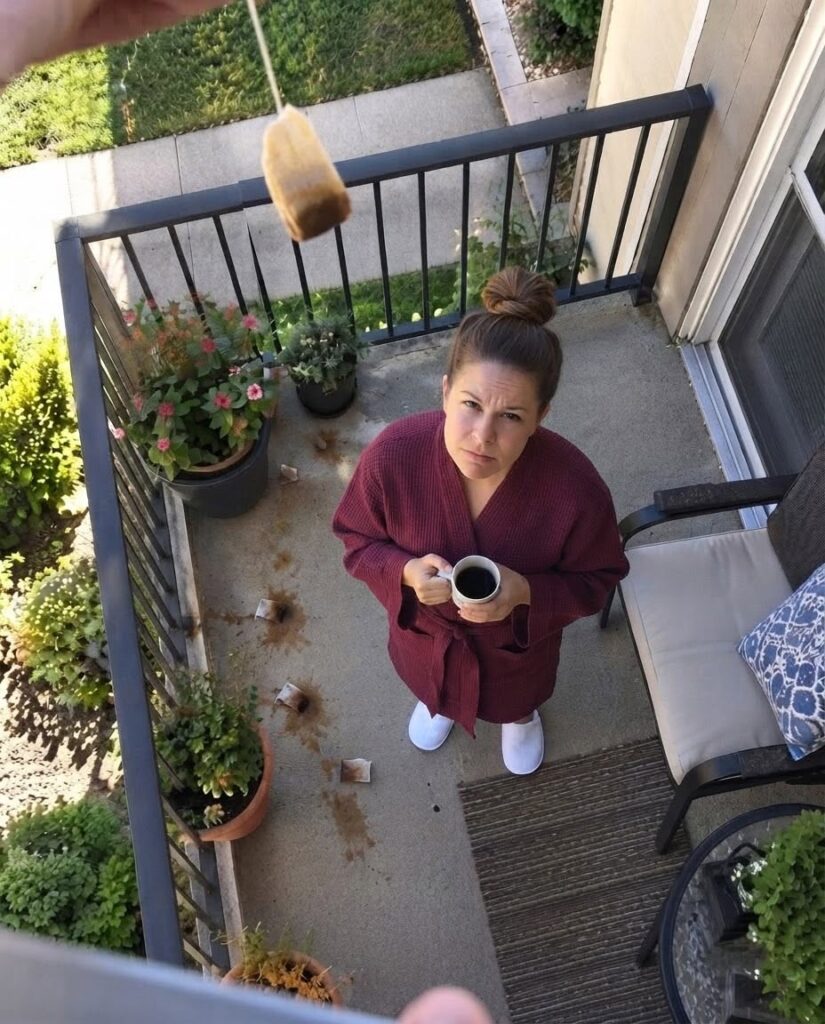
The first tea bag appeared on my balcony during his second month.
November.
Cold.
Wet.
I stepped outside one morning and found a used breakfast-tea bag on the concrete.
Still damp.
I looked upward.
Daniel’s balcony was directly above mine.
But I didn’t immediately assume he’d deliberately thrown it.
Maybe wind had carried it.
Maybe somebody dropped it.
Maybe it had fallen while he was emptying something.
I threw it away.
Several days later, another appeared.
Then another.
By December, I’d collected several.
Still, I said nothing.
Then one morning I hung two freshly washed white towels outside.
When I returned, one had a large brown stain across the middle.
A soaked tea bag was sitting in a fold of the fabric.
That was different.
I went upstairs.
Daniel answered looking half asleep.
“Sorry to bother you, but are you throwing tea bags over your balcony?”
His expression changed.
“Oh God. Are they landing downstairs?”
“Yes.”
He rubbed his face.
“That’s me. I’m sorry. Sometimes when I’m outside in the morning, I just flick them over the railing without thinking.”
“They’re landing on my balcony.”
“I honestly didn’t realize.”
“One ruined a towel this morning.”
He looked genuinely embarrassed.
“Oh, no. Margaret, I’m sorry. Seriously. I’ll stop.”
I believed him.
In fact, I walked downstairs feeling slightly guilty for confronting him.
At seven the following morning, I heard something hit the balcony.
Another tea bag.
I stood inside looking through the glass.
Still, I waited.
That might sound ridiculous.
But people who’ve lived in apartment buildings understand.
Shared buildings operate on social mathematics.
You may pass the same person in a narrow hallway hundreds of times.
You hear one another through walls.
Share lifts.
Share entrances.
Share parking spaces.
A small argument can make years of ordinary interactions uncomfortable.
I wanted to believe Daniel was careless rather than inconsiderate.
So I gave him time.
Three weeks.
Then one January morning, I was sitting outside with coffee and a book when something dropped from above.
A wet tea bag landed directly on the pale cushion beside me.
I stared at it.
Tea slowly spread across the fabric.
This time, I didn’t have to wonder where it came from.
I tried cleaning the cushion that evening.
The stain remained.
So I went upstairs again.
Daniel opened his door.
“You’re still throwing tea bags over the balcony.”
He shrugged.
“It’s a tea bag.”
I waited, thinking perhaps I’d misunderstood his tone.
“It stains. I’ve already lost a towel. Now I’ve got a stained cushion.”
Daniel leaned against his doorframe.
“You live below me.”
I stared at him.
“That’s how apartment buildings work.”
“No. Living underneath someone doesn’t mean their rubbish becomes mine.”
He smiled.
Not warmly.
“You should be glad it’s only tea.”
I frowned.
“What does that mean?”
“Nothing. I’m just saying it could be worse.”
Then he closed the door.
I remained in the hallway for almost a minute.
That conversation changed everything.
Until then, I’d believed Daniel was careless.
Now I understood.
He thought I was harmless.
Margaret from 3B.
The polite older woman.
The neighbor who accepted his packages.
The woman who would keep asking nicely until eventually she became too embarrassed to ask again.
More importantly, I suspected Daniel wanted me angry.
He wanted me pounding on his door.
Shouting.
Threatening.
Then he could tell management about the unstable woman downstairs who’d lost her mind over a few tea bags.
So I didn’t give him that.
I went home.
Made myself tea, which felt appropriately ironic, and sat at my kitchen table.
I decided to give him one final morning.
At 7:04 the next day, another tea bag landed beside my plants.
I finished my coffee.
Then I got to work.
Before retirement, I’d spent twenty-two years as a records manager for a law firm.
People hear “records manager” and imagine filing cabinets.
That wasn’t really the job.
My job was knowing what information existed.
Where it was stored.
How apparently unrelated details connected.
And, most importantly, how to retrieve evidence when somebody suddenly needed it.
I was very good at my job.
And unlike Daniel, I had time.
I wasn’t planning revenge.
I wanted a solution.
There is a difference.
First, I retrieved my lease.
I’d lived there long enough to know most of it already.
Tenants couldn’t create repeated nuisances for other residents.
Balconies formed part of the rented unit.
Throwing rubbish from balconies was prohibited.
Damage resulting from negligent behavior could become the responsibility of the tenant who caused it.
Then I read the management company’s complaint procedure.
That was where things became interesting.
Repeated documented complaints involving the same behavior could trigger a formal review.
So I opened my phone.
Fortunately, I’d already photographed several incidents.
Tea bags.
The stained towel.
The ruined cushion.
The tea bag that appeared the morning after Daniel promised he’d stop.
Seven photographs.
I created a timeline.
Dates.
Approximate times.
Descriptions.
Then I documented my two conversations with Daniel.
No insults.
No speculation about his character.
No dramatic language.
Just facts.
I wrote a three-page complaint.
It was, if I may say so myself, an excellent letter.
Facts rarely need exclamation marks.
I submitted everything Tuesday evening.
Then I set my alarm.
Wednesday morning, I sat on my balcony before seven.
Warm coat.
Coffee.
Phone.
At 7:06, I heard Daniel’s balcony door.
At 7:07, something fell.
A tea bag.
I picked up my phone.
Twelve seconds of video.
The tea bag.
My balcony.
The balcony directly above.
Date.
Time.
Simple.
Clear.
I uploaded it immediately.
The response was almost disappointingly boring.
Management acknowledged my complaint.
They gave me a reference number.
Several days later, Daniel received a formal notice reminding him of his obligations under the lease.
And then something extraordinary happened.
Nothing.
No tea bag Monday.
Nothing Tuesday.
Nothing Wednesday.
I sat outside with my coffee and enjoyed fifteen uninterrupted minutes in which absolutely nothing fell from the sky.
It was glorious.
Two weeks later, there was a handwritten note in my mailbox.
You could have just talked to me. I would’ve stopped. You didn’t need to involve management.
I read it twice.
Then I wrote:
I did talk to you. Twice.
The first time, you apologized and promised to stop.
The second time, you told me I should be grateful it was only tea and closed the door.
I’m not sure what third conversation you expected.
I’ve lived here for eleven years. I signed for your packages all last winter. I try to be a good neighbor. That works both ways.
The tea bags have stopped. That was all I wanted.
I put it into his mailbox.
Daniel never replied.
And no tea bag ever landed on my balcony again.
That could have been the ending.
For a while, I thought it was.
Then, about six weeks later, Mrs. Okafor from 2C stopped by.
During our conversation, she mentioned Daniel.
“He carried my groceries upstairs last week.”
“Did he?”
“Three trips.”
“That was kind.”
She hesitated.
“His mother is very ill.”
I looked at her.
Apparently, Daniel had moved into our building specifically to be closer to his mother.
He visited her nearly every day.
Her health had deteriorated quickly.
After Mrs. Okafor left, I sat alone for a while.
His mother’s illness didn’t excuse what he’d done.
Grief doesn’t give someone permission to damage another person’s property.
Stress doesn’t transform cruelty into kindness.
But context can change the way we understand someone’s behavior without changing whether that behavior was acceptable.
I knew something about watching a mother disappear.
I’d done it myself.
So the following Sunday, I knocked on Daniel’s door.
He looked different.
Thinner.
Tired.
Not ordinary tired.
The kind that settles behind someone’s eyes.
“I heard about your mother.”
He looked surprised.
“I’m sorry.”
Daniel nodded.
“She’s in residential care now.”
He looked down.
“She doesn’t always recognize me.”
I knew that pain.
“My mother went through something similar.”
His eyes met mine.
“I’m sorry.”
We stood quietly.
Then Daniel said:
“The tea bags…”
I waited.
“I wasn’t thinking.”
He shook his head.
“No. That’s not true.”
I said nothing.
“I was thinking. I just didn’t care enough.”
That was more honest.
“My mother had gotten much worse around then. I was angry all the time.”
“That explains some things.”
“It doesn’t excuse them.”
“No.”
He nodded.
Then he looked embarrassed.
“And the note I put in your mailbox…”
“You mean the one saying I should’ve talked to you?”
“Yes.”
“I did talk to you.”
“I know.”
“I remember.”
“I was angry when I wrote it.”
I nodded.
Then I remembered something.
“I’ve got packages downstairs for you.”
His eyebrows rose.
“I’ll bring them up later.”
“Why?”
“Why what?”
“Why would you still do that?”
I thought about it.
“Because the complaint was about tea bags.”
He stared at me.
“The packages are about being neighbors.”
Something in his expression softened.
“I’d appreciate that.”
I started toward the stairs.
“Mrs. Collier?”
I turned.
“I’m sorry about the towel.”
“And the cushion.”
“Yes.”
“You should’ve replaced them.”
“I know.”
He disappeared inside.
A minute later, he returned holding cash.
The exact amount.
“I looked up what they cost after management contacted me.”
I took it.
“You should’ve done this earlier.”
“Yes.”
“But doing it now still matters.”
That afternoon, I carried his packages upstairs.
For the first time, I stepped farther into his apartment.
It looked unfinished.
Pictures leaned against walls.
Books remained inside boxes.
There were plants everywhere, but almost nothing personal had been properly arranged.
“You never unpacked.”
Daniel glanced around.
“I kept thinking I’d wait.”
“For?”
“Until things got better.”
He didn’t need to say what things.
His mother.
I looked at the photographs leaning against the wall.
“Put them up.”
He frowned.
“Why?”
“Because waiting for the right moment to start living can become very expensive.”
He stared at me.
I left.
Several days later, I noticed through his open doorway that the pictures were hanging.
Spring came.
No tea bags.
Daniel began saying hello in the lift.
Then hello became small conversations.
He started regularly helping Mrs. Okafor with her groceries.
In April, I found a package outside my door.
Inside was a new cushion cover.
Grey-blue.
Not quite the same color as the original.
There was a note.
I still owe you a towel.
I’m working on it.
D.
I smiled.
Then put the mismatched cover on my chair.
Daniel’s mother died in June.
The following morning, he knocked on my door.
Apparently, Mrs. Okafor had told him he could.
I let him in.
Then I made tea.
The irony wasn’t lost on either of us.
Daniel sat at the same kitchen table where I’d once arranged photographs of his discarded tea bags beside copies of my lease.
For a while, he said almost nothing.
Then he began talking about his mother.
Who she’d been before she became ill.
What she liked.
The things that irritated her.
The particular shop where she always bought tea.
“She called me last Sunday,” he eventually said.
His voice tightened.
“She didn’t know who I was.”
I waited.
“But she still asked whether I was okay.”
I thought about that.
“Maybe some part of her still knew what mattered.”
Daniel nodded.
“Yeah.”
After another silence, he said:
“You didn’t have to let me in.”
“I know.”
“I behaved badly.”
“Yes.”
“I was careless first.”
“Yes.”
“Then I was rude.”
“Very.”
He almost smiled.
“You were completely right.”
“I know.”
That made him laugh quietly.
Then his expression became serious again.
“And you still kept taking my packages.”
“The complaint was about tea bags.”
He looked at me.
“The packages were about being neighbors.”
“They’re separate.”
Daniel considered that.
“Most people would’ve held a grudge.”
“Grudges are expensive.”
“How expensive?”
“More than towels.”
He laughed.
A real laugh this time.
Later that summer, Daniel told me he was moving.
Without his mother nearby, there wasn’t much reason for him to remain in our building.
He’d found somewhere smaller and closer to work.
“A place I can actually settle into,” he said.
I knew he remembered our conversation.
On moving day, I helped him carry a lamp and two bags of bedding downstairs.
At the curb, he extended his hand.
I shook it.
“Whoever moves into 4B,” Daniel said, “you should warn them about the woman downstairs.”
“I will.”
He smiled.
“What will you say?”
“That she’s reasonable.”
I paused.
“As long as they are.”
Daniel laughed.
Then he left.
There’s a new tenant in 4B now.
A woman in her thirties.
Friendly.
Slightly overwhelmed.
When she moved in, I gave her my usual card.
Maintenance.
Recycling.
Quiet hours.
Building manager.
She grows herbs on her balcony.
So far, nothing has come over the railing.
Every morning, I still sit outside.
Coffee.
Plants.
My chair.
And the grey-blue cushion that doesn’t quite match.
I could’ve replaced it with the correct color months ago.
I haven’t.
I think I prefer it this way.
That cushion reminds me of two things that people sometimes mistakenly believe cannot coexist.
Boundaries and compassion.
Being reasonable doesn’t mean tolerating everything.
Being kind doesn’t mean allowing someone to repeatedly disrespect you.
When someone crosses a line, talk to them.
Give them an opportunity to correct it.
But when they make it clear they won’t, you’re allowed to protect your space.
Document what’s happening.
Understand your rights.
Use the systems available to you.
You don’t have to scream to be taken seriously.
But there’s another part people sometimes forget.
Once the problem is resolved, you don’t have to turn one person’s bad behavior into a permanent definition of who they are.
Daniel was wrong about the tea bags.
Completely wrong.
He was also a frightened son watching his mother slowly disappear.
Both things were true.
His grief explained something.
It excused nothing.
The complaint dealt with his behavior.
Compassion dealt with the human being underneath it.
Those things never needed to cancel each other out.
Daniel never replaced my towel.
That’s all right.
Some things are worth writing off.
But the important things?
My balcony.
My mornings.
My peace.
And the home I’ve carefully built over eleven years?
Those I kept.
That was always the point.