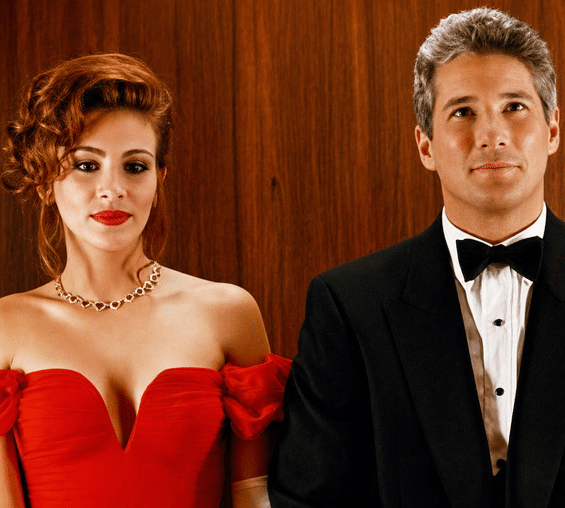
The croissant, it turns out, had quietly become a pancake, swapped in because director Garry Marshall preferred a later take of Julia Roberts and chose to keep it in the finished film regardless of the switch.
From Dark Script to Disney Romance
Before it was a beloved rom-com, Pretty Woman started life as something far grittier. Screenwriter J.F. Lawton originally titled his script 3,000, and it dug into darker themes of class division, corporate greed, and sex work in Los Angeles.
Disney bought the project and reworked it entirely. The studio softened the harder edges, poured in a bigger budget, and reshaped the story into the glossy romantic comedy audiences fell in love with.
Casting Surprises and On-Set Chemistry
Richard Gere wasn’t the first choice for Edward Lewis. Al Pacino was originally attached to the role and even did a casting reading opposite Julia Roberts before ultimately walking away from the part.
Pacino never explained exactly why he passed, but he later praised Roberts generously. “I mean, you could tell at the reading, this is going to be good, this is going to be a hit picture. You just knew it,” he said, adding that he asked Garry Marshall where he’d found her.
Julia Roberts, meanwhile, was determined to have Gere on board. According to Roberts, she agreed with everything Gere said during their early conversations about the role, then told him plainly that the film would fall apart without him.
Gere has recalled the moment that sealed the deal: while they were getting to know each other, Roberts wrote something on a piece of paper and slid it across to him. It read, “Please say yes.”
Their off-screen bond turned out to be just as real as it looked on camera. Gere later said they “loved each other immediately” and that they used to talk three or four times a day, a habit that continued long after filming wrapped. Garry Marshall noticed the spark instantly, recalling how he once stepped away and came back to find the two actors simply staring at each other down a hallway.
Costume, Prop, and Continuity Details
The pancake wasn’t the only detail that shifted mid-scene. In the first shot featuring the pancake, Vivian takes a second bite, but in the very next shot the pancake shows only one bite missing, and the bite pattern doesn’t match at all.
Costume choices carried real weight in the story too. The red dress Vivian wears to the opera marks her transformation, and Vogue once described it as “eye-catching, incredibly sexy without losing an ounce of elegance.” Costume designer Marilyn Vance created six outfits for the character, including that showstopper.
Vance also designed the polka dot dress Vivian wears to the horse race, made from vintage silk sourced at a small antique fabric shop, paired with Chanel shoes for the finishing touch.
Richard Gere’s now-iconic tie, the one Vivian yanks from a store employee, wasn’t designer at all. Vance picked it up locally for about $48. Watch closely and you’ll notice its knot changes throughout the film, shifting from a half-Windsor with a straight collar during the polo match to a full-Windsor with a spread collar later on.
The Rodeo Drive shopping spree that transforms Vivian’s wardrobe came with a real price tag, too. Vance estimated the outing would have cost Edward’s character around $30,000.
The ruby-and-diamond necklace Vivian wears with her red gown wasn’t a prop stand-in either. It was valued at roughly a quarter of a million dollars, and an armed guard hired by the jewelry store stood watch behind the director throughout filming.
A few smaller inconsistencies slipped through as well. Edward’s shoes vanish and then reappear during the park scene after the opera. The $100 bill Vivian tucks into her boot disappears without explanation by the time she removes her boots later. And the four colored condoms Vivian lays out rearrange themselves between shots before snapping back to their original order.
Behind-the-Scenes Stories and Real-Life Bond
The jewelry box scene, often cited as one of the film’s most romantic beats, actually began as a prank. Marshall and Gere planned it to jolt a tired 23-year-old Roberts awake after a late night.
“I said, ‘Richard, you gotta wake her up a little, so when she reaches for the box, slam it. It was a soft box. I would never hurt her,'” Marshall explained. Roberts’ genuine, startled laugh made the final cut and became one of the movie’s signature moments. “We put it in… and it became like the trademark of the movie,” Marshall said.
Gere hasn’t always been sentimental about his own role. At a film festival in Venice, he called Edward “criminally underwritten,” joking that the character was “just a suit and a good haircut.” He was even more pointed about the piano scene, sarcastically remarking that he and Roberts had “no chemistry” in a moment widely regarded as one of the film’s sexiest.
That scene wasn’t originally scripted. Marshall asked Gere what he actually did during sleepless nights in hotels, and Gere described finding a piano and playing to pass the time. Marshall suggested building a scene around that habit, and the result was largely improvised, with Marshall simply directing Gere to “play something moody.”
Decades later, the mix of studio polish, real jewelry, unscripted jokes, and genuine off-screen friendship still shapes how audiences remember Pretty Woman. The small continuity slips and behind-the-scenes surprises haven’t dulled its charm; if anything, they’re part of why fans keep rewatching it, still finding something new each time.