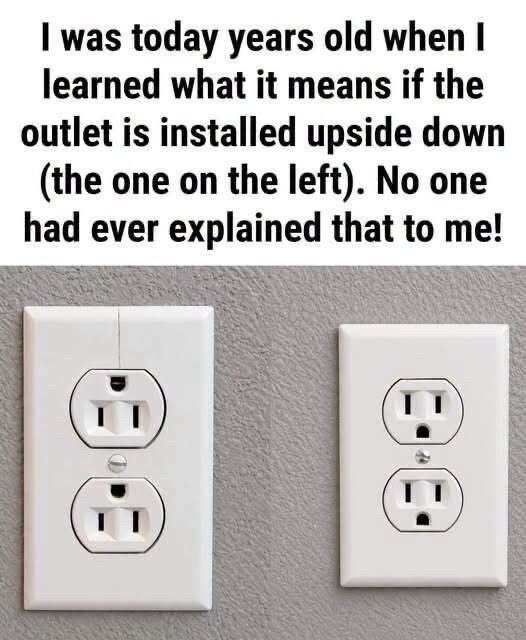
But that unusual outlet may have been installed that way intentionally.
One possible explanation involves switched outlets, a feature commonly found in older homes and in rooms where lamps were intended to provide the main source of lighting.
Before ceiling fixtures became commonplace in every room, builders frequently installed wall switches that controlled an electrical receptacle instead.
You could plug a floor or table lamp into the outlet and operate it using the wall switch just like a ceiling light.
Some receptacles were even divided so that only one half was controlled by the switch.
For example, the top socket might turn on and off with the wall switch, while the bottom socket remained powered continuously.
That allowed homeowners to connect a lamp to the switched portion while still having constant electricity available for something like a clock, charger or other device.
But how would you know which outlet was different from all the others?
In some installations, electricians turned the switched receptacle upside down.
With the grounding hole positioned at the top, the unusual orientation became a simple visual clue that the receptacle functioned differently from the standard outlets around it.
However, there’s an important catch.
An upside-down outlet does not automatically mean it’s controlled by a wall switch.
Outlet orientation can vary according to the electrician, builder, facility or local convention.
In the United States, the National Electrical Code does not generally establish one universal up-or-down orientation for ordinary receptacles.
There can also be other reasons for installing a receptacle with the ground pin upward.
Some electricians prefer that orientation because they believe it offers a practical advantage in certain situations.
If a plug is partially pulled from the receptacle and a conductive object falls between the plug and outlet, having the grounding pin at the top may reduce the chance of that object contacting the energized blades first.
Still, seeing the ground hole at the top isn’t enough to determine exactly why the electrician installed it that way.
If you’re curious whether an unusual outlet in your house is switch-controlled, there’s a simple test.
Plug a lamp into it and try the nearby wall switches.
If one switch turns the lamp on and off, you’ve found a switched receptacle.
If the receptacle has two sockets, test both separately because it’s possible for one half to be switched while the other remains continuously powered.
Just avoid removing the outlet cover or working on the wiring unless you know how to do so safely; electrical work can present serious shock and fire hazards.
Ultimately, that seemingly upside-down outlet may not be upside down at all.
It could be marking a switched circuit.
It could reflect an electrician’s preferred installation method.
Or it could simply be how the builder installed the outlets throughout the property.
So the next time you notice one outlet facing the “wrong” direction, don’t immediately assume someone made a mistake.
Sometimes the smallest details in a house can reveal how it was designed to work.