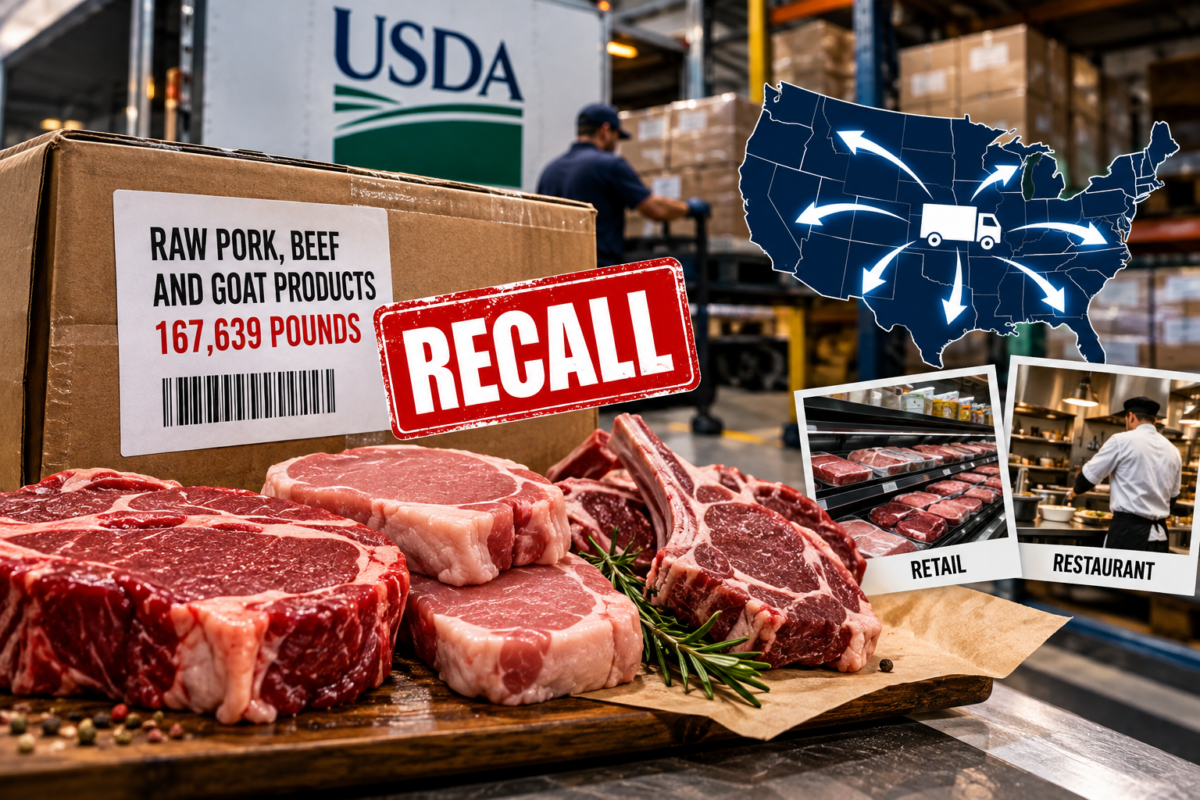
…That determination is why the U.S. Department of Agriculture’s Food Safety and Inspection Service moved on September 22, 2026, announcing a recall covering approximately 167,639 pounds of raw pork, beef and goat products already shipped to businesses around the country.
The False Inspection Mark Behind the Recall
FSIS said the affected products carry a false USDA mark of inspection with establishment number “EST. 1363.” That number, the agency said, does not have a federal grant of inspection attached to it.
FSIS was blunt about what that means for consumers. “Any product bearing the false establishment number ‘EST. 1363’ should be considered misbranded and unsafe to eat,” the agency said, adding that the problem extends beyond incorrect labeling to the legitimacy of the inspection claim itself.
The products were discovered during routine FSIS surveillance activities. As of the announcement, there were no confirmed reports of illness or injury linked to consumption of the recalled meat.
Scope of the Recall and Distribution
The recall names Star Meat Delivery Inc. of Lucama, North Carolina, as the producer. The company is recalling roughly 167,639 pounds of raw pork, beef and goat products made on various dates before September 22.
Those products were shipped to A&D Foods, a distributor in Georgia, for further distribution to retailers and restaurants nationwide. The affected list spans more than 20 items, including goat cuts, beef oxtail, beef short ribs, beef feet, shanks, ground pork, pork chorizo, pork chops, pork feet, several Boston-cut pork products and a menudo mix, all vacuum-sealed and packed into cardboard boxes of varying weights.
Identifying the meat at home may not be simple. FSIS noted that individual retail packages may not match the original bulk labeling, since retail stores may have applied their own stickers with pricing and safe-handling instructions over the original packaging.
Because of that, FSIS said it is concerned some of the recalled product may still be sitting in consumer, retailer or restaurant refrigerators and freezers. The agency said it may update the list of affected products and labels as more information comes in, and it plans recall effectiveness checks to confirm Star Meat Delivery has notified its customers and pulled remaining product from commerce.
A&D Foods and Star Meat Delivery did not immediately respond to PEOPLE’s request for comment.
Similar Recalls Earlier in 2026
This is not the first time this year FSIS has pulled meat produced or imported without proper inspection. On August 7, Corte Argentino USA LLC of Aventura, Florida, recalled about 29,628 pounds of raw boneless beef imported from Argentina without required import reinspection, distributed to Florida and Texas.
On August 17, Indus Foods LLC, doing business as Gangothri Foods, recalled roughly 1,626 pounds of ready-to-eat pickled goat and chicken products sold nationwide and directly to consumers online, none of which bore a USDA inspection mark.
Then on August 26, Shanghai Ravioli Corporation of Boston recalled approximately 24,900 pounds of frozen Buffalo chicken products distributed to several New England states. Those products also carried a false inspection mark, using a different establishment number, “EST. 18004.” The incidents involved separate companies and circumstances and are not shown to be connected.
The Debate Over Food-Safety Oversight
FSIS said the Class I designation reflects a reasonable probability that exposure to the product could cause serious adverse health consequences or death, though that classification does not mean anyone has actually gotten sick.
The recall arrives amid wider scrutiny of federal food-safety staffing. A 2025 NPR report cited former inspector Paula Soldner, who said remaining inspectors were covering roughly double the usual number of facilities after staffing reductions, raising her doubts about whether every plant still received daily inspection.
Sarah Sorscher of the Center for Science in the Public Interest told NPR the food-safety system was under significant strain. USDA responded that inspectors remain essential workers and pointed to an additional $14.5 million in funding to reimburse states for food-safety inspections.
Not everyone reads rising recall numbers the same way. University of Florida food-safety professor Keith Schneider told Newsweek that a recall often shows the oversight system working as intended, catching a problem and removing affected product before it causes harm.
What Consumers Should Do Now
Anyone who believes they purchased one of the recalled products should not eat it. FSIS advises throwing the meat away or returning it to the place of purchase, and reminds shoppers that individual packages may carry different store-applied stickers than the original labeling.
Restaurants and retailers holding any of the affected products should not sell or serve them. Consumers with food-safety questions can call the USDA Meat and Poultry Hotline at 888-MPHotline (888-674-6854) or email [email protected], and can report problems through the FSIS Electronic Consumer Complaint Monitoring System.