
My name is Walter Pierce. I’m 67 years old, and I spent 38 years working as a hospital pharmacist in Asheville, North Carolina. After that much time around medications, charts, dosage schedules, and medical records, you develop a certain way of looking at the world. I trust numbers.
A Family Built on Trust
Six years ago, my son Adam, his wife Renee, and their twelve-year-old son Caleb were driving home from a Fourth of July cookout when a delivery truck ran a red light. Adam walked away with a broken collarbone. Renee wasn’t hurt. Caleb’s life changed forever.
Doctors diagnosed severe diaphragmatic nerve damage. His lungs could no longer work on their own, and four months later he came home dependent on a portable ventilator, with a feeding tube and a complicated schedule of medications and therapy. As the family pharmacist, I became deeply involved in his care.
Two years after the accident, Adam died unexpectedly in his sleep from a heart attack at 39. There was no warning. Renee stayed, and everyone praised her for it. My late wife told me the girl could have remarried but stayed for the boy. I believed that completely.
When Renee suggested I sell my house and move into her guest suite to help with Caleb’s care, I did it without hesitation. I thought I was helping my family through the worst years of our lives. I didn’t realize I was also handing Renee near-complete access to everything I had left.
For six years our home ran like a hospital ward with nicer furniture. Renee handled appointments and daily care; I managed medications and paid what needed paying, trusting her with the paperwork. There was also Caleb’s medical trust, set up by my late wife’s brother at just over $6 million. Renee handled that paperwork too. Why would I question it?
The Morning Everything Changed
One gray Tuesday in October, Renee kissed my cheek and said she was flying to Sedona with her sisters for a wellness retreat. Her car disappeared past the mailbox at 7:50. Eight minutes later, I heard footsteps upstairs — not the sound of someone shifting in bed, but footsteps.
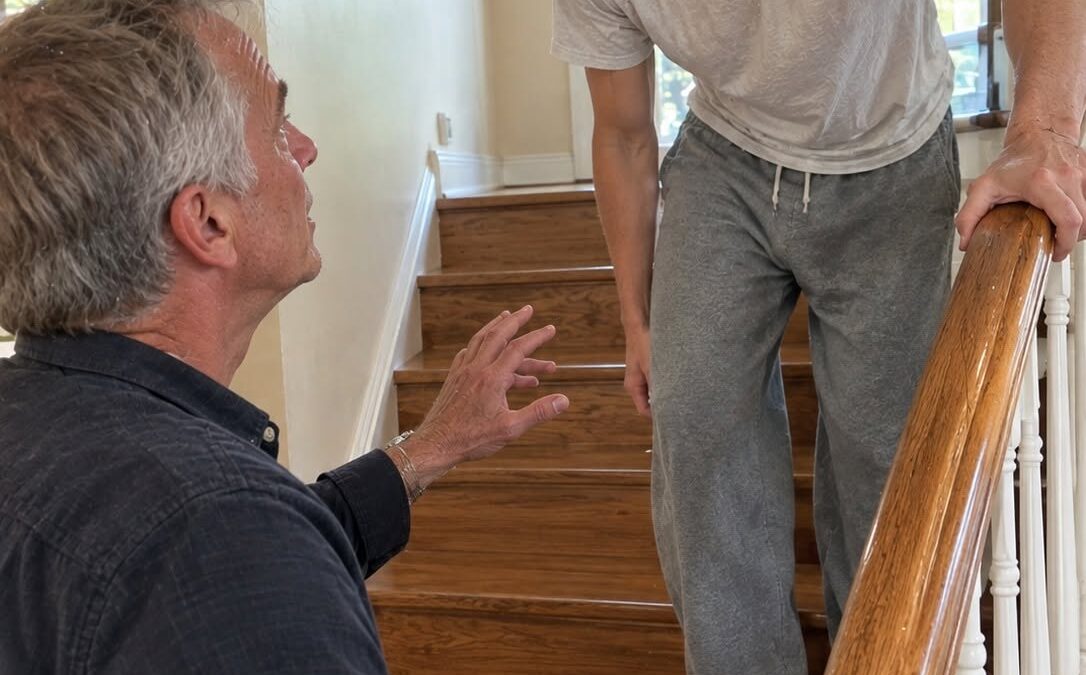
I ran to the stairs expecting a ventilator emergency. Instead, Caleb stood at the top, eighteen years old, gripping the banister, sweat soaking his shirt, legs trembling. He was breathing. No machine. No tube. Completely on his own.
He begged me not to call anyone, telling me Renee wasn’t really on a plane. She never booked flights until the last minute, he said. She was meeting someone. Caleb told me he’d secretly been able to breathe on his own for almost a year, ever since a low-battery alarm on his ventilator went unanswered and he discovered he didn’t need it.
He’d kept it hidden, and through the vents in his room he’d overheard Renee speaking with a conservatorship lawyer. She was meeting that man that day, and Caleb had heard her say my name. Then my phone buzzed — a bank alert about a large, unusual transfer pending review on my personal account.
Something in me shifted. I told Caleb to grab what he could carry. In the garage, we found Renee’s SUV wouldn’t start; the battery cables had been cut clean through. I broke the window of my old truck, twisted the ignition wires together, and drove us away without knowing where we were going.
Uncovering the Deception
That afternoon, while Caleb slept in a motel room, I opened my banking records for the first time in six years. Careful withdrawals of a few hundred dollars at a time, labeled as household reimbursements, had drained roughly $340,000 from the account holding what remained of my house sale — money I’d been able to access because I’d given Renee power of attorney after my wife died.
Worse was Caleb’s trust. The $6 million balance had fallen to just $41,000. Nearly all of it had gone to a company called Meridian Regenerative Wellness LLC, tied to a single name: Dr. Gordon Vance, the pulmonologist who had overseen Caleb’s ventilator care from the start.
I also remembered Renee telling neighbors she worried about my memory — comments that, in hindsight, looked like preparation for a conservatorship claim on me. I didn’t call the police that night. I worried I’d sound like a confused old man. I needed evidence.
I brought a forensic-lab friend, Priya Anand, six capsules I’d found hidden in Caleb’s nightstand, which Renee had been slipping into his nightly feeding formula as a supposed muscle relaxant. Priya ran the test three times before calling me: it was a veterinary neuromuscular blocking agent, capable of suppressing breathing muscles over time and mimicking the very impairment Caleb had been diagnosed with.
That raised a darker question about Adam. A retired investigator, Harold Dunore, helped me dig through years of records. He found a $12,000 cash withdrawal Renee made nine days before Adam died, traced to a compounding pharmacist later stripped of his license for prescription fraud.
We couldn’t prove everything, but we had enough to hand investigators a real trail — and a strong suspicion that Renee had played a role in Adam’s death, though she was never formally charged for it.
Confrontation and Aftermath
Six days after Caleb first stood in that hallway, Renee came home from her supposed retreat. She hadn’t been in Sedona; she’d spent the week at a hotel with Dr. Vance. Instead of the family she’d controlled for six years, she found Caleb and me waiting with two detectives and Harold, evidence spread across the coffee table.
She reached for Caleb. He stepped back. “You’re not my mother,” he told her. He said he knew what she’d taken from him, and that he’d heard her on the phone for a year. Renee was arrested in the living room. Dr. Vance was arrested that same evening at the hotel.
The months that followed brought lawyers, a trial, and long physical therapy sessions as Caleb relearned how to walk after years of forced stillness. Most of the stolen money was never recovered, moved through channels too tangled to fully trace.
Eight months later, I stood with Caleb outside the state university as he carried his own duffel bag toward the dorms. No wheelchair. No ventilator. No one holding him up. He told me he had it from here, and I watched him walk through the doors on his own breath, into the life that had been waiting for him all along.