But appearances can be incredibly misleading.
Rather than being designed for combat, objects built in this rugged style could have a much more ordinary and practical purpose—helping people perform difficult work around farms, fences, fields and other properties.
And when you look more closely at the construction, that possibility begins to make sense.
Older agricultural and industrial equipment wasn’t designed to look attractive.
It was designed to survive.
Workers needed equipment that could be dragged across rough ground, exposed to rain and mud, struck repeatedly, loaded with weight and used year after year without requiring complicated repairs.
Heavy steel was perfect for that.
If something broke, it could often be welded.
If the surface became scratched or dented, it usually didn’t matter.
As long as the tool continued doing its job, appearance was almost irrelevant.
That’s one reason unidentified pieces of old equipment can be so difficult for modern observers to recognize.
Decades of weathering can erase the clues that once made their purpose obvious.
Paint disappears.
Labels rust away.
Wooden components rot.
Chains, handles or attachments become separated.
Eventually, what remains may be nothing more than an unusual chunk of steel.
Then somebody discovers it decades later and naturally wonders:
What on earth was this thing used for?
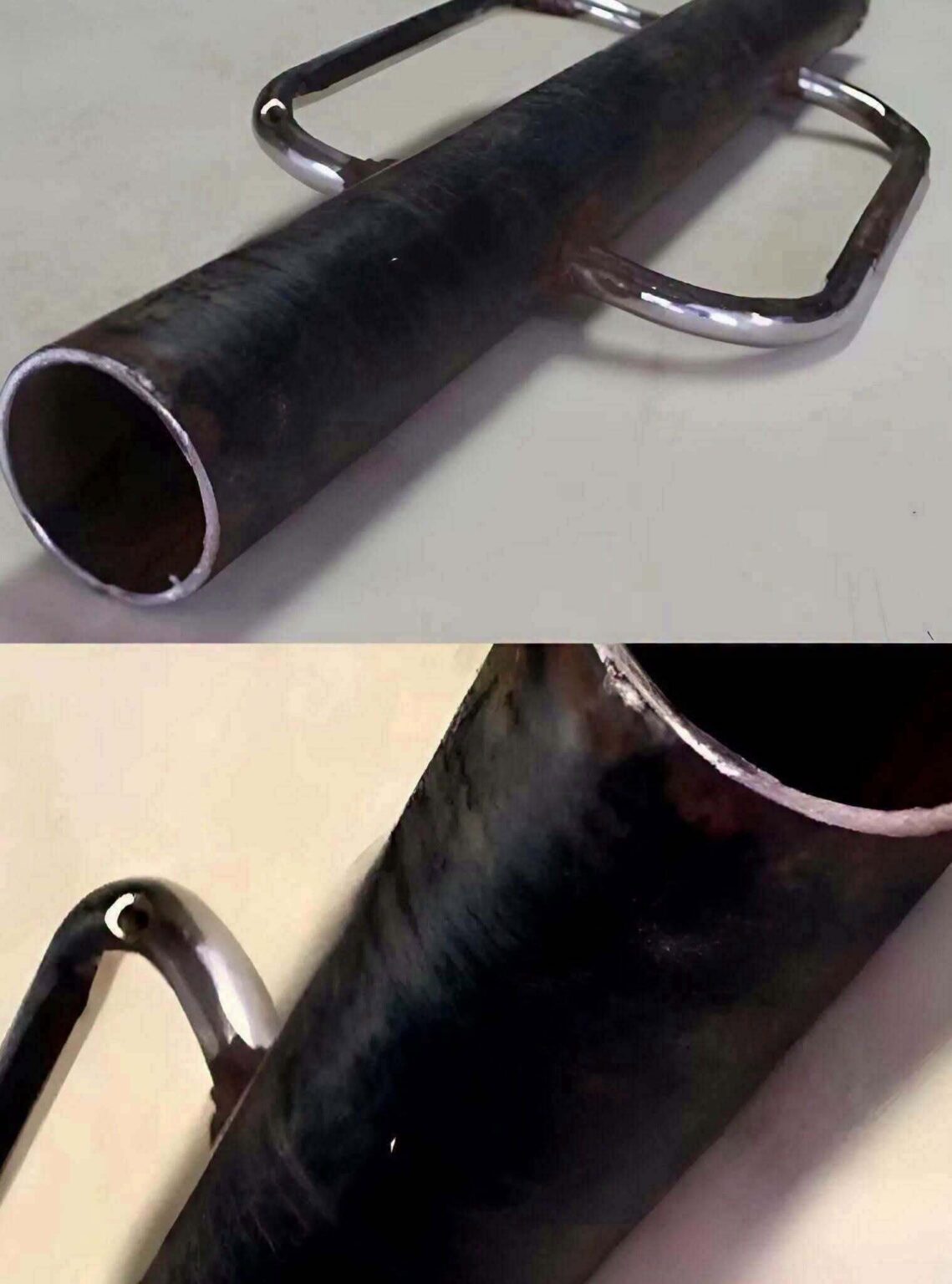
The welded handles can provide an especially interesting clue.
Handles generally suggest that somebody needed to lift, position, stabilize or move the object during use.
Its cylindrical shape may offer another clue, while its substantial construction suggests it was expected to withstand considerable force.
These aren’t necessarily random design choices.
With old tools, almost every strange-looking feature may have existed for a reason.
That’s why context is so important when identifying mysterious equipment.
Where was it discovered?
Near an old farm?
Beside a fence line?
Inside a barn?
Near former industrial property?
Were chains or additional metal pieces found nearby?
Does it have openings, attachment points or evidence that something else was once connected to it?
Sometimes one tiny detail can completely change the identification.
An object that looks like military debris when photographed by itself may suddenly make perfect sense when discovered beside decades-old fencing equipment.
Something resembling a machine component might actually have been a simple manually operated tool.
And that’s part of what makes these discoveries so fascinating.
They provide a glimpse into an era when many difficult jobs were accomplished through remarkably straightforward engineering.
There were no electronics.
No computerized controls.
Sometimes there wasn’t even a complicated mechanical system.
Instead, workers relied on weight, leverage, durable materials and clever design.
If the equipment worked, it stayed in use.
Sometimes for decades.
Eventually, however, newer machinery replaced many of those tools.
The old equipment was pushed into barns, sheds and fields.
Wood disappeared.
Metal rusted.
Memories faded.
And practical everyday objects slowly became mysteries.
That’s why it’s worth resisting the temptation to identify an unusual object solely from its appearance.
Something that looks dangerous may have been completely ordinary.
Something resembling battlefield scrap may once have helped maintain farmland.
And something that appears to be worthless industrial junk today may have been an essential piece of equipment to the person who used it generations ago.
This battered steel object is a perfect reminder.
Rust can hide history.
Time can hide purpose.
And sometimes the strangest-looking object isn’t mysterious at all.
We’re simply looking at an old solution to an everyday problem that most of us no longer have t