Then my heart started racing.
I’d had fainting spells since childhood, but this felt different.
I reached for the counter and missed.
The last thing I remember before losing consciousness was my father telling the paramedics:
“She’ll live. She’s had these episodes before.”
Their flight left at six.
They went.
I went the opposite direction in an ambulance.
At the hospital, doctors had to shock my heart back into rhythm.
When I woke in the cardiac unit, a doctor asked:
“Is there someone we should call?”
I was thirty-four years old.
I couldn’t think of anyone.
“There’s no one.”
My parents knew I was hospitalized.
That evening, the family group chat filled with photographs from Camille’s celebration.
Mom sent me one private message:
So glad you’re okay. Camille was radiant tonight. Rest up.
She had no idea whether I was okay.
She hadn’t called the hospital.
Neither had Dad.
I’d been fainting since I was nine.
My parents always had an explanation.
I was sensitive.
Dramatic.
Looking for attention.
Eventually, I stopped asking them to believe me.
On my second day in the hospital, an electrophysiologist named Dr. Lindren reviewed my records.
“Florence, someone noticed something when you were nine.”
She showed me an old entry.
Prolonged QT interval.
A potentially dangerous electrical problem with the heart.
“There should be more records after this,” she said. “But the file stops.”
The full pediatric file arrived two days later.
This time, my estranged brother Reed was sitting beside me.
I’d called him after remembering something I’d done six years earlier.
During another frightening ER visit, I’d completed an advance directive naming Reed as the person I trusted to make medical decisions if I ever became unable to make them myself.
We hadn’t spoken properly in years.
My parents had cut him off after he confronted them about the way our family worked.
But when I called from the hospital, Reed arrived ninety minutes later.
“You came,” I whispered.
“You called.”
Then he sat in the chair beside my bed.
The chair that had been empty for four days.
Dr. Lindren opened my childhood file.
At nine, after one of my fainting episodes, a cardiologist had identified the problem.
He recommended medication.
Regular monitoring.
Further treatment if the episodes continued.
Then she turned to the final page.
A refusal form.
Signed by both my parents.
At the bottom, my mother had written:
Child is well. We don’t want her labeled.
I read it three times.
Twenty-five years of fainting.
Twenty-five years of being told I was dramatic.
And they’d known.
“They knew,” I said.
Dr. Lindren nodded.
“They knew there was a medical concern serious enough that a specialist recommended treatment.”
Suddenly, something Dad had said on the kitchen floor sounded completely different.
She’ll live.
That hadn’t begun nine days earlier.
They’d been saying some version of it my entire life.
She’ll live.
Don’t make a fuss.
Don’t give it a name.
She always gets back up.
And because I kept surviving, they kept treating survival as proof that nothing was wrong.
On my sixth day in the hospital, Mom accidentally reached my room phone.
Her first concern wasn’t my heart.
“Please don’t put anything about this online,” she said. “Camille’s engagement pictures are doing beautifully. We don’t need people asking questions.”
I hung up.
By then, I’d spoken with the hospital social worker.
I confirmed in writing that my parents were not to receive my medical information or participate in my care.
Reed remained my healthcare agent if I became unable to speak for myself.
The hospital also documented the old pediatric records and the circumstances of my collapse for appropriate review.
Meanwhile, my parents extended their trip.
Dad called from somewhere near the water.
“Don’t let the hospital turn this into a whole thing. We’ll come get you when we’re back.”
Nine days after they stepped around my gurney to catch their flight, he texted:
Landing at 2. Coming straight to the hospital to sign you out and bring you home. Enough drama.
I didn’t correct him.
They arrived tanned.
That’s what I remember most.
Dad had sunglasses hanging from his shirt.
Mom had a fresh manicure.
Camille’s engagement ring glittered under the hospital lights.
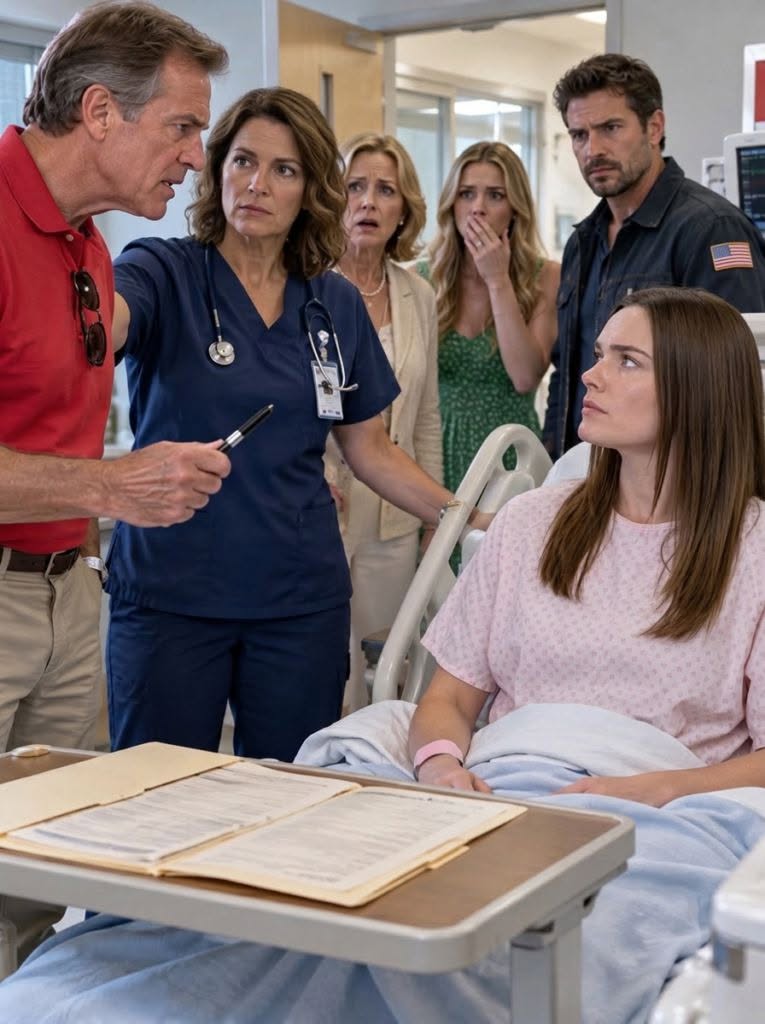
Dad walked toward my room holding a pen.
“There’s my girl. You look better than I expected. Where do I sign?”
Ruth, the charge nurse who had cared for me all week, stopped him.
“Mr. Young, Florence is not being discharged to you.”
Dad laughed.
“We’re her parents.”
“Florence is an adult. She makes her own decisions.”
His smile disappeared.
“And if she ever becomes unable to make them,” Ruth continued, “she has already designated someone else.”
Dad looked toward me.
I said nothing.
Then Reed stood from the chair beside my bed.
“Hello, Dad.”
My mother’s face went white.
“Reed?”
“Six years,” he said. “You threw me out six years ago.”
He looked toward me.
“I stayed on her paperwork anyway.”
Dad stared at him.
“You have no right—”
“He does,” I said.
It was the first thing I’d said.
“And more importantly, so do I.”
Dr. Lindren entered carrying the old manila folder.
“There is something else Florence has authorized us to discuss with you.”
She opened it.
Dad’s expression changed when he saw the old pages.
Mom looked away.
Dr. Lindren showed them the ECG from when I was nine.
Then the cardiologist’s recommendations.
Finally, she placed the refusal form on the table.
Two signatures.
Dad’s.
Mom’s.
And underneath:
Child is well. We don’t want her labeled.
Nobody spoke.
Dr. Lindren explained that the condition identified in childhood was consistent with the dangerous rhythm that had nearly killed me nine days earlier.
Dad became defensive.
“We made the decision we thought was best. And look at her—she’s alive.”
There it was again.
Alive.
As if that settled everything.
I looked at him.
“You keep saying that.”
He stopped.
“You said it while I was lying on your kitchen floor. You basically said it when I was nine.”
“Florence—”
“No.”
My voice stayed calm.
“You were right. I lived.”
I looked from him to Mom.
“I always lived.”
Then I finally understood what I wanted them to hear.
“But I lived through it alone.”
The room went silent.
“‘She’ll live’ was never care. It was permission to leave.”
Dad lowered the pen.
Camille had started crying.
“I didn’t know,” she whispered. “They always told me you did it for attention.”
I believed her.
She had grown up inside the same family story I had.
But then Mom said her name.
“Camille.”
My sister looked at her.
Then at me.
For one second, I thought she might walk toward my bed.
Instead, she stepped back beside our parents.
“I’m sorry,” she whispered.
I think she meant it.
But she still stepped back.
That mattered too.
My parents were told they could leave peacefully or security would escort them from the unit.
Dad placed his unused pen on the table.
Neither parent apologized.
They simply turned around and walked away.
Exactly as they had nine days earlier.
Camille lingered in the doorway.
Her eyes moved toward Reed.
Toward the chair beside my bed.
Then she left too.
Reed sat back down.
His hand rested carefully on my arm, avoiding the IV.
The chair wasn’t empty anymore.
A few days later, doctors implanted a defibrillator beneath my collarbone.
If my heart ever falls into that dangerous rhythm again, the device can intervene.
For the first time in my life, my condition has a name.
And a treatment.
Reed drove me home.
A month later, Camille sent me a message:
I think about that folder every day. I’m sorry I stepped back.
I believe her.
But I’ve also learned that apologizing from a safe distance isn’t the same as showing up.
My parents spent my entire life saying, “She’ll live,” as though surviving alone meant I’d been cared for.
It doesn’t.
Surviving what someone does—or fails to do—doesn’t prove it was acceptable.
It only proves you survived it.
For thirty-four years, I thought family meant the people whose names matched mine.
Nine days in a cardiac ward taught me something different.
Sometimes family is a nurse who brings you ice without being asked.
A doctor who reads the pages everyone else ignored.
And a brother you haven’t spoken to in six years who answers the phone and says:
“Where are you?”
Then comes.