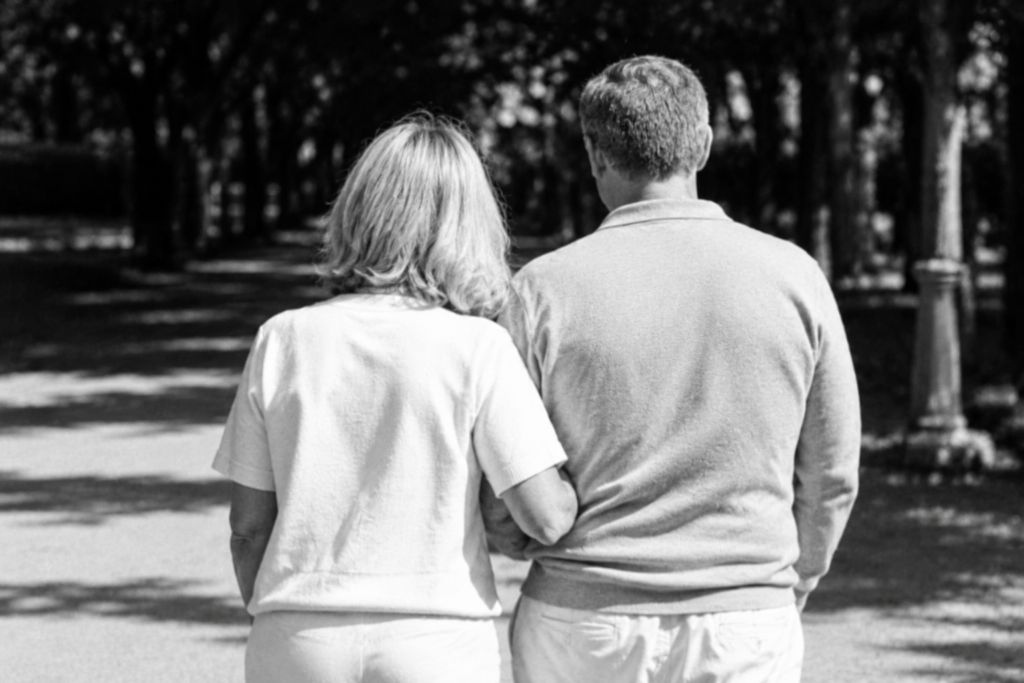
Jeffrey was on the other side.
The boy who’d been my best friend.
The man I’d secretly loved.
The person who’d written me one final letter in 1986 asking me never to contact him again.
His son, Peter, stood beside me.
“He’s been asking whether you’re here yet.”
I looked at him.
Peter had Jeffrey’s eyes.
“Is he awake?”
“He’s trying to stay awake for you.”
That almost made me leave.
I was sixty years old.
I’d spent most of my adult life learning how not to need answers from Jeffrey.
I wasn’t sure I could survive getting them now.
But I opened the door.
Jeffrey lay beneath a white hospital blanket.
His hair was white.
His face was thinner.
Age had changed almost everything about him.
Almost.
His eyes found mine.
Then came the faintest smile.
“Ruthie.”
My throat closed.
“Hey, idiot.”
He laughed.
Weakly.
But it was his laugh.
Then I noticed something beside his bed.
A wooden box.
I stopped breathing.
I knew that box.
It had belonged to my father.
And I’d been searching for it since the day he died.
“Jeffrey…”
He followed my eyes.
“Yeah.”
“Why do you have my father’s box?”
His smile disappeared.
“Because your father is part of the reason we lost forty-one years.”
Jeffrey and I became best friends when we were seventeen.
Not boyfriend and girlfriend.
Just Jeffrey and Ruth.
That distinction seemed very important to us.
Everyone else thought it was ridiculous.
Jeffrey dated girls.
I dated boys.
I even went to prom with someone else.
My date’s car broke down, and naturally Jeffrey ended up driving me there.
My mother, Erica, used to watch us sitting at the kitchen table arguing over homework and shake her head.
“One day, you two are going to figure this out.”
Jeffrey would grin.
“Figure out what?”
“You know exactly what.”
Then he’d look at me.
I’d roll my eyes.
“We’re friends, Mom.”
And technically, we were telling the truth.
What neither of us admitted was that losing the friendship frightened us more than risking something bigger excited us.
So we stayed safe.
Until the summer we were nineteen.
We’d both gone on terrible dates.
Mine spent almost two hours talking about himself.
Jeffrey’s date left early after they got into an argument over a movie.
We met afterward at our old high school football field.
The gates hadn’t been properly locked.
We slipped inside and sat beneath the bleachers.
Jeffrey leaned against one of the metal supports.
“We’re terrible at this.”
“At what?”
“Dating.”
I laughed.
“You’re terrible at dating.”
“You’re the one who just spent two hours listening to some guy explain his father’s boat.”
“It was apparently a very impressive boat.”
Jeffrey laughed.
Then he became quiet.
“What if we never get it right?”
“We’ll survive.”
“What if we’re both single forever?”
I looked at him.
He held out his pinky.
“If we’re both single at sixty, we stop being idiots and find each other.”
I laughed.
But Jeffrey wasn’t laughing.
“Jeffrey.”
“I’m serious.”
“Why sixty?”
“Because if we still haven’t figured it out by then, we clearly need professional help.”
I stared at his hand.
Then hooked my pinky around his.
“Deal.”
His eyes held mine.
“Deal.”
There was a moment after that.
A moment I’ve replayed thousands of times.
I could’ve kissed him.
He could’ve kissed me.
One of us could’ve said something.
Neither did.
Two months later, Jeffrey left for college three states away.
At first, we wrote constantly.
Real letters.
Long ones.
He told me about his roommate, who apparently believed dirty laundry belonged on every available surface.
I told him about working at the library while taking classes.
He complained about cafeteria food.
I complained about people returning books with coffee stains.
For that first year, I knew more about Jeffrey’s life than some people living in his dorm.
Then the letters slowed.
Every week became every other week.
Every other week became once a month.
I assumed college was changing him.
My life was changing too.
I was training to become a teacher.
I made new friends.
I dated.
But whenever anything important happened, Jeffrey remained the first person I wanted to tell.
Then, during his second year, he mentioned a girl.
Margaret.
She was studying nursing.
She was funny.
Smart.
Stubborn.
Jeffrey wrote:
You’d like her.
I sat on my bedroom floor holding that letter.
And suddenly, at twenty years old, I understood something everyone else had apparently known since I was seventeen.
I was in love with my best friend.
I cried for hours.
Then I started writing him a letter.
I told him everything.
That I’d loved him longer than I understood.
That I’d been scared.
That maybe our ridiculous promise at nineteen hadn’t actually been ridiculous.
I wrote several pages.
Then tore them apart.
Jeffrey sounded happy.
What right did I have to interfere?
So I continued being his friend.
For a while.
Then, in the summer of 1986, his final letter arrived.
I knew something was wrong immediately.
Jeffrey always began letters with a joke.
This one started with my name.
Ruth,
Margaret and I are getting married. The ceremony is in August.
I sat at our kitchen table staring at those words.
He explained that the wedding would be small.
Margaret’s family was helping them get settled.
He hoped I was doing well.
Then I reached the bottom.
And found the sentence that ended us.
Jeffrey asked me not to contact him again.
Margaret knew how close we’d been.
He wanted to give his marriage a fair chance.
Our friendship mattered too much to him to allow it to become something that hurt his wife.
Then:
I hope you have a wonderful life, Ruthie.
I’m sorry.
Jeffrey.
I cried for weeks.
But I respected his decision.
I didn’t write.
I didn’t call.
I didn’t show up.
I disappeared from his life because that was what he’d asked me to do.
For a few years, mutual acquaintances occasionally mentioned him.
Jeffrey and Margaret had a son.
Later, a daughter.
He built a career.
They moved.
Eventually, even those updates stopped.
I built my own life.
I became a teacher.
I had relationships.
Some were good.
One almost became marriage.
But whenever someone asked why I never settled down, I gave them the simplest answer.
“I never met the right man.”
It wasn’t entirely true.
I’d met him at seventeen.
I just hadn’t been brave enough to tell him.
Last Tuesday, I turned sixty.
I live in my childhood home now.
After my parents died, I kept it.
I’d spent years moving between apartments, and eventually returning home felt less like moving backward and more like finally choosing somewhere to stay.
That evening, I had dinner alone.
I cut myself a slice of birthday cake.
At exactly 9:17 p.m., the old landline rang.
Almost nobody called that number anymore.
I nearly ignored it.
Then something made me answer.
“Hello?”
A man’s voice said:
“Is this Ruth?”
“Yes.”
“My name is Peter.”
I waited.
“I’m Jeffrey’s son.”
I sat down.
“Jeffrey’s son?”
“Yes.”
“What happened?”
Silence.
Then Peter said:
“My father wants to speak with you.”
My hand tightened around the receiver.
“He doesn’t have much time.”
Before I could process those words, I heard movement.
Then another voice.
Older.
Weaker.
But unmistakable.
“Ruthie.”
My eyes filled instantly.
“Jeffrey?”
A faint laugh.
“You remembered.”
“Of course I remembered.”
Then he said something that broke forty-one years of silence in a single sentence.
“I remembered every birthday.”
I covered my mouth.
“Jeffrey…”
“Ruthie, I need you to know something before I die.”
“What?”
His breathing became uneven.
“I was in love with you when we made that promise.”
I couldn’t move.
“You were?”
“Yes.”
“Then why didn’t you say anything?”
“I was going to.”
Silence.
Then:
“I’d already bought the ring.”
My heart stopped.
“What ring?”
“The one I was going to give you before I left for college.”
I stood.
“Jeffrey, what are you talking about?”
“I was going to ask you to marry me.”
The room seemed to tilt.
“Then why didn’t you?”
He started crying.
And hearing Jeffrey cry somehow frightened me more than anything else.
“That’s what I’ve spent forty years wishing I could explain.”
“Then explain it.”
“I can’t do it properly over the phone.”
“Jeffrey—”
“Please come.”
He gave me the hospital information.
Then said:
“There’s something here you need to see.”
“What?”
“Your father’s box.”
I froze.
“My father’s what?”
“Please, Ruth.”
I grabbed my coat.
Forty minutes later, I stood beside Jeffrey’s hospital bed looking at that box.
My father, Thomas, had kept important papers inside it for as long as I could remember.
After he died, I’d searched the house.
The box had vanished.
Now I knew why.
“Open it,” Jeffrey said.
My hands shook as I lifted the lid.
There were letters inside.
Dozens.
My father’s handwriting.
My mother’s name.
Old envelopes.
And beneath them was a small ring box.
I knew before opening it.
Still, my breath caught.
Inside was a simple diamond ring.
I looked at Jeffrey.
“You bought this?”
He nodded.
“When?”
“Nineteen.”
My eyes filled.
“Why didn’t you give it to me?”
Jeffrey pointed toward an envelope.
My name wasn’t on it.
His was.
And the handwriting belonged to my father.
I unfolded the letter.
Jeffrey,
Ruth will likely be accepted into the teaching program here. She has a real future ahead of her. If you ask her to follow you, she will.
I stopped reading.
Jeffrey watched me.
I continued.
Please don’t make her choose between you and the life she can build here. If you care about her, give her room to become her own person.
Thomas
I stared at the page.
“My father wrote this?”
“Yes.”
“How did he know about the ring?”
“I told him.”
“Why?”
“Because I asked for his blessing.”
I sat down.
Suddenly I wasn’t sixty anymore.
I was nineteen.
And my father was deciding what future I should have without asking me.
“What did he say?”
“That we were too young.”
Jeffrey swallowed.
“That you were loyal to a fault. That if I asked you to come with me, you’d abandon the teaching program and follow me.”
“You believed him?”
“I was nineteen, Ruth.”
“So was I.”
“I know.”
Anger rose through my grief.
“You never asked me.”
“No.”
“You decided for me.”
“Yes.”
Jeffrey didn’t defend himself.
That somehow made it harder to stay angry.
“I thought I was protecting you.”
I laughed bitterly.
“People seem to do terrible things when they call them protection.”
“I know that now.”
I looked at the ring.
“So you left.”
“I went to college.”
“And the letters?”
“At first, I couldn’t let you go.”
“Neither could I.”
“But then your letters slowed.”
“Because yours slowed.”
He closed his eyes.
“I know.”
I looked at him.
“When did you figure that out?”
His answer surprised me.
“Before I married Margaret.”
My stomach tightened.
“What?”
“Your father came to see me.”
I stared at him.
“My father?”
“Yes.”
My father died the following year after a long illness.
Apparently, before that happened, regret had caught up with him.
“He told me he’d made a mistake,” Jeffrey said.
“Why?”
Jeffrey nodded toward the wooden box.
“Read the other letters.”
They were letters my father had written to my mother before they married.
In them was a story I’d never known.
My maternal grandfather hadn’t approved of my father.
He believed my mother was throwing away opportunities by marrying young.
He’d pressured them to separate.
My father had refused.
And decades later, he’d done almost exactly the same thing to me.
“He realized the hypocrisy,” Jeffrey said.
“He gave you this box?”
“Yes.”
“He told me he should’ve trusted you to make your own decision.”
“Then why didn’t you come back?”
Jeffrey looked toward the window.
“Because by then, I’d promised my life to Margaret.”
I waited.
“And I loved her too.”
I expected that sentence to hurt.
It didn’t.
Not the way I thought it would.
“What you had with Margaret was real?”
“Very.”
“Were you happy?”
He smiled.
“Yes.”
“Then I’m glad.”
He looked surprised.
I shook my head.
“I wouldn’t want another woman’s marriage turned into a forty-year mistake just so ours could’ve happened.”
His eyes filled.
“Margaret deserved better than that.”
“She did.”
“And so did you.”
I looked down.
“Maybe.”
Jeffrey reached for my hand.
I let him take it.
“I wrote that final letter because I knew if I kept talking to you, eventually I’d run back.”
“And you thought cutting me out completely was responsible?”
“At the time?”
He gave me a weak smile.
“Yes.”
“And now?”
“Possibly the stupidest decision I ever made.”
I laughed despite myself.
“Margaret knew?”
“Eventually.”
“What did she say?”
His smile grew.
“She said we were two of the stupidest people she’d ever heard of.”
I laughed.
Jeffrey laughed.
Even Peter laughed from the corner.
“I like her.”
“You would’ve.”
Jeffrey’s smile faded.
“She died several years ago.”
“I’m sorry.”
“So am I.”
After Margaret died, Jeffrey considered calling me.
Many times.
He never did.
“I didn’t know if I had the right.”
“You could’ve tried.”
“I know.”
I looked at him.
“So let me understand this.”
He waited.
“My father decided what was best for me.”
“Yes.”
“You decided what was best for me.”
“Yes.”
“And I decided keeping quiet about loving you was best for you.”
Jeffrey nodded.
“So we lost forty-one years because everybody kept making decisions for everybody else.”
“That’s basically it.”
I stared at him.
“That’s incredibly stupid.”
“Extremely.”
Then I remembered something.
“Jeffrey.”
“What?”
“I’m sixty.”
His eyes widened.
Slowly, he smiled.
“So you are.”
“We had a deal.”
He lifted his hand.
His fingers trembled.
Then he raised his pinky.
“If we’re both single at sixty…”
My eyes filled.
I hooked mine around his.
“We stop being idiots and find each other.”
Jeffrey cried.
“So…”
He cleared his throat.
“Still single?”
“Yes.”
He smiled.
“Me too.”
I stayed beside him through the following day.
We talked until his voice became too tired.
Then rested.
Then talked again.
He told me about Peter.
His daughter, Anna.
His marriage.
Margaret.
I told him about thirty-seven years of teaching.
My students.
The relationships I’d had.
The places I’d traveled.
The life I’d built.
And that mattered.
Because slowly, I understood something.
Those forty-one years weren’t empty simply because Jeffrey wasn’t in them.
I had lived.
So had he.
We had loved other people.
Helped other people.
Become people our nineteen-year-old selves couldn’t have imagined.
I could grieve what we’d lost without pretending everything that happened instead was meaningless.
Two days later, Jeffrey left the hospital.
Peter arranged for him to receive care at home.
Nobody knows exactly how much time he has.
Weeks.
Months.
Maybe longer.
I don’t ask anymore.
Yesterday, Peter drove Jeffrey to my house.
We sat on the same porch where we’d done homework as teenagers.
Jeffrey placed my father’s wooden box beside us.
For a while, we simply held hands.
Then he smiled.
“You know, I never officially asked you.”
“Asked me what?”
He picked up the little ring box.
My heart skipped.
“Ruth, would nineteen-year-old you have said yes?”
I thought about that girl.
Scared of losing her best friend.
Too frightened to say she loved him.
Certain she’d have unlimited time to figure everything out.
“Yes.”
Jeffrey closed his eyes briefly.
Then looked at me again.
“And sixty-year-old you?”
I smiled.
“She’s smarter.”
His face fell theatrically.
“So that’s a no?”
“It means she understands something nineteen-year-old Ruth didn’t.”
“What?”
“We don’t need forty more years to prove what we already know.”
Jeffrey opened the box.
Then paused.
He didn’t simply take the ring out.
He looked at me.
“May I?”
That nearly broke me.
Because after a lifetime of people making decisions for one another, he was finally asking.
“Yes.”
He slipped the ring onto my finger.
It fit.
Jeffrey leaned his head against mine.
Neither of us said anything.
We didn’t need to.
For most of my life, I’d believed our story ended in 1986.
It hadn’t.
We’d simply stopped writing it.
Now Jeffrey calls every morning.
Sometimes I call first.
Peter visits often.
Anna has started calling me Aunt Ruth, though I’ve repeatedly told her she doesn’t have to.
Jeffrey and I aren’t pretending we’re nineteen again.
We’re sixty.
Our knees hurt.
He gets tired quickly.
I occasionally forget why I walked into a room.
There is no magical way to recover forty-one years.
And I don’t want to spend whatever time remains grieving over days neither of us can change.
For decades, I believed meeting the right person at the wrong time meant the story was over.
Maybe sometimes it is.
But sometimes life brings someone back when both of you are finally brave enough to stop deciding what the other person needs.
Sometimes you get another conversation.
Another porch.
Another morning.
Another chance to say what you should’ve said forty-one years earlier.
And when that door opens, I’ve learned something important.
Don’t stand outside it wondering what might happen.
Open it.