1 and 7.
They had hung beside my mother’s front door for as long as I could remember.
And they were the only part of her house my father and Aunt Lisa were ever going to get.
A month before Mom died, I had come home from college unexpectedly.
She was upstairs sleeping after chemotherapy when I heard Lisa talking to Dad in the kitchen.
“I’m tired of waiting,” she said. “I want us to finally be together.”
Then Dad answered.
“Sweetheart, we’ve been together nearly a year already. She still has no idea.”
I froze.
Lisa said she wanted to move into the house after Mom was gone.
Dad lowered his voice.
“The house is in her name. I need to make sure everything gets transferred properly first. Until then, I have to keep acting like the devoted husband.”
I quietly walked back outside.
For an hour, I sat in my car trying to understand what I’d heard.
Dad warming Mom’s blankets after chemotherapy.
Lisa bringing her meals.
Dad kissing her forehead before hospital appointments.
Lisa sitting beside her bed.
How much had been genuine?
And how much had been performed by two people waiting for her to die?
For the next month, I said nothing.
I considered telling Mom almost every day.
But she was exhausted.
Some mornings, walking to the bathroom took everything she had.
I couldn’t bring myself to add another pain to the ones she already carried.
Maybe that was cowardice.
Maybe kindness.
At nineteen, I didn’t know.
Then Mom died.
Three weeks after the funeral, Dad called.
“Kristen, Lisa and I have grown close through our grief.”
I nearly laughed.
Instead, I asked when the wedding was.
“You’re coming?”
“Of course.”
Four days later, while sorting through Mom’s belongings, I received a call from a cancer-support organization.
They wanted to discuss the house.
“My mother’s house?”
The woman hesitated.
“You don’t know?”
That was how I learned Mom had made plans of her own.
During treatment, she’d met cancer patients who traveled hours for appointments. Some couldn’t afford hotels. One woman had slept in her car while her husband received treatment.
So Mom transferred ownership of her house to the organization while retaining the right to live there for the rest of her life.
After her death, it would become temporary housing for cancer patients and their caregivers.
I sat there stunned.
Dad had been waiting for Mom to transfer the house to him.
Mom had already given it away.
“Did she ever say why?”
“Nothing dramatic. She just said people shouldn’t have to sleep in hospital chairs because they live two hours away.”
That sounded exactly like her.
Then I asked:
“Did she know about my father and my aunt?”
The woman became quiet.
“Cathy never said that directly.”
“But?”
“She once told me people around her seemed to be talking about her future instead of talking to her about it.”
My chest tightened.
Then the woman told me something else.
“She talked about you constantly.”
“What did she say?”
“That you were spending too much time caring for her and not enough time being nineteen.”
I laughed through tears.
“There was one thing she told me,” the woman continued. “I asked whether you knew what she’d done with the house.”
I waited.
“She said, ‘My daughter is nineteen. Let her just be my daughter a little longer.’”
I covered my mouth.
For weeks, I’d thought I was protecting Mom by hiding what I knew.
Maybe she’d been protecting me too.
That afternoon, I looked toward the front door.
At the brass 17 beside it.
And I knew exactly what I was bringing to the wedding.
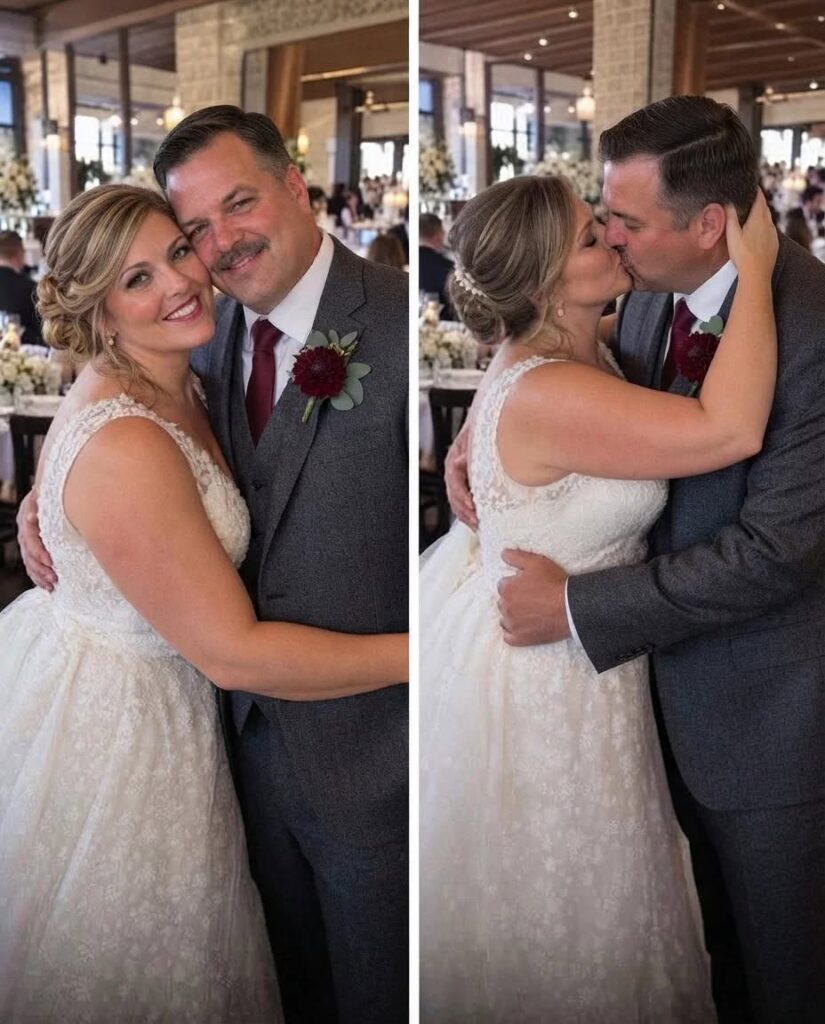
Lisa was cutting the cake when I arrived.
Dad looked uncomfortable the moment he saw me.
Lisa kissed my cheek.
“I’m so happy you came.”
Then she noticed the box.
“You brought us a present?”
“I did.”
Dad opened it.
Lisa lifted out the brass numbers.
“What are these?”
Dad had already found the card beneath them.
He read it.
His face changed.
Lisa took it from him and read aloud:
Since you were both waiting for Mom’s house, I saved you the only part that was available.
“What did you do?” Lisa demanded.
“Nothing.”
I picked up my purse.
“Mom did.”
Twenty minutes later, they followed me to the house.
Lisa stepped out of the car in her wedding dress and stopped.
The old numbers were gone.
Volunteers were carrying linens and supplies inside.
Dad marched toward them.
“What is happening here?”
A woman from the organization approached.
“We’re preparing the property for our first guests.”
“What guests?”
“Cancer patients receiving treatment nearby and their caregivers.”
Dad stared at her.
“This was my wife’s house.”
“Yes.”
“Who authorized this?”
“Cathy.”
Lisa turned toward Dad.
“She gave away the house?”
The woman explained that Mom had legally transferred the property while retaining her right to live there until her death.
Lisa’s face hardened.
“You told me she was transferring it.”
Dad looked uncomfortable.
“I said I was handling the situation.”
“You said this house would be ours.”
The woman from the organization interrupted gently.
“Cathy never mentioned either of you when she arranged the donation. She talked about the patients she’d met and what their families were going through.”
That silenced everyone.
And strangely, it silenced me too.
Because suddenly I understood something.
Mom hadn’t spent her final months plotting revenge.
She hadn’t given away the house to punish Dad.
She’d seen people suffering and decided she could help.
Their betrayal hadn’t been the center of her final decision.
Her compassion had.
Dad eventually looked at me.
“How long have you known?”
“About the house?”
His jaw tightened.
“About Lisa and me.”
“Since before Mom died.”
His face fell.
“You heard us?”
“In the kitchen.”
He exhaled.
“Kristen, your mother and I hadn’t been happy for a long time—”
“Don’t.”
He stopped.
“If you want any relationship with me after today, don’t tell me a story where all of this somehow happened to you.”
I looked directly at him.
“Tell me what you chose to do.”
He lowered his eyes.
For once, there was no explanation.
No justification.
No carefully rehearsed version of events.
Just silence.
I walked into the house.
In the back bedroom, a volunteer was struggling to pull a fitted sheet over a mattress.
“Need help?” I asked.
“Desperately.”
I grabbed the opposite corner.
Behind us, Dad and Lisa began arguing.
I stopped listening.
A few minutes later, I passed the front entrance carrying towels.
A pale rectangle remained beside the door where the brass 17 had hung for years.
I touched it once.
Then someone called from the kitchen.
“Kristen? Where should these mugs go?”
I turned away from the empty space.
“Kitchen cabinet.”
And carried the towels inside.