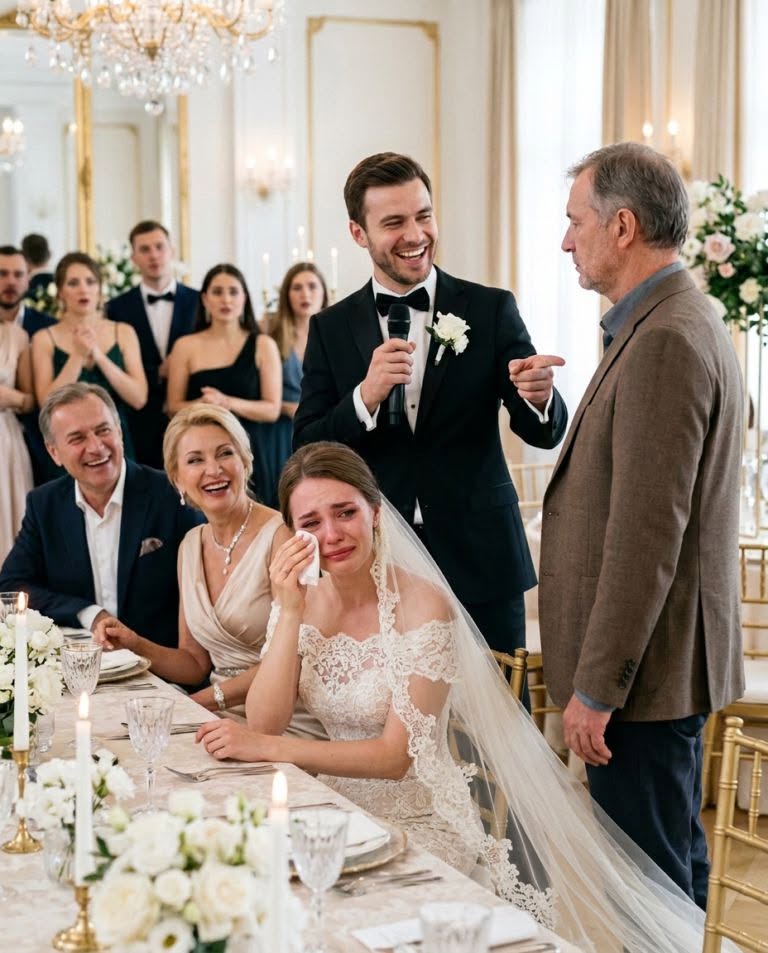
Then his parents laughed.
My daughter Emily went pale.
I’d worn the same brown jacket for twelve years. The cuffs were worn, my shoes had been repaired twice, and nothing on me carried a designer label.
Apparently, that bothered the Whitmores.
Chase’s father, Richard, looked me over.
“Small-town people have no sense of occasion.”
His wife laughed. “Surely someone could have rented him a proper suit.”
Emily whispered, “Dad, I’m sorry.”
“Don’t be.”
Chase grinned.
“Come on, Mr. Miller. We’re joking.”
“No,” I said. “You’re showing me who you are.”
Chase had always assumed I was poor.
I’d told him I worked with agricultural properties and local businesses. He apparently translated that into failed farmer.
I never corrected him.
Dinner made things worse.
Richard loudly mentioned that I’d contributed “almost nothing” to the wedding.
Technically, he was right.
The Whitmores believed they’d paid for everything.
What they didn’t know was that the venue had waived its $42,000 fee because one of my companies owned the building.
They also didn’t know that a company I controlled owned the vineyard supplying the wine.
More importantly, Richard didn’t know that one of my lending companies held a substantial commercial loan to Whitmore Development Group.
Until that evening, none of that mattered to me.
Then Chase took the microphone again.
“I’d especially like to thank my parents for paying for all this, because apparently emotional support counts as a financial contribution now.”
Several people looked toward me.
“Chase, stop,” Emily said.
He laughed.
“What? Everyone knows your dad isn’t exactly swimming in money.”
That was when I noticed something.
Emily wasn’t embarrassed.
She was afraid.
I stepped onto the terrace.
She followed.
“How often does he speak to you like that?”
She looked away.
Then she said, “He made me sign some papers yesterday.”
“What papers?”
“Financial things. He said married couples have to sign them.”
“Did you read them?”
“He wouldn’t let me. He said his family’s lawyer had already checked everything.”
That frightened me far more than the jokes.
“Send me pictures.”
I forwarded them to my attorney.
He called within minutes.
“Thomas, these aren’t routine marital documents. They’re attempting to make Emily personally responsible for obligations connected to Chase’s business.”
“How much?”
“Potentially a lot. Don’t let her sign anything else. We need the originals and proper review.”
Through the glass doors, I watched Chase laughing with his father.
My office had already been reviewing Richard’s loan.
His development company owed one of ours millions, and there were questions about whether it remained compliant with the lending agreement.
Until then, I’d deliberately stayed away from the matter.
Richard was becoming family.
I didn’t want personal relationships influencing a commercial loan.
Now I had another reason to insist that professionals examine everything carefully.
Chase called from inside.
“Where’s our local beggar?”
More laughter.
I walked back into the ballroom.
“There he is!” Richard shouted.
Chase handed me the microphone.
“Careful. These people aren’t used to farm speeches.”
I looked at him.
Then at Emily.
“You’re right, Chase. I didn’t pay for this wedding.”
His parents smiled.
“I only own the building.”
Nobody laughed.
Chase stared at me.
“The vineyard supplying tonight’s wine is also one of ours.”
Richard’s expression changed.
He knew my company’s name.
“You’re Thomas Miller?”
“Yes.”
His wife looked between us.
“What does that mean?”
Richard didn’t answer.
So I did.
“His company has a substantial loan with one of mine.”
Chase lowered his glass.
I turned toward him.
“But that’s business. What concerns me tonight is my daughter.”
Emily looked at me.
“I’ve had the documents you asked her to sign reviewed.”
Chase’s face changed immediately.
“That has nothing to do with you.”
“It has everything to do with Emily.”
Richard stood.
“This is completely inappropriate.”
“So is asking a woman to sign significant financial documents the day before her wedding without giving her a meaningful opportunity to understand them.”
Chase turned toward Emily.
“You sent him the papers?”
“Yes.”
His voice hardened.
“We talked about this.”
Emily stepped backward.
That told me more than anything else.
I handed the microphone back.
“Your family’s loan will be handled by the professionals responsible for it. I won’t interfere either to help you or hurt you. But given what has come to my attention, they’ll review whether all required disclosures and covenants have been satisfied.”
Richard had stopped smiling.
“If everything is proper,” I said, “there shouldn’t be a problem.”
He said nothing.
Chase grabbed Emily’s wrist.
“We’re leaving.”
She pulled away.
“No.”
The room went quiet again.
“Emily.”
“No.”
She removed her wedding ring.
Chase stared at her.
“You’re choosing your father?”
She shook her head.
“I’m choosing myself.”
She placed the ring on the table.
The marriage didn’t magically disappear that night.
The next morning, Emily met with her own attorney to understand her options.
What happened to Richard’s company also took months, not minutes.
My lending team handled the review independently. It uncovered financial issues serious enough to require restructuring, asset sales and additional protections for the lender.
I stayed out of the decisions.
That mattered to me.
I hadn’t spent decades building businesses so I could use them to punish someone who insulted my jacket.
Chase’s business struggled too, especially after his family’s financial support tightened.
But none of that was the part I cared about.
Emily was.
Several months later, she moved into a small apartment near me and returned to work.
One Sunday, we sat on my porch drinking coffee.
I was wearing the same brown jacket.
She touched the sleeve.
“You know you can afford another one.”
“I know.”
“Then why do you keep wearing this?”
I smiled.
“Because there’s nothing wrong with it.”
She laughed.
Then I looked at her.
“And because it reminds me not to judge people by what they’re wearing.”
Emily became quiet.
“That wedding must have felt pretty good after everyone realized who you were.”
I thought about it.
For a few seconds that night, perhaps it had.
But humiliation wasn’t what I remembered most.
I remembered Emily pulling her wrist away.
I remembered her saying no.
I remembered watching fear disappear from my daughter’s face.
“I didn’t need them to find out I was rich,” I said.
“Then what did you need?”
I looked at her.
“For you to realize you didn’t have to marry someone who made you feel small.”
She rested her head against my shoulder.
And that was worth considerably more than owning the building.