Evan had photographed it from every possible angle.
He knew the price.
He knew the suspension.
He knew how much it weighed.
He even had a picture of it taped above his desk.
Every Saturday evening, I’d ask:
“How’s the bike fund?”
And Evan would smile.
“Getting there.”
Except the bike never appeared.
Then Evan started becoming strangely secretive.
He stopped talking about how much he’d saved.
He guarded his backpack.
And whenever I asked about his paychecks, his answers became shorter.
I assumed he was saving cash somewhere because he wanted to surprise me.
Until his boss called.
“Mrs. Carter?”
“Yes?”
“This is Cal from the diner.”
My stomach tightened immediately.
“Is Evan okay?”
“He’s fine.”
Cal paused.
“But I think you need to come down here.”
“What happened?”
Another pause.
“It’s about his paychecks.”
I grabbed my keys.
“What about them?”
Cal lowered his voice.
“Your son has been giving them away.”
Twenty minutes later, I walked into the diner and found Evan arguing with a grown man beside the register.
His paycheck was in his hand.
The man kept pushing it back toward him.
“Take it,” Evan insisted.
“No.”
“You said you’d let me.”
“I said we’d talk about it.”
“It’s my money.”
“And I don’t want it.”
Then Evan saw me.
His face went white.
“Mom?”
I looked at the check.
Then at Cal.
“What is going on?”
Evan immediately shoved the check into his pocket.
“Nothing.”
Cal crossed his arms.
“Tell her.”
“Cal.”
“Evan.”
“Tell me what?”
My son stared at the floor.
Finally, Cal answered for him.
“In six months, your boy has kept one paycheck.”
I thought I’d misheard him.
“One?”
Cal nodded.
“The rest went somewhere else.”
I turned toward Evan.
“You told me you were saving for your bike.”
“I am.”
“With what?”
He didn’t answer.
I suddenly felt frightened.
Not angry.
Frightened.
Had someone been taking his money?
Was an older kid threatening him?
Had somebody convinced my thirteen-year-old son to pay them?
“Who’s getting your money?”
“Nobody.”
“Cal just said—”
“Nobody is taking it from me.”
“Then where is it going?”
Evan tightened his jaw.
“It’s mine.”
“I know.”
“So I can decide what to do with it.”
Technically, he wasn’t wrong.
But he was thirteen.
And thirteen-year-olds don’t normally work for six months and quietly give almost everything away.
“Evan, I’m your mother.”
“I know.”
“Then help me understand.”
He wouldn’t.
Cal looked at me.
“Check his backpack.”
Evan spun toward him.
“Don’t.”
That single word told me everything.
I reached for the backpack.
Evan grabbed it first.
“Mom.”
“What is inside?”
“Nothing.”
“Then give it to me.”
His eyes filled.
That scared me more than anything.
I softened my voice.
“Evan, if somebody is making you give them money, you’re not in trouble.”
“Nobody’s making me.”
“Then show me.”
Slowly, he handed me the backpack.
Inside were schoolbooks.
A sweatshirt.
A half-eaten granola bar.
And a folded bus map.
I opened it.
There were circles everywhere.
Beside them were names.
Addresses.
Dollar amounts.
Miller Tire — $180
Tony’s Barber Shop — $45
Donnelly — $120
Greenway Market — $86
There were more.
Some crossed out.
Some still circled.
I recognized several names.
And suddenly I couldn’t breathe.
These weren’t random people.
They were people who had helped us after my husband Jeremy died.
Jeremy had been gone for three years.
And somehow my thirteen-year-old son had been quietly traveling around town repaying everyone who had once helped our family.
I looked at Evan.
“Why?”
He stared at the floor.
“I owed them.”
“No, you didn’t.”
“Yes, I did.”
“Evan—”
“Dad did.”
That stopped me.
The diner suddenly seemed very quiet.
Cal looked away.
I unfolded the map again.
Miller Tire.
I remembered.
Four years earlier, before Jeremy died, we’d blown a tire during one of the worst months financially we’d ever had.
The owner replaced it.
Jeremy tried paying him later.
The man refused.
“Pay me when things are easier,” he’d said.
Apparently, Evan had remembered.
I drove straight there.
Evan sat silently beside me.
The owner, Mr. Miller, recognized him immediately.
His expression changed when he saw me.
“Evan’s mom.”
I held up the map.
“Did my son bring you money?”
Mr. Miller sighed.
Then reached beneath the counter.
He pulled out an envelope.
Inside was $180.
Every dollar Evan had given him.
“I couldn’t spend it,” he said.
I looked at Evan.
“You told me you accepted it.”
Mr. Miller shook his head.
“I told him I’d hold it.”
Then he looked at me.
“He came in here three times before I finally took the envelope.”
I turned toward my son.
“Why would you do this?”
Evan’s eyes filled.
“Dad said you pay people back.”
I froze.
“What?”
“He always said that.”
Evan looked at Mr. Miller.
“When somebody helps you, you don’t forget.”
I knew exactly what he meant.
Jeremy had said variations of that sentence a hundred times.
But Evan had been a child.
I hadn’t realized how carefully he’d been listening.
“He couldn’t finish,” Evan whispered.
“Finish what?”
“Paying everybody back.”
His voice cracked.
“So I am.”
That was when I understood.
My son wasn’t simply giving away money.
He had inherited a list of debts that existed only in his head.
Every kindness someone had shown us during Jeremy’s illness.
Every meal.
Every ride.
Every favor.
Every dollar.
Evan had turned all of it into an obligation.
We sat in my car outside the tire shop.
I opened the map.
“Tell me about these.”
He pointed.
“Greenway Market.”
I remembered that one.
The owner had let Jeremy take groceries home when his card declined.
“Tony’s Barber Shop?”
“Dad didn’t pay for my haircut after he got sick.”
“Mrs. Donnelly?”
Evan hesitated.
“She drove me to school.”
“For two weeks.”
“Seventeen days.”
I looked at him.
He remembered the exact number.
“Evan…”
“She used gas.”
“She was helping us.”
“That costs money.”
“She didn’t ask for it.”
“Neither did Mr. Miller.”
He sounded frustrated now.
“That’s the point.”
“What point?”
“Dad would’ve paid them back.”
There it was again.
Dad.
Not Evan.
Dad.
I folded the map.
“Your father also helped people.”
“I know.”
“He fixed Mr. Donnelly’s porch railing for free.”
Evan shrugged.
“He helped Tony move into his apartment.”
“I know.”
“He spent an entire Saturday repairing Cal’s old truck.”
“I know.”
“And do you know what happened when Dad needed help?”
Evan looked away.
“People helped him.”
I touched the map.
“That’s what you’re missing.”
He said nothing.
“Your father didn’t keep a ledger, Evan.”
“But he would’ve—”
“No.”
I shook my head.
“He believed you should remember kindness. That’s different from turning kindness into debt.”
His eyes filled again.
“But he can’t do it anymore.”
The words were barely audible.
“He can’t do what?”
“Take care of things.”
And suddenly, this wasn’t about money at all.
I waited.
Evan stared through the windshield.
“After Dad died, everybody kept saying I was the man of the house.”
My heart sank.
“Who said that?”
“People.”
“Evan—”
“At the funeral.”
He wiped his nose with his sleeve.
“They kept saying I had to look after you.”
I closed my eyes.
I’d heard it too.
Well-meaning relatives.
Neighbors.
Men patting an eleven-year-old boy on the shoulder.
You’re the man of the house now.
Take care of your mom.
Your dad would be proud.
Adults say things like that because they don’t know what else to say to a grieving child.
But Evan had listened.
And believed them.
“I thought you needed me to do what Dad did.”
I looked at him.
“I don’t.”
His face crumpled.
Not because I’d hurt him.
Because I think part of him was relieved.
“You don’t?”
“No.”
I reached across the console.
“I need my son.”
He started crying.
“I thought I was supposed to take care of you.”
“You’re thirteen.”
“But Dad—”
“Dad was your father.”
I took his hand.
“You don’t have to become him because he’s gone.”
Evan cried harder.
I hadn’t seen him cry like that since the funeral.
“You didn’t inherit your father’s unfinished responsibilities.”
He looked at me.
“You inherited his kindness.”
I squeezed his hand.
“Those are not the same thing.”
We sat there for a long time.
Then I unfolded the bus map.
I looked at all those circles.
All those names.
All the journeys my child had been making alone.
“You remember Mrs. Donnelly driving you to school?”
He nodded.
“You remember Mr. Miller fixing our tire?”
Another nod.
“Good.”
I pointed toward his chest.
“Keep that part.”
“What?”
“Remembering.”
Then I tapped the dollar amounts.
“But let this part go.”
He stared at the map.
“What if I still want to help people?”
“Then help them.”
“How?”
“The way your dad did.”
He looked confused.
I smiled.
“Not because you owe them.”
I squeezed his hand.
“Because you can.”
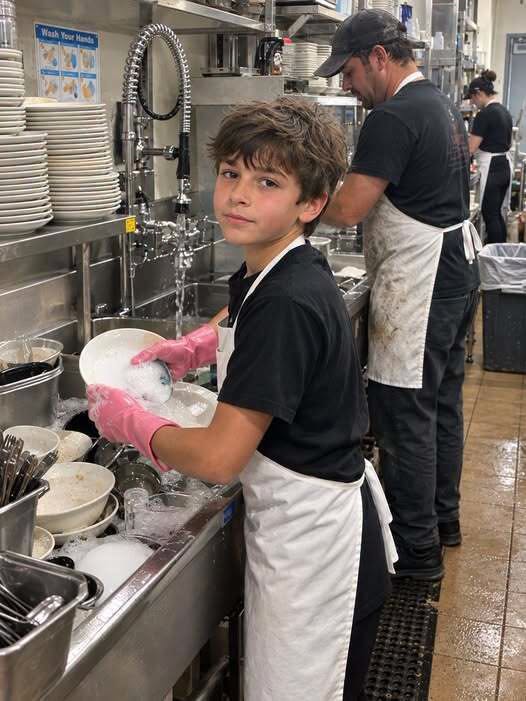
The following Saturday, Evan returned to the diner.
When Cal handed him his paycheck, Evan stared at it.
Cal waited.
“So?”
Evan looked toward me.
I was sitting in a booth drinking coffee.
Then he folded the check.
And put it in his pocket.
Cal smiled.
“About time.”
Evan rolled his eyes.
But he smiled too.
Mr. Miller returned the $180.
A few other people returned what Evan had tried giving them.
Some money couldn’t be recovered because he’d already spent it helping people in smaller ways.
I decided not to chase every dollar.
That would’ve missed the point.
Evan started saving again.
This time, genuinely.
Every few weeks, he’d show me the total.
“Bike fund.”
I never asked him whether he was sure.
Months later, we finally drove downtown.
The black mountain bike with the red lettering was still there.
Evan stood in front of it for almost ten minutes.
“You’re buying it, right?” I finally asked.
He grinned.
“I think so.”
“You’ve been talking about this bike for almost a year.”
“I know.”
“Buy the bike, Evan.”
He laughed.
So he did.
He paid for it with money he’d earned.
Not money he’d saved to fix his father’s unfinished life.
His money.
For something he wanted.
The first weekend he rode it at the park, I sat on a bench with my phone.
“Time me!” he shouted.
“You’re going to regret asking me that.”
He took off.
Halfway around the path, he suddenly stopped.
A younger boy was crouched beside a small bike.
Its chain had fallen off.
Evan leaned his mountain bike against a tree.
Then crouched beside him.
I watched from a distance.
A few minutes later, the chain was back in place.
The boy’s father reached into his pocket.
I saw him offer Evan something.
Probably money.
Evan shook his head.
The man tried again.
Evan shook his head harder.
Then he said something.
I couldn’t hear it.
When he finally rode back toward me, I stopped the timer.
“You completely destroyed your time.”
“I know.”
“What did that man offer you?”
“Five bucks.”
“You didn’t take it?”
“No.”
I raised an eyebrow.
For half a second, I wondered whether we were about to have the same conversation all over again.
Then Evan smiled.
“I told him to help somebody else when they’re stuck.”
I stared at him.
That sounded exactly like Jeremy.
Not because my son was trying to replace him.
Not because he believed he owed the world something.
Simply because kindness had become part of who he was.
“Ready?” Evan asked.
“For what?”
“Again.”
I reset the timer.
He positioned his bike at the edge of the path.
“Go!”
Evan pushed off.
And this time, I watched my thirteen-year-old son ride away carrying exactly what his father had meant to leave him.
Not the debts.
Not the responsibilities.
Not the weight.
Just the good.