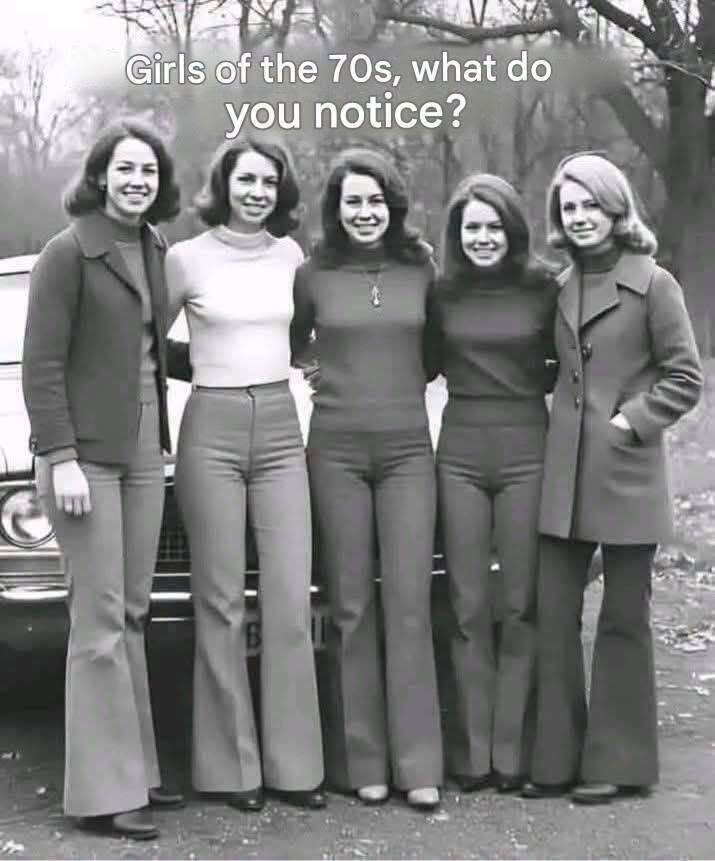
Instead, this simple image offers a fascinating glimpse into everyday life during the 1970s — a time that can feel surprisingly distant today.
The clothing alone immediately reveals the era.
Slim trousers, polo shirts, uncomplicated coats and solid colors helped define the everyday wardrobe of many young people. The outfits weren’t necessarily extravagant, yet they still had personality.
People dressed according to the fashions of their time without having thousands of new styles delivered to their screens every day.
There was no endless stream of influencers showing viewers what to buy next.
No algorithm constantly introducing another micro-trend.
Fashion still changed, of course, and the 1970s produced plenty of unforgettable styles. But an ordinary outfit could remain an ordinary outfit rather than something photographed, posted and judged by hundreds of strangers.
Then there is the hair.
Longer cuts, natural textures and relatively simple hairstyles became closely associated with the decade.
Combined with the clothing, those hairstyles create a visual identity so distinctive that many people can recognize a photograph from the 1970s almost immediately.
But perhaps the most interesting thing about old photographs isn’t what appears in them.
It’s what doesn’t.
Imagine spending an entire afternoon with friends without checking a notification.
There was no Instagram to refresh.
No TikTok feed.
No group chat demanding an immediate response.
No smartphone camera permanently waiting in your pocket.
If someone wanted to talk to you while you were away from home, they generally couldn’t simply send a message and expect an instant reply.
People could actually be temporarily unreachable.
Today, that almost sounds unusual.
Entertainment was different too.
Music might come from a record player, radio, cassette or live performance rather than an enormous streaming library containing millions of songs.
People watched whatever happened to be showing on television rather than choosing from thousands of programs on demand.
If friends gathered together, conversation itself was often part of the entertainment.
They talked.
They joked.
They listened to music.
They watched the people around them.
Sometimes they simply sat together.
That doesn’t mean everyone in the 1970s was constantly having meaningful conversations or living some perfectly peaceful existence.
People became bored.
They argued.
They wasted time.
They had distractions of their own.
But those distractions weren’t carried everywhere inside a small device capable of demanding attention every few seconds.
Even taking a photograph required a different mindset.
Film cameras offered a limited number of exposures.
Every press of the shutter used one.
You couldn’t immediately look at a screen and decide you disliked your expression.
You couldn’t take 47 versions of the same pose and choose the most flattering one.
You certainly couldn’t delete the picture and pretend it never existed.
Film had to be developed.
Sometimes days or weeks passed before anyone discovered whether a photograph had even turned out properly.
Someone might have blinked.
The image might have been slightly blurry.
The lighting could have been terrible.
A person’s hair might have been caught in an unfortunate position.
And that photograph could still end up inside the family album for the next 50 years.
Perhaps that imperfection is part of what makes old photographs feel so authentic today.
They weren’t always performances.
Many were simply moments.
A birthday.
A family gathering.
A trip.
Friends standing outside.
Someone sitting in a living room.
People doing completely ordinary things without realizing that decades later their clothes, hairstyles, furniture and surroundings would become fascinating pieces of history.
Of course, nostalgia can make the past appear simpler than it really was.
The 1970s had serious economic, political and social problems.
Communication could be frustratingly slow.
Getting information required more effort.
Being unable to instantly contact someone wasn’t always charming — sometimes it was frightening or inconvenient.
Modern technology has solved countless problems that previous generations simply had to accept.
Today, families separated by thousands of miles can see each other’s faces instantly.
Parents can receive photographs of their children within seconds.
People can access maps, emergency information, medical resources, news, education and entertainment from something small enough to fit inside a pocket.
And unlike families waiting nervously for film to return from a developer, we can capture thousands of photographs without worrying about wasting a frame.
There is enormous value in that.
But something has changed along the way.
Today we probably take more photographs than any previous generation in human history.
Yet individual photographs can sometimes feel less precious.
Thousands accumulate on our phones.
Screenshots.
Selfies.
Meals.
Pets.
Vacations.
Birthdays.
Sunsets.
Many are viewed once and then disappear into enormous digital libraries.
Compare that with an old family photograph carefully placed inside an album.
Someone kept it.
Someone carried it from one home to another.
Someone protected it through moves, marriages, births and deaths.
Eventually, a younger relative might discover it and ask:
“Who are these people?”
Suddenly, an ordinary afternoon from 1974 becomes history.
That is what makes photographs like this so captivating.
They allow us to study details that the people inside the picture probably considered completely unremarkable.
Their clothes.
Their hair.
The furniture.
The cars.
The expressions on their faces.
The way they stood together.
The absence of technology we now consider essential.
To them, none of it was “retro.”
It was simply life.
And that raises an interesting question about the photographs we’re taking today.
What will people notice about us 50 years from now?
Perhaps they’ll laugh at our hairstyles.
Maybe today’s fashionable clothes will look bizarre.
They may wonder why everyone carried rectangular smartphones or why people photographed their meals.
Maybe social media itself will seem as outdated to them as rotary telephones and film cameras seem to many young people today.
They might look at a photograph from 2026 and instantly recognize an entire era from details we barely notice.
That’s the strange thing about everyday life.
You rarely realize you’re living through history while it’s happening.
One day you’re simply standing beside your friends wearing your favorite clothes.
Decades later, someone discovers the photograph and sees an entirely different world.
And perhaps that is the real beauty of this old 1970s image.
It isn’t only about fashion or hairstyles.
It isn’t about proving that life was better before smartphones.
It’s a reminder that ordinary moments don’t stay ordinary forever.
Technology changes.
Fashion disappears and returns.
People grow older.
Families change.
Entire ways of living slowly vanish.
But sometimes, one little photograph survives.
And for a moment, it opens a window back into a world that once felt completely normal.