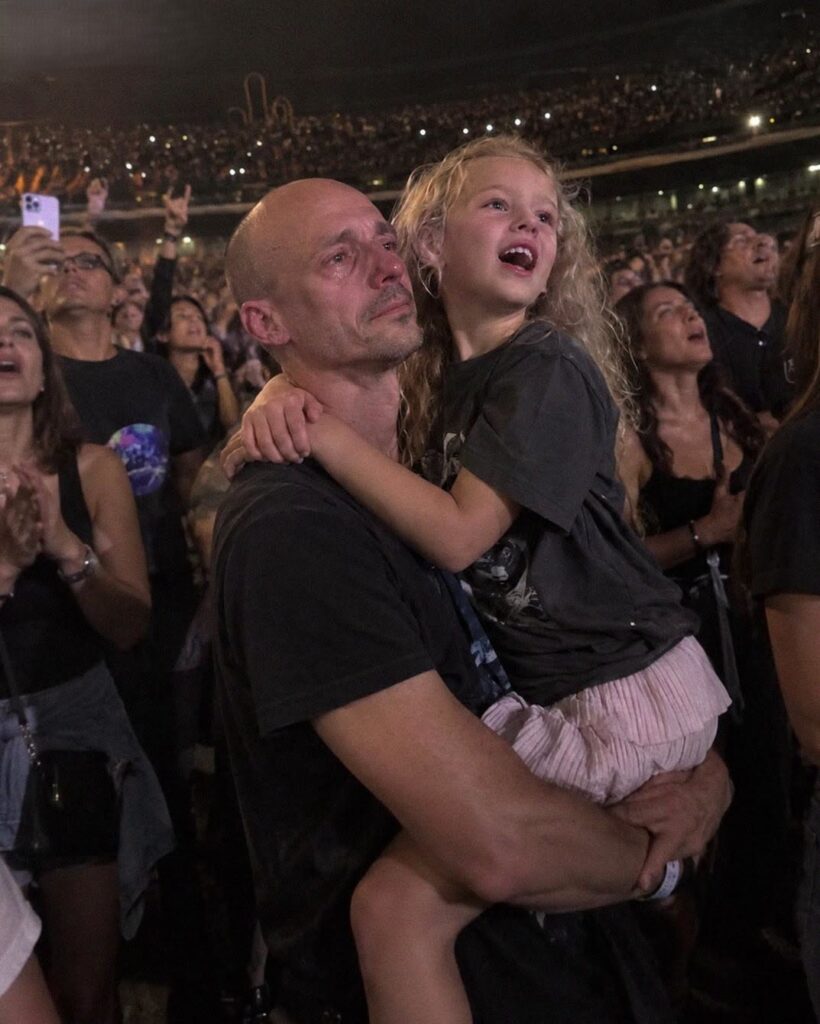
He was holding her tightly.
And he was crying.
Another message appeared.
“It’s definitely her. She’s been with this guy the whole concert.”
I immediately called my wife.
Once.
Twice.
No answer.
When Dorothy finally picked up twenty minutes later, the first thing she said was:
“Mark, please don’t jump to conclusions.”
That was when I knew the photograph wasn’t the worst part.
My wife had lied to me.
What I couldn’t understand was why.
Until she came home holding the same man’s hand and told me the secret she’d been keeping for twenty-five years.
Until that night, we’d always been a family of three.
Dorothy.
Our daughter, Nancy.
And me.
Life wasn’t particularly exciting.
Work.
School pickups.
Dinner.
Homework.
Bedtime.
Most days, Dorothy and I didn’t have a truly uninterrupted conversation until Nancy was asleep.
But Dorothy was still the person I told everything.
And I’d always assumed I was the same for her.
There was only one subject she refused to discuss.
Her mother.
For years, Dorothy let her calls go to voicemail.
Once, after watching the phone ring until it stopped, I asked:
“Everything okay?”
Dorothy turned the phone facedown.
“Please don’t make me talk about her.”
Something in her expression told me not to push.
So I didn’t.
Then her mother suffered a serious stroke.
Suddenly, everything changed.
Dorothy started visiting the hospital constantly.
Parking receipts filled her coat pockets.
“Another visit?” I asked one afternoon when she grabbed her keys.
“She shouldn’t be alone.”
I squeezed her shoulder.
I assumed almost losing her mother had changed something.
Maybe mortality had softened whatever had happened between them.
Then came Saturday.
Dorothy stood by the front door with Nancy.
“Mom keeps asking for her,” she explained. “I thought we’d try to cheer her up.”
Nancy held up a folded piece of construction paper.
“I made Grandma a card.”
“She’s going to love it.”
I kissed Nancy’s forehead.
Then Dorothy’s cheek.
“Drive safely.”
“We won’t be too late.”
Dorothy caught the door before it closed and smiled at me.
I trusted that smile completely.
Around nine that evening, my phone buzzed.
My cousin Jason.
“Mark, am I crazy, or is this Nancy? That girl is her spitting image.”
Below the message was a photograph.
I opened it.
My stomach dropped.
Nancy was at a concert.
Not a hospital.
She had her arms wrapped around a man’s neck.
He looked roughly Dorothy’s age in the photograph because of his thick beard, and he was holding Nancy as though he’d known her forever.
Then Jason sent another message.
“It’s definitely her. She’s been with this guy the whole concert.”
That made even less sense.
Nancy was shy.
At school events, she sometimes hid behind me when unfamiliar parents tried talking to her.
She didn’t hug strangers.
She certainly didn’t wrap herself around them while singing.
I called Dorothy.
No answer.
Again.
Nothing.
By the time she finally picked up, I was already holding my car keys.
“Where are you?”
Silence.
“Dorothy?”
“Mark, please don’t jump to conclusions.”
My stomach tightened.
“Jason just sent me a picture of Nancy at a concert with some man.”
Nothing.
“You told me you were at the hospital.”
“Mark—”
“Who is he?”
“I can’t explain this properly over the phone.”
“Try.”
“Please. Just wait for us.”
“Us?”
Another pause.
“We’ll be home around ten.”
Then she said something that made everything worse.
“You’ll meet him.”
I gripped the phone.
“Meet who?”
“Please. We’ll explain everything when we get there. It’s not what you’re imagining.”
She hung up.
I put down my keys.
Then opened the photograph again.
I kept studying Nancy.
That was the part I couldn’t understand.
She wasn’t afraid.
She wasn’t uncomfortable.
She wasn’t behaving like a child standing beside someone she’d just met.
She was pressed against his chest.
Completely at ease.
Dorothy hadn’t simply lied about where they were going.
She had taken our daughter to meet someone who apparently required no introduction.
At 10:06, I heard the front door unlock.
Dorothy entered first.
Then Nancy.
Holding the stranger’s hand.
He looked younger in person.
Mid-twenties, maybe.
His eyes were swollen and red.
Nancy released his hand when she saw me.
“Dad, please don’t be mad at Mom.”
I looked at Dorothy.
“What have you told her?”
“Mark—”
The stranger stepped forward.
“I’m sorry you had to find out about me this way.”
I stared at him.
“Apparently, I’m the only one who didn’t know.”
His eyes dropped.
I opened the front door.
“Leave.”
“Mark.”
Dorothy caught my arm.
I pulled away.
“Not now.”
She looked directly at me.
“Before you make him leave, you need to hear a story that started twenty-five years ago.”
“Dorothy—”
“Please.”
Nancy edged closer to her.
Dorothy immediately crouched beside her.
“You haven’t done anything wrong, sweetheart. Go upstairs and get ready for bed.”
“Will you come up?”
“Yes.”
Only after Nancy disappeared upstairs did I close the door.
Dorothy sat down.
She kept twisting her wedding ring.
I remained standing.
Then she started talking.
“When I was sixteen, my mother found my pregnancy test.”
I stared at her.
“What?”
Dorothy looked at the stranger.
Then back at me.
And took me twenty-five years into the past.
She had been sixteen.
In love with a boy who waited outside the diner after her shifts so they could walk home together.
They’d split sandwiches.
He always gave her the bigger half.
Then Dorothy discovered she was pregnant.
She planned to tell him.
Her mother found out first.
“Does he know?” her mother asked.
“Not yet. I was going to tell him tomorrow.”
“Give me your phone.”
“Mom—”
“Now.”
Dorothy’s mother called the boy herself.
At least, that’s what Dorothy believed.
Then she packed their belongings and moved Dorothy to another state.
She told Dorothy she’d informed the father about the pregnancy.
“He doesn’t want either of you.”
Dorothy believed her.
“What did he say?”
“That he wants nothing to do with this.”
Dorothy wrote letters anyway.
She gave them to her mother to mail.
Every afternoon, she asked whether anything had arrived in return.
Nothing ever did.
Then her mother began leaving adoption information beside her breakfast.
“I’m keeping my baby,” Dorothy told her.
“And where are you going to live?”
“Here.”
“Who pays the bills?”
“I’ll work.”
“Who watches the baby while you finish school?”
“I’ll figure it out.”
“Not in my house.”
Dorothy resisted for as long as she could.
But she was sixteen.
No money.
No home of her own.
No support.
And she believed the baby’s father had rejected both of them.
When her son was born, Dorothy held him.
He curled his fingers around hers.
She remembered the crease above his nose.
The dark hair flattened against his head.
When he opened his mouth, she expected him to cry.
He yawned instead.
“Hello,” she whispered.
“I’m your mom.”
The adoptive mother waited beside the bed.
“May I?”
“Just another minute.”
Dorothy’s mother reached for her.
“You signed.”
Eventually, Dorothy lifted her baby toward the woman.
His tiny fingers caught her hospital gown.
She had to loosen them herself.
One finger at a time.
Years passed.
Dorothy grew up.
Found work.
Got her own apartment.
Stopped answering her mother’s calls.
But every year on her son’s birthday, she counted.
Five.
Eight.
Ten.
She wondered whether he hated peas.
Whether somebody checked his forehead when he was sick.
Whether he knew he was adopted.
Whether he ever wondered about her.
Then, ten years after her mother took her away, Dorothy heard someone call her name in a grocery store.
She turned.
And there I was.
The boy she’d loved.
Older.
Standing beside a grocery cart.
“Do you have time for coffee?” I’d asked.
I remembered that day.
What I didn’t know was what Dorothy had believed about me.
She’d thought I knew about the baby.
I thought our teenage relationship had simply been destroyed by her mother moving her away.
Neither of us understood that we’d been living inside two different versions of the same past.
Coffee became dinner.
Dinner became another date.
One night, I apologized.
“I should’ve fought harder to stay with you.”
Dorothy heard something I wasn’t saying.
She thought I was apologizing for abandoning her and our baby.
I was apologizing for letting our teenage relationship disappear.
“I can’t go through those months again,” she told me.
“We don’t have to.”
I held her hand.
“Can we start here?”
She said yes.
We married the following spring.
Years later, Nancy was born.
I placed her against Dorothy’s chest.
Our daughter’s fingers grabbed Dorothy’s hospital gown.
I remember Dorothy suddenly crying.
“What’s wrong?”
“Nothing.”
I kissed her forehead.
“She knows her mom.”
I never knew those words had broken something open inside her.
Because she remembered another baby’s fingers wrapped around another hospital gown.
And still, she didn’t tell me.
That part mattered.
Her mother had created the first lie.
But Dorothy admitted she’d had opportunities to tell me afterward.
Before our wedding.
During her pregnancy with Nancy.
On countless quiet nights after our daughter fell asleep.
Each time, Dorothy imagined me asking why she’d waited so long.
So she waited longer.
Then her mother’s stroke sent her back into the house she’d spent years avoiding.
While looking through a drawer, she found paperwork.
And beneath it, a shoebox.
Inside were two bundles of letters.
The first bundle had Dorothy’s name written across the envelopes.
In my handwriting.
She opened one.
“Your mother said you don’t want me to contact you. Please tell me yourself. I thought we were happy.”
Another had been written three weeks later.
Another two months after that.
“Whatever happened, let me come see you. You don’t have to stay with me. Just let me know you’re okay.”
Dorothy sat on her mother’s bedroom floor reading every letter.
Not one mentioned a pregnancy.
Not one mentioned a baby.
Because I had never known.
The following morning, Dorothy took the letters to the hospital.
She placed them on her mother’s tray.
“You told me he knew I was pregnant.”
Her mother stared at the envelopes.
“Did you tell him?”
“No.”
Dorothy gripped the bed rail.
“You let me believe he didn’t want us.”
Her mother’s answer was simple.
“You would’ve gone back.”
Then Dorothy opened the second bundle.
Those letters were newer.
They were addressed to her mother.
The most recent was only three months old.
“My name is Ethan. I believe your daughter, Dorothy, is my birth mother.”
Dorothy’s hands started shaking.
The letter included his birthday.
The date matched.
“This was the only family address I could trace. Please pass along my number. She doesn’t have to call me, but I’d like her to know I’ve had a good life.”
Dorothy called immediately.
A man answered.
“Hello?”
“Ethan?”
“Speaking.”
“My name is Dorothy.”
Silence.
Then Ethan asked:
“Did you get my letters?”
“Only today.”
They met at a café.
When Dorothy approached the table, Ethan stood.
Then hesitated.
“Would it be okay if I hugged you?”
Dorothy nodded because she couldn’t speak.
He held her until she stopped shaking.
Eventually, Ethan asked about her life.
She showed him photographs.
Me.
Nancy.
Then Ethan stared at our daughter’s picture.
“You married him?”
“Yes.”
“Does he know about me?”
Dorothy shook her head.
“I have to tell him.”
Then Ethan asked:
“Could I meet her first?”
That was where Dorothy made another mistake.
Ethan hadn’t asked her to lie to me.
She chose that herself.
He was helping organize a concert and arranged three seats near the stage, along with a backstage visit.
Dorothy decided she would introduce Nancy to her brother first.
Then she’d come home and tell me everything.
That Saturday, Nancy climbed into the car holding the card she’d made for Grandma.
“Are we seeing Grandma later?”
Dorothy looked at her.
“Not tonight.”
Then she told our nine-year-old daughter something I still didn’t know.
“There is someone here I need you to meet.”
She explained that Ethan was her older brother.
That Dorothy had been very young when he was born.
That another family had raised him.
Nancy’s first question was:
“Does Dad know him?”
Dorothy hesitated.
“Not yet.”
Then she promised:
“I’ll explain everything to Dad tonight.”
Backstage, Nancy met Ethan.
Apparently, she accepted him with the uncomplicated curiosity only a child can manage.
She asked whether he knew every singer.
Whether he’d ever been onstage.
Whether he knew her name before meeting her.
Then, during the concert, a song Nancy loved started playing.
She threw her arms around Ethan’s neck.
“Thank you for bringing me!”
Ethan held her.
And cried.
That was the moment Jason photographed.
Dorothy had been sitting beside them.
The photograph simply hadn’t included her.
When my calls started, Dorothy panicked.
She’d spent twenty-five years hiding one truth and suddenly realized she’d created another lie trying to reveal it.
After the concert, she told Ethan:
“He deserves the truth.”
“Should I come?”
“Yes.”
And that’s how my wife ended up walking through our front door with the grown son I never knew existed.
When Dorothy finished speaking, nobody moved.
I looked at Ethan.
Twenty-five years old.
My son.
I tried to imagine him as a newborn.
Couldn’t.
All I could see was the grown man sitting in my living room waiting to find out whether I was about to throw him out.
“I swear to you,” Dorothy whispered. “I didn’t know you never knew.”
I looked at her.
There were questions.
So many questions.
Why hadn’t she told me before we married?
Why hadn’t she told me when Nancy was born?
Why had she taken our daughter to meet Ethan before telling me?
Why had she lied about the hospital?
Those questions mattered.
But they could wait.
Because none of them were Ethan’s fault.
I looked at him.
“I would’ve come.”
His eyes lifted.
“For both of you.”
Ethan pressed his lips together.
His chin trembled.
Dorothy covered her mouth.
I crossed the room.
Ethan stood uncertainly.
Then I put my arms around him.
For a moment, he didn’t move.
Then his hands gripped the back of my shirt.
“I wasn’t sure you’d want me here,” he whispered.
I couldn’t answer.
So I held him tighter.
Twenty-five years.
Twenty-five birthdays I hadn’t known I was missing.
First steps.
First day of school.
Christmas mornings.
Broken bones, maybe.
Graduation.
Heartbreak.
All the ordinary pieces of someone’s life that make a person yours long before they’re old enough to understand what family means.
Eventually, we stepped apart.
Ethan wiped his face with his sleeve.
I did the same.
“Were you happy?”
He looked surprised.
“Growing up.”
He nodded.
“I was. My parents are good people.”
Relief hit me so hard I had to sit down.
“Good.”
I swallowed.
“That’s good.”
Ethan glanced toward the hallway.
“I should probably let you two talk.”
He started to stand.
“No.”
He stopped.
I wasn’t ready to watch my son walk through my front door again.
Not after discovering he’d already been walking away from me for twenty-five years without either of us knowing it.
I pulled out the chair beside mine.
“Not yet.”
Ethan slowly sat down.
I left my hand resting on the back of his chair.
Dorothy and I had things to work through.
Her mother’s lie had stolen years from both of us.
Dorothy’s silence had extended that loss.
And taking Nancy to meet Ethan before telling me had created a wound we couldn’t pretend wasn’t there.
But those were problems between my wife and me.
I refused to let them become Ethan’s burden.
I looked at the stranger who wasn’t a stranger anymore.
My son.
I didn’t know his favorite food.
I didn’t know what music he listened to.
I didn’t know what he’d wanted to be when he was nine.
I didn’t even know what made him laugh.
But for the first time, I had the chance to find out.
“Stay awhile,” I said.
Ethan looked at me.
“Tell me about yourself.”