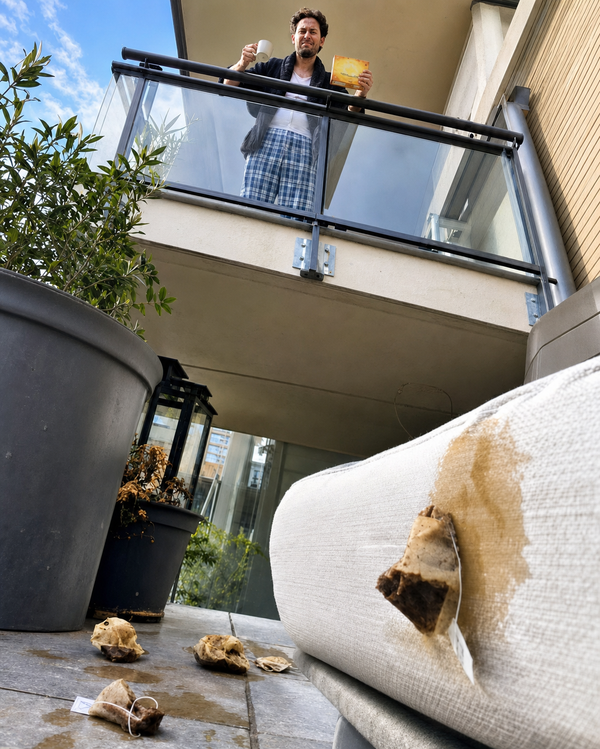
…stop. What followed was a stained white towel and a ruined chair cushion cover, and a neighbor who seemed to think basic courtesy didn’t apply once you lived on a lower floor.
A Pattern Too Consistent to Ignore
The first tea bag, she chalked up to accident and tossed in the bin without a word. But when a second one left a coffee-cup-sized brown stain on a towel she’d hung to dry, she knocked on his door to raise it directly.
Greg apologized, blaming morning grogginess, and she went back downstairs believing she’d overreacted. It happened again the very next morning. She waited three more weeks, reluctant to be the resident who complains, until a tea bag soaked through her cushion cover.
When she confronted him again, Greg shrugged it off. “You live underneath. That’s how buildings work,” he told her, before adding that she was lucky it was only tea bags and shutting the door.
Building the Catcher
Standing on the landing afterward, she thought about eleven years of watching neighbors’ cats and signing for Greg’s packages all winter. She realized he wanted a scene he could gossip about, so she gave him one last silent test: if nothing came over the railing the next morning, she’d let it go.
At 7:04 a.m., a tea bag landed by her plant pots exactly on schedule. Within an afternoon, she’d designed her answer: a clear plastic panel with an angled surface and a shallow tray underneath, positioned to catch anything dropped from above.
Before installing it, she checked the building’s rules twice, making sure everything stayed within her own balcony space and blocked no one’s view. The next morning, she sat with her coffee and waited. The tea bag came over, hit the panel, and slid neatly into the tray.
Proof of Intent
Greg leaned over his railing, confused, then irritated, once he learned she’d been counting his tea bags since their first conversation. That evening, a bag sailed past the panel’s edge and landed in her largest plant pot instead.
It happened again the next morning, and again that night, each one landing in a spot it had never reached before. Once dropping straight down became harder, Greg had apparently decided to improve his aim, which told her everything.
She began photographing each incident with dates and approximate times, building a folder alongside pictures of the stained towel and ruined cushion cover. She also emailed herself a summary of both prior conversations while they were still fresh.
That Saturday, Greg showed up at her door demanding she remove the panel, insisting it looked ridiculous. When she pointed out he’d suddenly gotten better at throwing tea bags around it for someone who claimed not to think about it, his expression shifted. “Fine,” he said. “I’ll just throw them farther.”
A neighbor from across the hall, Mrs. Alvarez, had just arrived home and heard the exchange. She told Greg it didn’t sound like much of a joke, and later offered to back up what she’d witnessed if it ever mattered.
Taking It to the Residents’ Meeting
It mattered the following Wednesday. She arrived early to the building’s residents’ meeting with a folder of printed photographs, receipts for the towel and cushion cover, and a written timeline of both confrontations.
She also brought a clear container holding the dried tea bags she’d collected from the tray, not for theatrics, but to make something Greg had dismissed as trivial impossible to ignore.
Building manager Mr. Lewis reviewed the photographs, including the ones showing bags landing farther out after the panel went up. When Greg called the whole thing ridiculous, Mrs. Alvarez spoke up, confirming she’d heard him threaten to throw the bags farther.
Mr. Lewis reminded the room that building rules prohibited throwing anything from balconies, regardless of how soft the object was. Greg received a formal written warning and was ordered to reimburse her for the towel and cushion cover.
Mr. Lewis also revealed he’d been reviewing Greg’s separate request to install privacy screening on his balcony. Given the active warning, he told Greg he was postponing approval of any additional balcony fixtures until the matter was settled.
The meeting ended shortly after. Greg left first, visibly frustrated, and the next day accused her in the hallway of making him look foolish over a tea bag. She reminded him she’d only shown people what he was already doing.
She hadn’t enjoyed any of it, she told him, not the ruined towel, the replaced cushion cover, or checking her chair before sitting down. She’d simply wanted him to stop.
A Quiet Balcony Again
The following days, she sat outside at the usual times and heard his door open above her, followed by nothing. No tea bag came over the railing that morning, that evening, or the days after.
After four days without incident, she took the panel down. Her balcony looked ordinary again, her plants undisturbed and her new cushion cover clean, and she noticed she’d finally stopped flinching every time his door slid open.
A week later, a delivery driver asked her to accept a package for Greg’s apartment, something she’d done routinely all the previous winter. This time she declined, telling the driver he’d have to collect it himself.
When Greg confronted her about it later, she reminded him that she used to do favors for a neighbor who respected her home. He had nothing to say back.
She still holds elevators for him and would knock on his door if there were ever an emergency. But eleven years of quietly keeping the peace had taught her something else too, that being a good neighbor was never meant to mean tolerating whatever someone else decided to throw her way.