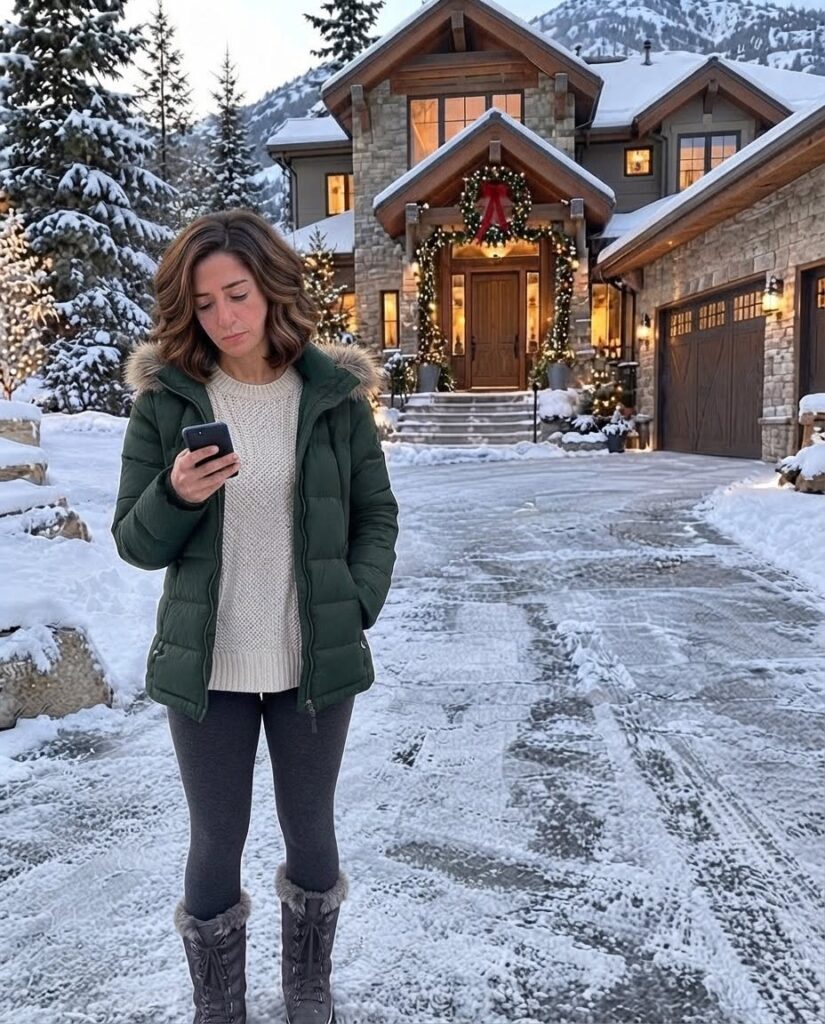
A roof.
Large windows.
A fireplace.
Rooms arranged in a way that made sense to me, although I couldn’t have explained why.
Then the condensation disappeared.
So did the house.
I drew it again.
Thirty-one years later, I suppose I’m still drawing it.
My name is Miranda Holt.
I grew up in Asheville, North Carolina, with my parents and my younger sister, Brooke.
My parents weren’t cruel people.
That’s important.
There was no single terrible thing they did to me.
Our family simply tilted toward Brooke.
Always.
When I turned sixteen, Brooke wanted the same birthday cake I’d chosen, so my birthday became a joint celebration.
When I graduated near the top of my class, my parents left before my name was called because fourteen-year-old Brooke wanted to get to a pool party.
When I received a regional business award at twenty-eight, they didn’t attend because Brooke was “going through something.”
Every time, I gave roughly the same answer.
“Fine.”
After enough years, fine stops meaning fine.
It means you’ve learned what not to expect.
So I built things instead.
At twenty-six, I started Holt Ridge Developments from a folding desk in a rented apartment.
I took projects larger developers didn’t want.
Small renovations.
Difficult properties.
Tight margins.
I obsessed over materials, contractors, timelines and details most people would never notice.
Five years later, we’d completed fourteen projects across western North Carolina.
Then I found twenty-two acres outside Asheville overlooking the French Broad River.
The moment I stood on the ridge, I knew.
I wanted every important room facing the mountains.
Floor-to-ceiling windows.
A fireplace built from local fieldstone.
Ceiling beams reclaimed from an old white-oak barn.
A greenhouse my closest friend and colleague Megan argued with me about for nearly a month.
She was right about most of it.
I still made her prove it.
The house took twenty months.
When it was finished, I stood in the kitchen one October morning with coffee in my hand and watched sunlight move across the mountains.
And suddenly I remembered that nine-year-old girl drawing on the window.
This was her house.
There was only one thing left that I wanted.
I wanted my parents to see it.
So I invited them for Christmas.
I found the Ethiopian coffee my father liked.
I drove to Black Mountain for my mother’s favorite orange marmalade.
I prepared the guest rooms.
Four days before Christmas, I set the dining table and imagined them sitting there.
There was something I hadn’t told them.
Months earlier, Megan had secretly submitted the house to a television production company filming a national Christmas special.
The producers loved it.
They’d filmed the stone, reclaimed beams, greenhouse and mountain views.
They’d also interviewed me beside the fireplace.
At one point, the interviewer asked:
“What do you want someone to feel when they enter this home?”
I answered without thinking.
“I wanted to build a place where nobody had to earn the right to belong.”
The Christmas special would air on Christmas Eve.
I hadn’t told my parents because I wanted them to see the house before they saw the recognition.
Three days before Christmas, Mom texted.
We’re not coming for Christmas. Brooke needs groceries and help around her apartment. Maybe another weekend.
I read it twice.
Brooke was twenty-eight.
She had a car.
She lived eleven minutes from my parents.
I looked around my kitchen.
Dad’s coffee.
Mom’s marmalade.
Fresh linens upstairs.
Four place settings on the table.
I typed:
All good.
Then I removed three place settings.
Mom.
Dad.
Brooke.
Megan arrived that afternoon carrying a pie.
One look at the table was enough.
“They canceled?”
I handed her the phone.
She read the message.
“Groceries?”
“Apparently.”
She looked around at everything I’d prepared.
“They’re missing this.”
“They’re missing dinner.”
“No, Miranda.”
I looked at her.
“They’re missing you.”
That hurt because it was true.
But Christmas wasn’t canceled.
Friends and coworkers were already coming that evening.
So we cooked.
By six, the house was full.
Contractors.
Architects.
People from Holt Ridge.
Megan and her boyfriend.
Pete, one of my oldest contractors, arrived with his wife and children.
People wandered through the rooms, touched the old beams and stopped in front of the windows.
Someone put on jazz.
An argument about zoning regulations somehow migrated into my kitchen.
Pete’s children claimed the best window seats.
And I stood near the edge of the room watching it all.
The house was doing exactly what I’d designed it to do.
Holding people.
Making them comfortable.
Making them feel considered.
At eight, Megan gathered everyone in the media room.
The Christmas special began.
First came a Victorian in Vermont.
Then a mid-century house in California.
A waterfront property in Maine.
Finally, the host said:
“And for our final home tonight, we’re traveling to the Blue Ridge Mountains outside Asheville, North Carolina.”
My house appeared.
Warm light glowed through the windows against the dark mountains.
Someone behind me whispered:
“Oh.”
The camera moved through the kitchen.
The greenhouse.
The fireplace.
The reclaimed beams.
Then I appeared on screen.
The interviewer asked what I wanted people to feel when they entered.
Television-me answered:
“I wanted to build a place where nobody had to earn the right to belong.”
When the segment ended, the room was silent for a moment.
Then everyone applauded.
My phone started vibrating almost immediately.
Clients.
Former classmates.
Developers.
People I hadn’t heard from in years.
I looked through the messages.
Nothing from Mom.
Nothing from Dad.
Nothing from Brooke.
It hurt.
I let it hurt.
Then I put the phone away and returned to my guests.
About half an hour later, it rang.
The number was local.
“Miranda? This is Carolyn Marsh.”
Carolyn had lived next door to my parents for twenty years.
“I just saw your house on television.”
“Thank you.”
“It was extraordinary.”
Then she said something that made me straighten.
“I called your mother.”
I said nothing.
“She had no idea.”
“No.”
“I told her about the house. She asked me to describe it.”
That surprised me.
“What do you mean?”
“Everything. The stone. The greenhouse. The beams. The windows.”
Carolyn paused.
“And every time I described something, your mother recognized you in it.”
My throat tightened.
“She said the old wood sounded like you because you’ve always loved old things. She said of course you’d have a greenhouse because you used to grow herbs on apartment windowsills.”
I closed my eyes.
“And when I told her about all that light coming through the windows, she said, ‘Yes. That sounds like Miranda.’”
For some reason, that sentence hurt more than if my mother had simply dismissed the program.
Carolyn’s voice softened.
“Your mother knows you very well.”
“Yes,” I whispered.
“She does.”
After we hung up, I remained in the hallway.
For years, I’d told myself my parents favored Brooke because they didn’t really see me.
Maybe they didn’t understand who I was.
Maybe I was invisible.
But my mother had recognized me through rooms she’d never entered.
The beams.
The greenhouse.
The light.
That sounds like Miranda.
She knew me.
And she still hadn’t come.
Both things were true.
Megan eventually found me.
I told her about the call.
“She knows you,” she said.
“Yes.”
“And she still didn’t come.”
“Yes.”
“What are you going to do?”
I thought about it.
“Invite her again.”
Megan stared at me.
“Seriously?”
“Yes.”
“Why?”
I looked back toward the living room.
The house was full of people.
“I don’t want every invitation to become a test.”
“What if she chooses Brooke again?”
“Then I’ll be disappointed again.”
“And you’ll just keep inviting them?”
“Not endlessly. Not at the expense of myself.”
I thought about the sentence I’d said during the interview.
“But I don’t want to become someone who withholds love just to make another person understand what withholding felt like.”
Megan considered that.
“That sounds exhausting.”
“It probably will be.”
She smiled.
“At least you’re consistent.”
Later that night, after most of the guests had gone, I sat in the window seat overlooking the mountains.
I opened my phone.
Then I wrote:
Mom. Carolyn told me you saw the house. The invitation is still open. Come see it whenever you can—not because it was on television, but because you’re my mother and I built something I’d like to show you. Love, Miranda.
I sent it.
Then I put my phone facedown.
I didn’t wait for the typing dots.
The message wasn’t another test.
She could come.
Or not.
That decision belonged to her.
Around me, the evidence of Christmas remained.
Empty plates.
Wineglasses.
A blanket where Pete’s daughter had fallen asleep beside the window.
The last pieces of firewood glowing in the fireplace.
Megan washing dishes in the kitchen despite my telling her to stop.
The house had been full.
People had eaten at my table.
Children had curled up beside the windows.
Friends had laughed in the kitchen.
People I loved had walked through rooms I’d designed and felt at home there.
Nothing about that became less real because three people hadn’t come.
I looked out toward the dark outline of the mountains.
Somewhere inside me was still that nine-year-old girl drawing a house onto a fogged window.
Maybe she’d been trying to create the place she needed.
A home where someone had thought carefully about what it would feel like to be inside.
Thirty-one years later, she finally had it.
Whether my parents ever walked through the front door or not.