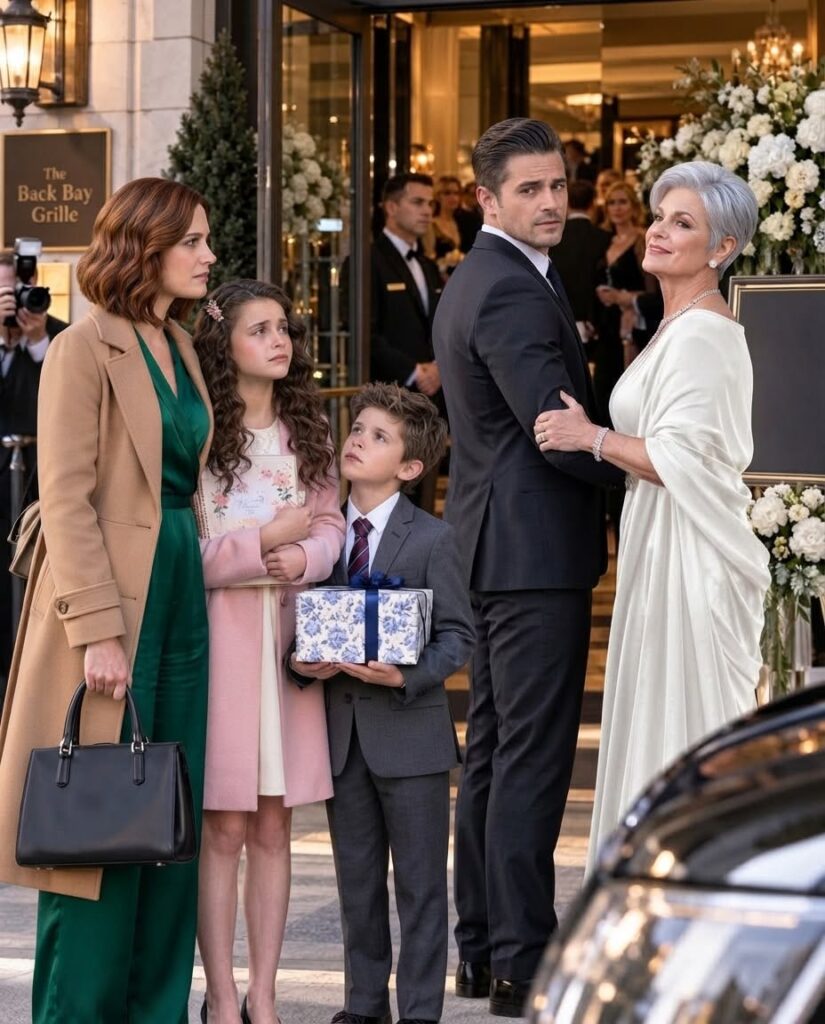
Behind Margaret, champagne was circulating beneath white orchids while a jazz trio played.
Beside me, my fourteen-year-old daughter Sophie held the scrapbook she’d spent a week making.
My nine-year-old son Caleb carried a porcelain tea set he’d bought with months of saved allowance.
“Grandma,” he said, “I got the blue flowers because Mom said they’re your favorite.”
Margaret barely looked at it.
“Put it away, sweetheart. I want a peaceful evening.”
I stared at her.
“What exactly is the problem?”
Her expression hardened.
“This is my birthday. I decide who attends. I’m not reorganizing my evening around another man’s children.”
Their father, Daniel, had died six years earlier.
She knew that.
Sophie went completely still.
Caleb looked at me.
“Mom… are we a burden?”
That was the moment something inside me changed.
I looked at Nathan.
His mother had just humiliated my children outside a party I had organized and paid for because he’d begged me to make her birthday special.
“Are you going inside?”
Nathan looked miserable.
“Caroline, please. I can’t ruin her birthday.”
Then he walked through the doors.
Without us.
I didn’t yell.
I took my children’s hands and left.
From the car, I emailed the restaurant manager.
The dinner itself was prepaid.
Anything additional—extra wine, overtime, upgrades—was not.
I withdrew authorization for further charges to my card.
Then I called my brother James, an attorney.
“I think my marriage is over.”
He was silent for a moment.
“What happened?”
I told him.
“Save everything,” he said. “And don’t make any major financial decisions tonight.”
Nathan came home after midnight furious.
Apparently Margaret had ordered additional wine and extended the event, and the restaurant required payment before closing the account.
“You embarrassed me,” he said.
I stared at him.
“I embarrassed you?”
“Everyone knew your card had been removed.”
“The dinner was already paid for. I simply stopped paying for anything else after you abandoned my children outside.”
“My mother was emotional.”
“And you chose her.”
“It was one birthday.”
“No, Nathan. It was one choice.”
He shook his head.
“You’re seriously talking about divorce over this?”
“I’m talking about divorce because when your mother forced you to choose between keeping her happy and protecting two children who trusted you, you walked inside.”
He didn’t answer.
The next morning, he tried to make everything normal.
“We’ll go to Mom’s tonight. The kids can give her their presents. Everybody apologizes.”
Caleb held the porcelain box tighter.
“I don’t want her to have it anymore.”
Nathan frowned.
“Caleb—”
“He doesn’t have to give it to her,” I said.
“You’re turning them against my family.”
Sophie looked directly at him.
“Nobody had to turn us against anything. We were there.”
Nathan went quiet.
Later that morning, I met James.
We went through the finances.
The Seaport penthouse had come through the trust Daniel established for me and the children. Nathan had lived there during our marriage, but he didn’t own it.
The smaller Brookline condo where Margaret lived was also mine. I’d bought it before marrying Nathan and had allowed her to live there without rent.
Nathan had spent years letting his mother believe he’d provided it.
That wasn’t all.
I’d also quietly helped his family financially over the years.
Not enough to make them dependent on me, but enough that the pattern was impossible to ignore.
Margaret’s condo expenses.
Some medical bills.
A loan I’d given Nathan’s sister.
Money toward his brother’s struggling business.
Nathan frequently asked me to send the money through him.
Let me handle it.
Mom doesn’t need to know.
It’ll save me an argument.
I’d thought I was protecting his pride.
Instead, I’d helped him create a version of himself that wasn’t real.
That afternoon, Margaret called.
“Nathan tells me you’re threatening divorce.”
“I’m not threatening anything.”
“This is ridiculous. Those children aren’t even—”
“Finish that sentence and this conversation ends permanently.”
She paused.
Then changed direction.
“You’re destroying a family over one dinner.”
“No. You told me exactly who you consider family.”
A few days later, Nathan finally admitted something.
His mother believed he owned the Brookline condo.
She also believed he’d paid for her birthday.
“And you never corrected her?”
“I didn’t think it mattered.”
“It mattered enough for you to take the credit.”
He looked ashamed.
“Caroline, I know I handled this badly.”
“Badly?”
“I should’ve brought you and the kids inside.”
“No. You should’ve told your mother that wherever your wife and children aren’t welcome, you aren’t welcome either.”
“They’re not my biological children.”
The second the words left his mouth, he regretted them.
I just stared at him.
For years, he’d attended their school events.
Helped Caleb build science projects.
Taught Sophie to drive in empty parking lots.
He’d told them he loved them.
And when his mother forced him to define what they were to him, he’d chosen biology.
“That,” I said quietly, “is why we’re getting divorced.”
The process took months.
There was no dramatic courtroom showdown.
Attorneys dealt with property, finances and the terms of our separation.
Nathan initially asked questions about the penthouse and other assets, but the ownership records were straightforward enough.
Margaret received proper notice concerning the Brookline condo.
I didn’t throw her belongings onto a sidewalk.
I didn’t need revenge.
I simply stopped providing housing for someone who had looked at my children and treated them as unwanted attachments to me.
Nathan’s relationship with Sophie and Caleb was harder.
He asked to see them.
Sophie refused.
Caleb wasn’t sure.
I didn’t decide for them.
With appropriate adult guidance, I let them have boundaries.
Months later, Caleb agreed to meet Nathan for lunch.
When he came home, he was carrying the porcelain tea set.
I was confused.
“Where did you get that?”
“Nathan had it.”
Apparently, after the birthday, Nathan had taken the gift from our home and given it to Margaret anyway.
Caleb had specifically said he didn’t want her to have it.
That hurt him almost as much as the dinner.
“She gave it back?” I asked.
“Nathan got it.”
Caleb opened the box.
Everything was still intact.
“Can we keep it?”
“Of course.”
He thought for a moment.
“Can we actually use it?”
So we did.
That evening, I made hot chocolate.
Sophie laughed when I poured it into the delicate blue-and-white cups.
“Grandma would’ve had a heart attack.”
“Sophie.”
“What? She would.”
Even Caleb laughed.
Then Sophie brought out the scrapbook she’d once made for Margaret.
She slowly flipped through photographs of birthdays, vacations and ordinary afternoons.
Near the end was a picture of Daniel with both children when they were little.
The final page was blank.
“Can I change this?” she asked.
“It’s yours.”
She printed a photograph we’d taken recently near Boston Harbor.
The three of us.
She glued it onto the final page.
Then underneath, she wrote:
Family.
I stared at that word for a long time.
For years, I’d thought keeping peace meant keeping everyone comfortable.
Helping Nathan protect his pride.
Helping his mother.
Helping his siblings.
Ignoring comments because confrontation seemed worse.
Then Margaret barred my children from a party I’d paid for, and Nathan walked through the door without us.
It was cruel.
But it was also clarifying.
Margaret wanted to show me where my children belonged.
Instead, she reminded me where I belonged.
Beside them.